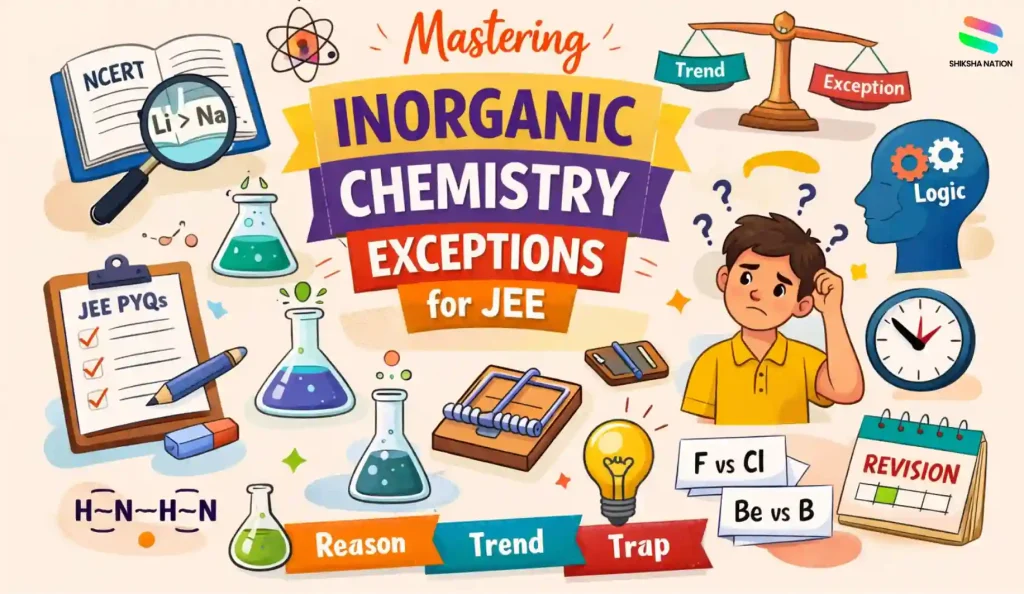
Why Students Forget Exceptions (Real Problem Nobody Talks About)
Most students face this, but nobody says it clearly. You try to mug up all exceptions like a list, and after 2-3 days, everything gets mixed up.
Biggest issue is this:
- You study from NCERT, then coaching notes say something slightly different
- Mind gets confused between trend vs exception
For example, many students think:
“Fluorine is smallest, so it must have highest electron affinity”
But actual answer is chlorine. Why? Because of repulsion – but this logic is not stored in brain.
Also, no visual memory + reason connection is built.
Also Check : Answer Key of Session 2 JEE mains Shift 1 & 2 (2nd April Attempt)
The Logic Behind Exceptions (So You Don’t Mug Up)
See, if you try to remember exceptions without logic, it will never stay. But once you understand why exceptions occur in periodic table, things become much easier. Let’s break it simply.
Size vs Repulsion Game
Take F vs Cl (electron affinity). Fluorine is very small, so electrons are already crowded. When a new electron comes, repulsion increases, so energy release is less.
Chlorine has more space → less repulsion → higher electron affinity.
Rule: Too small size = more repulsion = trend can fail
Stability of Half/Full Filled Orbitals
Example: N > O (IE), Be > B
Nitrogen has half-filled p orbitals → extra stability
Beryllium has fully filled s orbital → stable
So removing electron becomes difficult.
Rule: Half or full filled = extra stable = exception possible
Poor Shielding (d/f Block Effect)
Example: Ga smaller than Al
Because d-electrons in Ga don’t shield properly, nuclear pull increases → size decreases.
Rule: Poor shielding = more nuclear pull = smaller size than expected
If logic is clear, exception will come automatically in mind.
Most Asked Exceptions You Must Remember (1-Min Revision Table)
Before exam, you don’t have time to read full chapter again. You need a quick list of inorganic chemistry exceptions for JEE which you can revise in 1-2 minutes. This is exactly what helps in last revision.
Many students tell me, “Sir everything was coming, but I marked wrong in exceptions.” That happens because these are small points but high weightage.
So keep this table in mind:
| Concept |
Trend (What you expect) |
Exception (What actually happens) |
Reason (Simple logic) |
| Ionization Energy |
Increases across period |
Be > B, N > O |
Half/fully filled orbitals are more stable |
| Electron Affinity |
F should be highest |
Cl > F |
F is too small → more repulsion |
| Atomic Size |
Size decreases across |
Ga < Al |
Poor shielding by d-electrons |
| Oxide Nature |
Group 2 oxides are basic |
BeO is amphoteric |
Small size, high polarizing power |
| Hydrides BP |
Should decrease down group |
NH₃ highest |
Hydrogen bonding present |
| Oxidation State |
Group 13 → +3 stable |
Tl prefers +1 |
Inert pair effect |
| Halides Formation |
All form similar types |
N forms only NCl₃ (not NCl₅) |
No d-orbitals in N |
| Reducing Nature (Alkali metals) |
Increases down group |
Li strongest in aqueous |
High hydration energy |
Now see, don’t just read this like a chart. Try to connect it.
For example, if you remember “small size = high repulsion”, automatically you will recall why Cl > F. No need to mug up separately.
Same in exam – question will not come directly like this table. It will come twisted. And if you only memorized, you’ll get confused between options.
One more thing – don’t try to learn 50 exceptions. Focus on these important exceptions for JEE Mains, these are asked again and again.
Keep revising this table 2-3 times before exam, and you’ll see difference in accuracy.
Also Check : JEE Mains 2026 Paper Analysis 2nd April
Now Test Yourself – Inorganic Chemistry Exceptions Quiz (Level 1)
This is basic level. If these are not clear, higher level will feel difficult. Don’t overthink – just recall properly.
Many students lose easy marks here only because they rush. So go slowly.
Questions
Q1. Which element shows anomalous behavior in Group 1?
A) Na
B) K
C) Li
D) Cs
Q2. Which has the highest boiling point among hydrogen halides?
A) HCl
B) HBr
C) HI
D) HF
Q3. Which of the following has zero electron affinity?
A) N
B) O
C) F
D) Cl
Q4. Which element shows diagonal relationship with magnesium?
A) Li
B) Be
C) B
D) Al
Q5. Which compound does NOT follow octet rule?
A) NH₃
B) CH₄
C) BF₃
D) H₂O
Q6. Which of the following has highest electronegativity?
A) Cl
B) F
C) O
D) N
Q7. Which element forms maximum number of oxides?
A) N
B) P
C) S
D) Cl
Q8. Which of the following shows catenation most strongly?
A) C
B) Si
C) Ge
D) Sn
Q9. Which of the following has highest bond dissociation energy?
A) F₂
B) Cl₂
C) Br₂
D) I₂
Q10. Which element shows maximum tendency to form multiple bonds?
A) Si
B) Ge
C) C
D) Sn
Teacher Note
If you are making mistakes here, don’t jump to tough questions. Fix basics first.
Get these 10 correct first – then move ahead.
Level 2 Quiz – Concept-Based Exceptions (Where Students Get Trapped)
Now this is the level where things start getting tricky. Not direct facts – you need to think a little.
Many students feel: “I remember the concept, but options confuse me.”
That’s normal. Here we improve that.
Questions
Q1. Why does fluorine show lower bond dissociation energy in F₂ compared to Cl₂?
A) Larger atomic size
B) Higher electronegativity
C) Strong inter-electronic repulsion in small size
D) Presence of d-orbitals
Q2. Why is boron unable to form BCl₅?
A) Large size
B) Absence of d-orbitals
C) Low electronegativity
D) High shielding effect
Q3. Why is carbon able to form multiple bonds but silicon cannot easily?
A) Larger size of carbon
B) Strong pπ-pπ overlap in carbon
C) Lower electronegativity of silicon
D) Presence of d-orbitals in carbon
Q4. Why is lithium similar to magnesium (diagonal relationship)?
A) Same atomic size
B) Similar charge density and polarizing power
C) Same number of electrons
D) Same electronegativity
Q5. Why does oxygen form hydrogen bonding but sulfur does not?
A) Larger size of oxygen
B) Lower electronegativity
C) Small size and high electronegativity of oxygen
D) Presence of d-orbitals
Q6. Why is the bond angle in NH₃ less than CH₄?
A) Larger size of nitrogen
B) Lone pair-bond pair repulsion
C) Lower electronegativity
D) Higher symmetry
Q7. Why does fluorine show only -1 oxidation state?
A) Low ionization energy
B) Highest electronegativity and absence of d-orbitals
C) Large atomic size
D) High shielding effect
Q8. Why is H₂O liquid while H₂S is gas at room temperature?
A) Larger size of oxygen
B) Hydrogen bonding in water
C) Lower electronegativity of oxygen
D) Higher molecular weight of H₂O
Q9. Why does nitrogen show less tendency to catenate compared to carbon?
A) Larger size of nitrogen
B) Weak N-N bond due to lone pair repulsion
C) Higher electronegativity
D) Presence of d-orbitals
Q10. Why are noble gases generally unreactive?
A) Large atomic size
B) High density
C) Completely filled valence shell
D) Low ionization energy
Teacher Note
Here if you are getting confused, it means you are still depending on memory.
JEE will not ask: “What is answer?”
It will ask: “Why is this answer?”
If you fix this level, your accuracy will improve automatically.
Level 3 Quiz – JEE Trap 10 Questions (PYQ Style)
Now focus here. These questions are not direct exceptions. They mix trend + exception + reasoning. This is where students feel, “I studied everything, still got wrong.”
Take your time. Don’t rush.
Questions
Q1. Correct order of first ionization enthalpy is:
A) B < Be < C
B) Be < B < C
C) B < C < Be
D) C < B < Be
Q2. Which of the following has highest electron gain enthalpy?
A) O
B) F
C) Cl
D) S
Q3. Which oxide shows maximum covalent character?
A) MgO
B) CaO
C) BeO
D) SrO
Q4. Correct order of boiling point is:
A) PH₃ > NH₃ > AsH₃
B) NH₃ > AsH₃ > PH₃
C) NH₃ > PH₃ > AsH₃
D) AsH₃ > PH₃ > NH₃
Q5. Which element forms strongest M-X bond (halide)?
A) Li
B) Na
C) K
D) Rb
Q6. Which statement is correct?
A) All Group 15 elements form pentahalides
B) Only heavier elements of Group 15 form pentahalides
C) Nitrogen forms stable pentahalides
D) All form only trihalides
Q7. Correct order of metallic character is:
A) B > Al > Ga
B) Ga > Al > B
C) Al > Ga > B
D) B > Ga > Al
Q8. Which species is most polarizing?
A) Mg²⁺
B) Ca²⁺
C) Be²⁺
D) Sr²⁺
Q9. Which element shows least tendency to gain electron?
A) N
B) O
C) F
D) Cl
Q10. Which of the following statements is incorrect?
A) Smaller atoms have higher electron repulsion
B) Half-filled orbitals are more stable
C) d-electrons shield effectively
D) Hydrogen bonding increases boiling point
Teacher Note
Now this is proper JEE level. Not too hard, but very easy to make mistake.
If you got confused in Q1 or Q7, that means your trend + exception link is weak.
If Q10 confused you, then concept clarity needs work.
Practice like this, and slowly that confusion will reduce.
Solutions (Answer Key + Real Exam Thinking)
Don’t just match answers and move on. Try to see why your answer was right or wrong. That is how you improve in inorganic chemistry exceptions questions with answers.
Level 1 Answers
- C (Li shows anomalous behaviour)
- D (HF has highest BP due to H-bonding)
- A (N has ~zero electron affinity)
- B (Be shows diagonal relation with Mg)
- C (BF₃ has incomplete octet)
- B (F is most electronegative)
- D (Cl forms maximum oxides)
- A (C shows maximum catenation)
- B (Cl₂ has highest bond energy among halogens)
- C (Carbon forms strongest multiple bonds)
Level 2 Answers
- C (Small size → more repulsion in F₂)
- B (No d-orbitals in boron)
- B (Strong pπ–pπ overlap in carbon)
- B (Similar charge density Li–Mg)
- C (Small size + high EN of oxygen)
- B (Lone pair repulsion reduces angle)
- B (F has no d-orbitals + very high EN)
- B (Hydrogen bonding in water)
- B (Lone pair repulsion weakens N–N bond)
- C (Filled valence shell → stable)
Level 3 Answers
- A
- C
- C
- C
- D
- B
- C
- A
- C
- C
Teacher Explanation (Important)
Now see the pattern carefully.
Case: Electron Affinity (F vs Cl)
Student thinks: “Fluorine is smallest → highest EA”
Reality: Very small size → electrons crowd → repulsion dominates → Cl wins
Case: Ionization Energy (Be vs B)
Student thinks: “Across period increases → B higher”
Reality: Be has fully filled orbital → more stability → harder to remove electron
Many students say after test, “I knew this, still wrong ho gaya.”
That happens because you remembered the trend, not the reason.
Start focusing on logic. Once logic is clear, even unseen questions become easy.
Common Mistakes Students Make in Exceptions (Must Read Before Exam)
Most errors in exams are not because you don’t know, but because you apply wrong logic at the wrong place. These are very common JEE chemistry mistakes in exceptions:
- Blindly following trend → You see pattern and mark answer without checking exception
- Ignoring NCERT lines → Many exceptions are directly written, but students skip them
- Confusion between IE and EA → Both feel similar, but logic is different
- Mixing size and shielding → Small size ≠ always stronger attraction
I’ve seen students solve full paper well, but lose marks only in these small areas. It feels bad because questions are easy.
“JEE doesn’t test memory, it tests where your logic breaks.”
Real Example (Case Study from JEE Paper)
Let’s take a simple PYQ-type situation.
Question: Which has higher ionization energy?
A) Be
B) B
What student thinks:
“Across period IE increases, so B should be higher.”
What topper thinks:
“Wait, Be has fully filled 2s² configuration → more stable → harder to remove electron.”
So correct answer: Be > B
See the difference? One follows trend blindly, other checks stability also.
Many times in exam, you will see both options look correct. That’s where this thinking matters.
How to Revise Exceptions in Last 24 Hours (Smart Strategy)
Last day is not for reading full chapters again. That will only create confusion.
Do this instead:
- Revise your exception table (1-2 times)
- Go through common mistakes
- Practice 10-15 mixed questions
Focus only on important exceptions in inorganic chemistry, not everything.
One simple method works best:
Revise → Test → Re-revise loop
Students who follow this feel more confident in exam. Others keep reading and still feel blank.
Keep it simple, and you’ll retain more.
FAQs – Inorganic Chemistry Exceptions for JEE
Q. What are exceptions in inorganic chemistry?
Exceptions are those cases where normal periodic trends don’t follow. Like you expect one thing, but actual answer is different. Mostly happens due to size, stability or repulsion factors.
Q. Why are exceptions important in JEE?
Because JEE often asks from these only. Simple trend-based questions are rare. Paper checks where students get confused between trend and exception.
Q. How to remember exceptions easily?
Don’t just mug up. Try to link with reason. For example, small size → more repulsion → that’s why Cl > F. Logic makes memory stronger.
Q. How many exceptions should I remember for JEE?
You don’t need 50-60. Around 15–20 important exceptions from NCERT are enough. Focus on repeated ones.
Q. Why do I always forget exceptions in exam?
Because you are remembering result, not reason. In exam pressure, memory fails but logic helps recall.
Q. Should I read NCERT or coaching notes for exceptions?
First NCERT, always. Most exceptions are directly or indirectly from there. Coaching notes sometimes overcomplicate.
Q. How to revise exceptions one day before exam?
Don’t open full chapters. Revise your exception list + mistakes + few questions. Keep it short and clear.
Q. Why do options look same in JEE questions?
Because examiner mixes trend and exception in options. That’s why you feel confused between 2 choices.
Q. Is practicing questions enough to learn exceptions?
Only practice is not enough. After solving, you must check why exception happens. That builds real understanding.