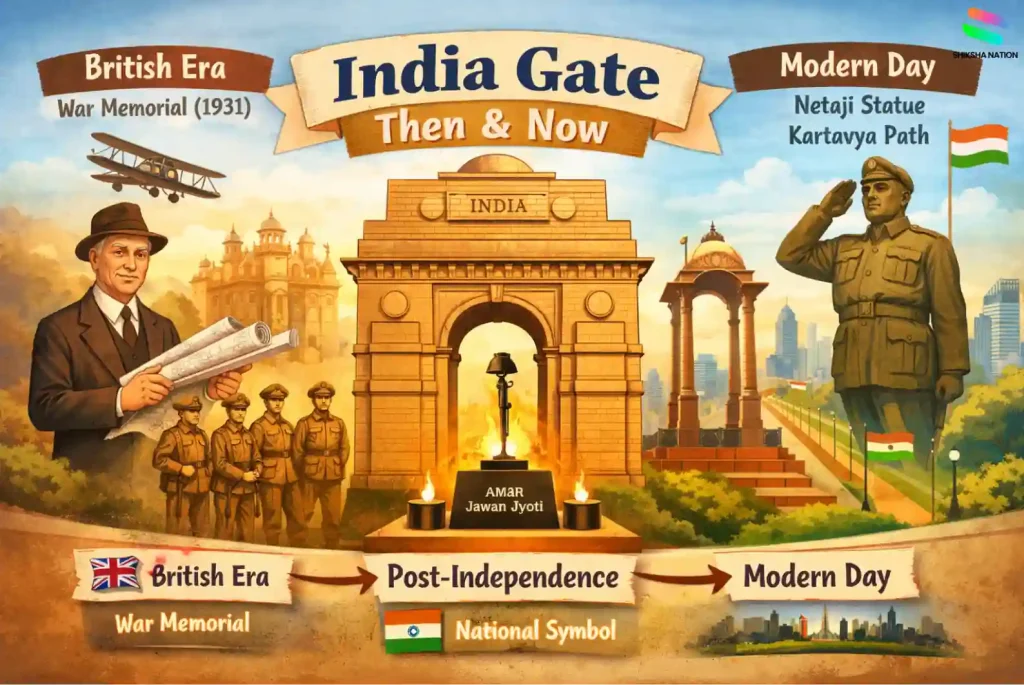
The Story Behind India Gate
When you read about India Gate in books, it feels very dry – just a monument, one date, one name. But the real story is a bit deeper.
More than 13,000 Indian soldiers’ names are actually engraved on the walls of India Gate. These were real people, from different parts of India, who went to fight in World War I and never came back. Imagine families waiting in villages, with no proper news, no closure. This gate was built as a way to remember them, not just as a structure in Delhi.
Now one thing students usually miss – Amar Jawan Jyoti was not there from the beginning. It was added much later, after the 1971 India-Pakistan war. That small flame changed the meaning of the place. Earlier it was more of a British-era war memorial, but after independence, especially with this addition, it slowly became a symbol of respect for Indian soldiers.
If you ever see Republic Day parade visuals, you will notice leaders paying tribute there. That tells you how the meaning has shifted over time – from a colonial structure to something that represents national pride.
Many students get confused here because textbooks don’t connect these events properly. They just give facts. But if you remember it like a story – soldiers, names on walls, then Amar Jawan Jyoti – you won’t forget it in exam.
Real Student Problem – Why You Forget India Gate Facts in Exams
Let me tell you honestly, the issue is not that India Gate is difficult. The issue is how you are trying to remember it.
Most students just read india gate important facts like a list – 1931, Lutyens, World War, Amar Jawan Jyoti – and try to mug it up. Then in the exam, everything mixes. Date goes here, architect goes there. Very common.
One more problem I see – students remember “Lutyens” separately, “Delhi planning” separately, and “India Gate” separately. No connection. So brain treats it like three different topics. Obviously you will forget.
Same with Amar Jawan Jyoti. You read it once and assume it was always there. But in exam, when question twists a little, confusion starts. Timeline becomes messy.
Think about it like this – if I give you 5 random numbers, you will forget. But if I connect them to a story, you remember easily. Your brain works on connections, not isolated facts.
Many of you study one night before exam and expect everything to stay. Then in exam hall you not able to recall.” That’s not memory problem, that’s lack of linking.
So the real issue is not syllabus. It’s that you are not connecting facts in a simple story format. Once you fix that, India Gate type questions become scoring, not confusing.
Smart Memory Tricks
See, you don’t need extra intelligence to remember india gate facts. You just need small anchors in your mind. If you study smart, even last-day revision works.
Try these simple india gate short tricks:
- 1931 → Think “3-1 = Gate opened for people”
Just imagine a big gate opening. Now the number sticks.
- Lutyens → Link with Delhi planning
You already read about Lutyens’ Delhi in history. Same person designed India Gate. One link, two topics covered.
- World War 1 → First big global war = first major memorial
“First war → important memory → India Gate.” Keep it that basic.
- Amar Jawan Jyoti → Always think “later addition”
Don’t fix it in the original structure. That’s where students go wrong.
- Location trick → Republic Day visuals
You have seen parade on TV, right? That road, that area – that’s where India Gate is. Visual memory works better than text.
Honestly, many of you read 5 times but still forget. Reason is simple – you are not giving your brain any hook. These small tricks act like hooks. Once attached, facts don’t slip easily.
Important Facts You Must Write in Exams (One-Liners)
In exam, don’t try to write a story unless asked. Just write clean, direct points. That’s how you score full marks using india gate upsc notes style.
Keep these india gate facts ready:
- Built in 1931
- Designed by Sir Edwin Lutyens
- Purpose: To honour Indian soldiers who died in World War I
- Type: War memorial
- Location: Kartavya Path, New Delhi
- Names of thousands of soldiers engraved on the walls
- Amar Jawan Jyoti added after 1971 war
- Symbol of remembrance and national pride
One mistake students do – they write extra but miss key points. Examiner is not checking your English, they are checking facts.
If you remember these 6-8 lines clearly, even a 5-mark question becomes very easy. No need to overcomplicate it.
Common Mistakes Students Make (Very Important)
I have checked many answer sheets, and honestly, the same india gate mistakes keep repeating. It’s not lack of study, it’s small confusion that costs marks.
Look at these carefully:
- Calling it an Independence monument
It is not related to 1947 directly. That’s a basic india gate confusion.
- Mixing World War I and World War II
Question asks WW1, student writes WW2. One wrong line, marks gone.
- Ignoring the Amar Jawan Jyoti timeline
Many students write it as part of original structure. That is incorrect.
- Writing incomplete answers
Only definition, no year or architect. Answer looks half.
- Spelling or name mistakes
“Lutyens” gets written wrong or skipped completely.
What happens – you study everything, but in exam hall small things slip. Then later you feel, “This was easy, why did I mess it up?”
That’s why focus on clarity, not just reading.
Example Question + Perfect Answer (Exam Ready)
Now let’s see how to actually write in exam. Not too long, not too short. Just proper structure.
Q: Write a short note on India Gate.
Answer:
India Gate is a war memorial located in New Delhi, built to honour Indian soldiers who died in World War I. It was constructed in 1931 and designed by Sir Edwin Lutyens. The monument serves as a tribute to thousands of soldiers whose names are engraved on its walls. Later, Amar Jawan Jyoti was added after the 1971 war to honour soldiers who sacrificed their lives for the nation.
That’s it. Clean and complete.
Many students either write too much unnecessary detail or too little. You don’t need decoration here. Just cover these 4 parts – definition, year, purpose, and Amar Jawan Jyoti.
If you follow this format in india gate exam questions, you won’t lose marks for structure.
India Gate Then vs Now (Easy to Understand Timeline)
If you see india gate history like a timeline, it becomes very easy. No need to cram separate facts.
- British Era → War memorial
It was built by the British to honour Indian soldiers who died in World War I. At that time, it was more of a colonial structure, not really about independent India.
- Post-Independence → National symbol
After 1947, its meaning slowly changed. With Amar Jawan Jyoti added later, it became a place to honour Indian soldiers. That shift is the real india gate significance.
- Modern India → New identity
Now you see Netaji Subhas Chandra Bose statue nearby and Kartavya Path redevelopment. The whole area represents duty, pride, and national identity.
Many students try to remember everything separately and get confused. Just think: British → Independence → Modern India. Three steps, done.
Quick Revision Table (Before Exam)
Before exam, don’t read full chapters. Just revise like this:
| Point |
Detail |
| Year |
1931 |
| Architect |
Edwin Lutyens |
| Purpose |
WW1 soldiers memorial |
| Location |
New Delhi (Kartavya Path area) |
| Special |
Amar Jawan Jyoti (post-1971) |
This type of india gate revision saves time.
Many of you open book and feel overwhelmed before exam. Instead, just go through this once or twice. Enough to recall in answer sheet.
FAQs – About India Gate
Q. Who build India Gate?
India Gate was designed by Sir Edwin Lutyens, a British architect. Many students think some Indian leader built it, but that’s not correct. It was constructed during British rule as part of their planning of New Delhi. Just remember Lutyens = Delhi design + India Gate, it becomes easier.
Q. For what India Gate is famous for?
India Gate is famous as a war memorial for Indian soldiers who died in World War I. It is also known for Amar Jawan Jyoti and national events like Republic Day. Most people recognize it as a symbol of respect for soldiers, not just a tourist place.
Q. What is Amar Jawan Jyoti?
Amar Jawan Jyoti is a flame placed under India Gate to honour soldiers who died in wars, especially after 1971. It was added later, not during original construction. Students often miss this timeline. Just remember-it represents sacrifice and is always kept burning.
Q. What’s the importance of India Gate in Exams?
In exams, India Gate is asked for basic facts like year, architect, and purpose. Sometimes short notes or one-liners come. If you remember 4-5 key points clearly, you can easily score marks. No need to write long answers unless specifically asked.
Q. India Gate kab bana tha exactly?
India Gate was completed in 1931. Many students get confused between start and completion year, but for exams, you should write 1931 directly. Keep it simple. Don’t overthink extra details unless the question specifically asks for construction timeline.
Q. India Gate kis war ke liye banaya gaya tha?
It was built to honour soldiers who died in World War I. This is where many students make mistakes by writing World War II. Just fix this in your mind – India Gate = WW1. One clear link, no confusion in exam.
Q. Kya India Gate independence se related hai?
No, India Gate is not directly related to India’s independence in 1947. It was built earlier during British rule. Students often mix this because it looks like a national monument. But in exam, writing independence link will be marked wrong.
Q. India Gate par naam likhe hue kyun hain?
Thousands of soldiers’ names are engraved on India Gate to honour them. These were real soldiers who died in war. This detail adds value in answers. If you include this line, your answer looks more complete and thoughtful.
Q. India Gate kaha par located hai?
India Gate is located in New Delhi, on Kartavya Path. You might have seen it during Republic Day parade on TV. That same road and area. Using this visual helps you remember location easily instead of just memorising it.