What Are Age Ratio Questions in Maths?
Age ratio questions are a type of age word problem where the ages of two or more people are compared using a ratio. Instead of giving exact ages, the question provides a relationship between ages and sometimes a difference in years.
These questions are closely related to ratio and proportion problems because students must use ratios to represent ages. After forming the ratio, the given condition (such as age difference or future age) is used to find the actual ages.
Students usually start learning these concepts in Class 6-8 mathematics, especially in chapters related to ratio, proportion, and basic algebra. Teachers use these questions to help students practise logical thinking and equation formation.
Where Students See These Questions
Students may encounter age problems in:
- School maths exercises and worksheets
- Olympiad or aptitude practice questions
- Competitive exam preparation at a basic level
Many textbooks also include age problems in maths with answers so that students can check their method after solving the question.
Simple Example
Suppose the ratio of the ages of two brothers is 3:5, and the difference in their ages is 10 years.
To solve age questions in maths, students assume the ages based on the ratio and then use the given difference to find the real ages. This step-by-step approach helps convert the ratio into actual numbers.
Step-by-Step Method to Solve Age Ratio Questions
Many students feel confused about how to solve age ratio questions because the problem looks like a story instead of numbers. A simple step-by-step method can make these questions much easier.
Once students learn this basic framework, they can apply the same process to most algebra age problems in school maths.
Step 1 – Represent Ages Using Ratio
The first step is to express the ages according to the ratio given in the question.
For example, if the ratio of two ages is 2:3, we can assume:
- First person’s age = 2x
- Second person’s age = 3x
Here, x is a common value that helps convert the ratio into real ages later.
Using this method keeps the solution organised and makes age problems with ratio easier to handle.
Step 2 – Use the Given Age Difference
Next, identify the information given in the question, such as the difference between ages.
For example:
- “A is 24 years older than B”
- “The difference between their ages is 10 years”
Students must convert this statement into a mathematical relationship between the assumed ages.
Step 3 – Form a Simple Equation
Now create a basic equation using the assumed ages.
Example structure:
- Age difference = larger age − smaller age
This step connects the ratio values with the actual difference given in the question.
Step 4 – Solve and Verify
Finally, solve the equation to find the value of x.
Then:
- Substitute the value of x back into the assumed ages
- Check whether the ages satisfy the condition given in the question
Verifying the answer helps students confirm they have correctly solved the problem.
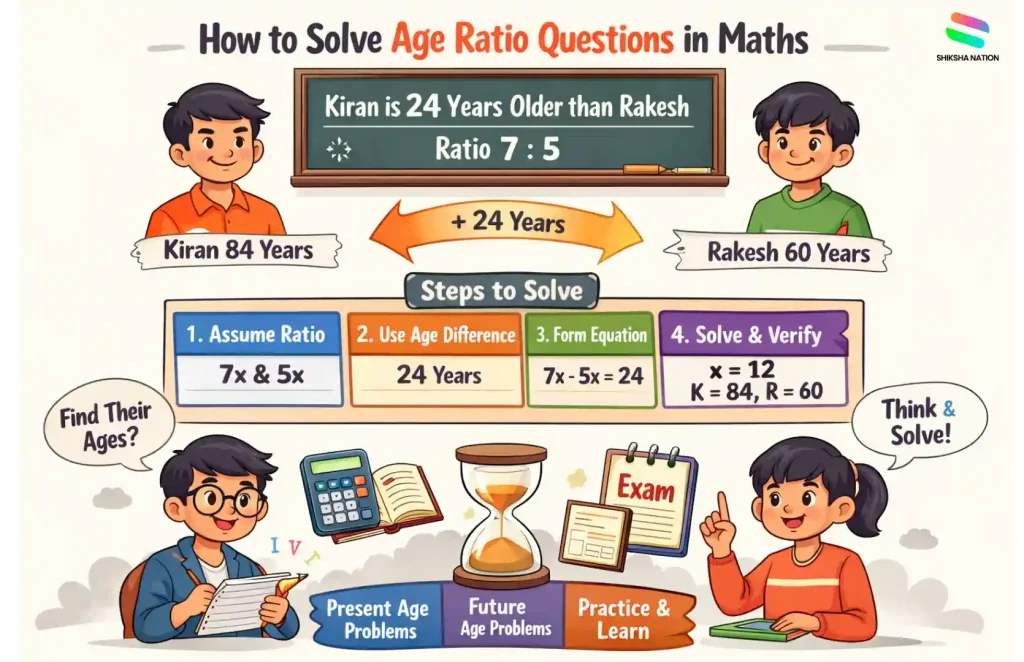
Solved Example – Kiran Is 24 Years Older Than Rakesh
Understanding a solved example helps students see how the method works in real questions. Let us solve one of the common present age problems step by step.
This type of explanation is useful for learners who are practising age ratio questions with solutions and want to check how each step is applied.
Question Explanation
The question states that Kiran is 24 years older than Rakesh.
The ratio of their present ages is 7:5.
We need to find the present ages of both Kiran and Rakesh.
Assume Ages Using Ratio
First, represent the ages using the given ratio.
- Age of Kiran = 7x
- Age of Rakesh = 5x
Here, x is a common number used to convert the ratio into actual ages.
Step-by-Step Solution
Now use the condition given in the question.
The difference between their ages is 24 years.
So,
- Difference in ratio ages = 7x − 5x
- This equals 2x
According to the question:
2x = 24
Now solve the equation.
x = 12
Find Their Actual Ages
Substitute the value of x.
- Kiran’s age = 7 × 12 = 84 years
- Rakesh’s age = 5 × 12 = 60 years
Final Answer
- Kiran is 84 years old
- Rakesh is 60 years old
Such age problems in maths with answers help students understand how ratios can be converted into real ages step by step.
Common Mistakes Students Make in Age Ratio Problems
Age ratio questions are usually simple once the method is clear. However, many students make small mistakes while solving ratio based word problems, which leads to incorrect answers.
Understanding these common errors can help students and parents guide practice more effectively.
Ignoring the Age Difference
One frequent mistake is not using the given age difference properly.
Students sometimes focus only on the ratio and forget to apply the condition like “A is 10 years older than B.” Without using this difference, the ratio cannot be converted into real ages.
Parents helping with homework should remind students that the difference always connects the ratio with actual numbers.
Incorrect Ratio Assumption
Another common issue happens when students assume the ratio incorrectly.
For example, if the ratio is 3 : 5, the ages should be written as 3x and 5x. Some students mistakenly write 3 and 5 directly, which breaks the calculation.
This small step is very important in many age related maths questions.
Misinterpreting Future Age Problems
Students also get confused in future age problems.
When a question says “after 5 years,” both ages must increase by 5. Many learners add years to only one person’s age, which changes the ratio incorrectly.
Carefully reading the question helps avoid such mistakes and improves accuracy in solving age problems.
Practice Question for Students
Practising a few problems is the best way to understand age questions in maths. Once students learn the method, they can easily solve many ratio based word problems by following the same steps.
Try solving the following question on your own before checking the answer.
Practice Problem
The ratio of the ages of A and B is 5 : 3.
The difference between their ages is 16 years.
Question:
Find the present ages of A and B.
Hint to Solve
Students can follow these steps:
- Assume the ages according to the ratio 5x and 3x
- Use the given difference between ages
- Form a simple equation
- Solve the value of x
Parents or teachers can encourage students to solve it on paper instead of doing it mentally. This helps build confidence in solving age problems in maths with answers and improves understanding of the method used in such questions.
Where Age Problems Appear in School Maths
Age questions are commonly included in school maths because they help students understand ratios, logical thinking, and basic equation formation. These age related maths questions usually appear in middle school classes.
Students may see such questions in textbooks, practice worksheets, and school tests.
Class 6
In Class 6, students first learn about ratio and proportion. Teachers may introduce simple age examples to help students understand how ratios work in real situations.
These problems are usually basic and focus on understanding the concept.
Class 7
In Class 7, age questions become slightly more structured. Students practise forming simple relationships between ages and using ratios correctly.
These questions help prepare students for more complex word problems later.
Class 8
In Class 8, students often learn how to solve age questions in maths class 8 using simple algebra. This stage connects ratios with equations.
Such problems also build aptitude foundations, which are useful later for board exams and competitive exam preparation.
FAQs on How to Solve Age Ratio Questions
Q. How do you solve age ratio questions easily?
To understand how to solve age ratio questions, students can follow a simple approach. First, represent the ages according to the given ratio, such as 3x and 5x. Next, use the age difference or condition mentioned in the question to form an equation. After solving the value of x, substitute it back to find the actual ages.
Q. What is the formula for age problems in maths?
There is no single fixed formula for age problems in maths with answers. Most questions rely on two ideas: representing ages using a ratio and applying a condition like age difference or future age. Students usually use simple algebra to convert these conditions into equations.
Q. How do you solve present age problems?
In present age problems, the question focuses on the current ages of people. Students assume ages according to the ratio given and then apply the difference or relationship mentioned in the problem. Solving the equation gives the present ages of the individuals.
Q. How do future age problems work?
In future age problems, the question may say something like “after 5 years” or “after 10 years.” In such cases, the same number of years is added to each person’s present age. After adjusting the ages, students apply the ratio or condition given in the problem.
Q. Why do students find age ratio questions confusing?
Many students get confused because these questions are written as word problems. Instead of direct numbers, the problem describes relationships between ages. Converting the language of the question into mathematical expressions requires careful reading and practice.
Q. Are age problems part of algebra?
Yes, many age questions involve basic algebra concepts. Students often represent ages using variables like x and form simple equations to find the answer. This is why age problems are commonly taught when students start learning algebra.
Q. In which classes do students learn age ratio questions?
Age problems usually appear in Class 6 to Class 8 mathematics, especially in chapters related to ratio, proportion, and basic algebra. These questions help students practise logical thinking and problem-solving.
Q. Are age questions important for exams?
Yes, age questions can appear in school exams, practice worksheets, and Olympiad-level problems. Learning how to solve them step by step helps students handle similar questions in both school tests and aptitude-based exams.
Q. How can students practise age problems effectively?
Students can improve by solving different types of age problems in maths with answers and checking each step carefully. Writing the solution clearly and verifying the final ages helps build accuracy and confidence.