

Introduction
Remember that physics class when your teacher asked, “If the hare runs 100 meters in 20 seconds, what’s its average speed?” Half the class stared blankly, while others scribbled frantically, unsure where to begin.
The famous Aesop’s fable about the hare and the tortoise isn’t just a moral lesson about persistence it’s a perfect real-world example to understand average speed, a fundamental concept in physics and mathematics. Whether you’re preparing for board exams, competitive tests, or simply doing homework, mastering speed calculations opens doors to understanding motion, distance, and time relationships.
This guide breaks down everything you need to know about calculating the average speed of the hare (or any moving object) using simple formulas, relatable examples, and exam-ready tips.
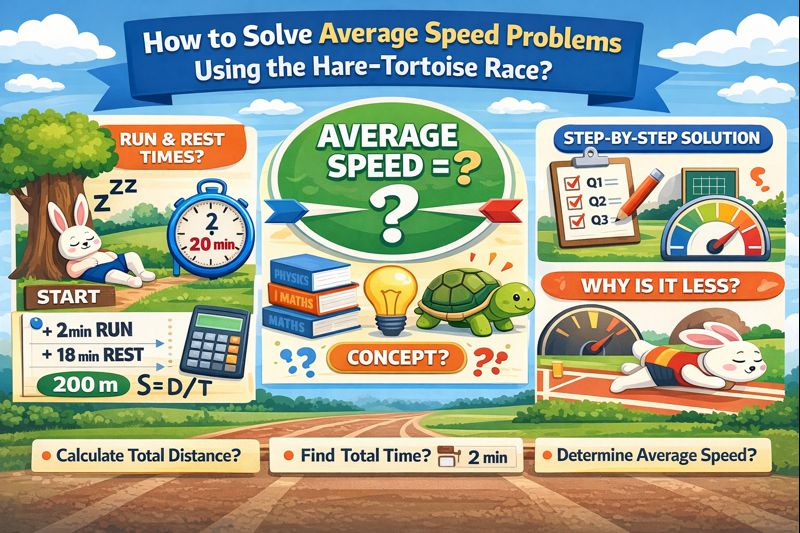
What is Average Speed?
Average speed tells us how fast an object moves over a total distance, regardless of variations in its speed during the journey.
Simple definition: Average speed is the total distance traveled divided by the total time taken.
Unlike instantaneous speed (speed at a particular moment), average speed considers the entire journey. The hare might sprint quickly, stop to rest, then run again but average speed accounts for all of it.
Why it matters:
- Essential for solving physics problems in Classes 7-12
- Appears in competitive exams like JEE, NEET, and board exams
- Helps understand real-world motion scenarios
The Basic Formula for Average Speed
The formula is beautifully simple:
Average Speed = Total Distance ÷ Total Time
Or mathematically:
v = d/t
Where:
- v = average speed
- d = total distance covered
- t = total time taken
Units to remember:
- Speed: meters per second (m/s) or kilometers per hour (km/h)
- Distance: meters (m) or kilometers (km)
- Time: seconds (s) or hours (h)
Pro tip: Always match your units! If distance is in meters and time in seconds, speed will be in m/s.
Understanding the Hare-Tortoise Race Problem
Let’s set up our classic race scenario:
The Race Setup:
- Total race distance: 100 meters
- The hare runs confidently, covering ground quickly
- The tortoise moves slowly but steadily
- Both start at the same time from the same point
Typical problem statement: “The hare covers 100 meters in 20 seconds during a race. Calculate the hare’s average speed.”
This straightforward problem teaches the fundamental application of the speed formula. But let’s explore deeper variations too.
Step-by-Step Calculation: Hare’s Average Speed
Basic Calculation
Given:
- Distance = 100 meters
- Time = 20 seconds
Step 1: Write the formula Average Speed = Distance ÷ Time
Step 2: Substitute the values Average Speed = 100 m ÷ 20 s
Step 3: Calculate Average Speed = 5 m/s
Answer: The hare’s average speed is 5 meters per second.
Converting to km/h
To convert 5 m/s to km/h:
Step 1: Use the conversion factor 1 m/s = 3.6 km/h
Step 2: Multiply 5 m/s × 3.6 = 18 km/h
Answer: The hare’s average speed is also 18 kilometers per hour.
Real-Life Classroom Examples
Example 1: The School Track Race
Problem: During sports day, Rahul runs a 200-meter track in 40 seconds. What’s his average speed?
Solution:
- Distance = 200 m
- Time = 40 s
- Average Speed = 200 ÷ 40 = 5 m/s
Answer: 5 m/s (same as our hare!)
Example 2: The Hare Takes a Nap
Problem: The hare runs 100 meters in the first 10 seconds, then sleeps for 30 seconds, then runs another 100 meters in 10 seconds. What’s the average speed for the entire journey?
Solution:
- Total Distance = 100 + 100 = 200 m
- Total Time = 10 + 30 + 10 = 50 s
- Average Speed = 200 ÷ 50 = 4 m/s
Key learning: Rest time counts! Average speed includes all time, even when stationary.
Example 3: Different Speeds in Different Sections
Problem: The hare runs the first 50 meters at 10 m/s and the next 50 meters at 5 m/s. Find the average speed.
Solution:
- Time for first 50 m = 50 ÷ 10 = 5 seconds
- Time for next 50 m = 50 ÷ 5 = 10 seconds
- Total Distance = 100 m
- Total Time = 5 + 10 = 15 s
- Average Speed = 100 ÷ 15 = 6.67 m/s
Important: Average speed is NOT the average of the two speeds (10+5)/2 = 7.5 m/s. Always use total distance and total time.
Common Mistakes Students Make
Mistake 1: Adding Speeds Instead of Using Formula
Wrong approach: If the hare runs at 10 m/s, then 5 m/s, average = (10+5)/2 = 7.5 m/s
Right approach: Calculate time for each segment, then use total distance/total time.
Mistake 2: Mixing Units
Wrong: Distance in km, time in seconds, resulting in incorrect speed.
Right: Always convert to matching units before calculating.
Mistake 3: Forgetting Rest Time
Wrong: Only counting time when moving.
Right: Include ALL time from start to finish, including stops.
Mistake 4: Confusing Average Speed with Average Velocity
Remember:
- Average speed = total distance ÷ total time (scalar, always positive)
- Average velocity = displacement ÷ time (vector, can be zero if returning to start)
Mistake 5: Rounding Too Early
Wrong: Rounding intermediate steps loses accuracy.
Right: Round only the final answer, or keep at least 2 decimal places in intermediate steps.
Easy Tricks to Remember Speed Calculations
The “DST Triangle” Method
Draw a triangle with D on top, S and T on the bottom:
 D
 ---
S | T- Cover D: D = S × T
- Cover S: S = D ÷ T
- Cover T: T = D ÷ S
The “5-18 Conversion Trick”
m/s to km/h: Multiply by 18/5 (or 3.6) km/h to m/s: Multiply by 5/18
Example: 5 m/s = 5 × 18/5 = 18 km/h
Memory Aid: “DTS”
Distance Tells Speed
Rearrange as needed:
- Speed = Distance/Time
- Time = Distance/Speed
- Distance = Speed × Time
How the Tortoise’s Speed Compares
Typical Tortoise Speed
Real tortoises move very slowly. Their average speed ranges from 0.27 to 0.5 km/h (or about 0.075 to 0.14 m/s).
In our race scenario:
If the tortoise completes the same 100-meter race:
- Assuming tortoise speed = 0.1 m/s
- Time taken = Distance ÷ Speed = 100 ÷ 0.1 = 1000 seconds
That’s over 16 minutes compared to the hare’s 20 seconds!
Comparative Table
| Racer | Distance | Time | Average Speed (m/s) | Average Speed (km/h) |
|---|---|---|---|---|
| Hare | 100 m | 20 s | 5 | 18 |
| Tortoise | 100 m | 1000 s | 0.1 | 0.36 |
| Rocket | 100 m | 0.1 s | 1000 | 3600 |
| Human Sprinter | 100 m | 10 s | 10 | 36 |
The hare is 50 times faster than the tortoise which makes the fable’s outcome even more remarkable.
FAQs About Average Speed
What is the average speed of a tortoise?
The average speed of a tortoise typically ranges from 0.27 to 0.5 kilometers per hour, which equals approximately 0.075 to 0.14 meters per second. This slow pace is due to their shell weight and leg structure, making them one of nature’s slowest land animals.
What speed is 100m in 20 seconds?
Running 100 meters in 20 seconds gives an average speed of 5 meters per second or 18 kilometers per hour. This is calculated using the formula: Speed = Distance ÷ Time, so 100m ÷ 20s = 5 m/s. This represents moderate running pace for humans.
How do we calculate average speed?
Average speed is calculated by dividing the total distance traveled by the total time taken. The formula is: Average Speed = Total Distance ÷ Total Time. Remember to use consistent units (meters with seconds, or kilometers with hours) and include all time, even rest periods.
What is the average speed of a tortoise in km/hr?
A tortoise’s average speed in kilometers per hour typically ranges between 0.27 to 0.5 km/h, depending on the species and terrain. Giant tortoises are slower (around 0.27 km/h), while smaller species may reach 0.5 km/h. This translates to covering just 270-500 meters in one hour.
Can you calculate how fast the rocket compared with the tortoise?
If a rocket covers 100 meters in 0.1 seconds, its speed is 1000 m/s. A tortoise moving at 0.1 m/s would take 1000 seconds for the same distance. The rocket is 10,000 times faster than the tortoise, demonstrating the extreme range of speeds in our universe.
Is average speed always equal to total distance divided by total time?
Yes, average speed is always calculated as total distance divided by total time, regardless of speed variations during the journey. This differs from average velocity, which uses displacement instead of distance. Average speed cannot be negative and represents the overall rate of motion.
Why can’t we just average the speeds?
Simply averaging speeds gives incorrect results because time spent at each speed differs. If you travel equal distances at different speeds, you spend more time at slower speeds, which affects the overall average. Always use total distance divided by total time for accuracy.
How is this concept used in exams?
Average speed problems appear in physics, mathematics, and aptitude tests from Class 7 through competitive exams like JEE and NEET. Questions test formula application, unit conversion, multiple-segment journeys, and problem-solving skills. Mastering this concept builds foundation for kinematics and mechanics topics.
Conclusion
Calculating the average speed of the hare in the classic race is more than just plugging numbers into a formula—it’s about understanding how motion works in the real world.
Note:
- Average speed = Total distance ÷ Total time
- Always match your units before calculating
- Include ALL time, even rest periods
- Don’t confuse average speed with averaging different speeds
- Practice with varied examples to master the concept
Whether the hare wins or loses the race, understanding its speed helps you ace physics problems, score better in exams, and see mathematics in everyday life. The tortoise teaches persistence, but the hare teaches us about speed calculations.