

How many weeks in a year? A standard calendar year has 52 weeks and 1 extra day, which is why the count is not a perfect whole number. This simple concept often appears in school maths and time-calculation questions.
For students, understanding how many weeks are there in a year helps in solving word problems related to days, weeks, and months. For parents, it makes homework support easier and avoids confusion during exam preparation. This explanation follows a clear, school-level approach, keeping the focus on understanding rather than complex calculations.
How Many Weeks Are There in a Year?
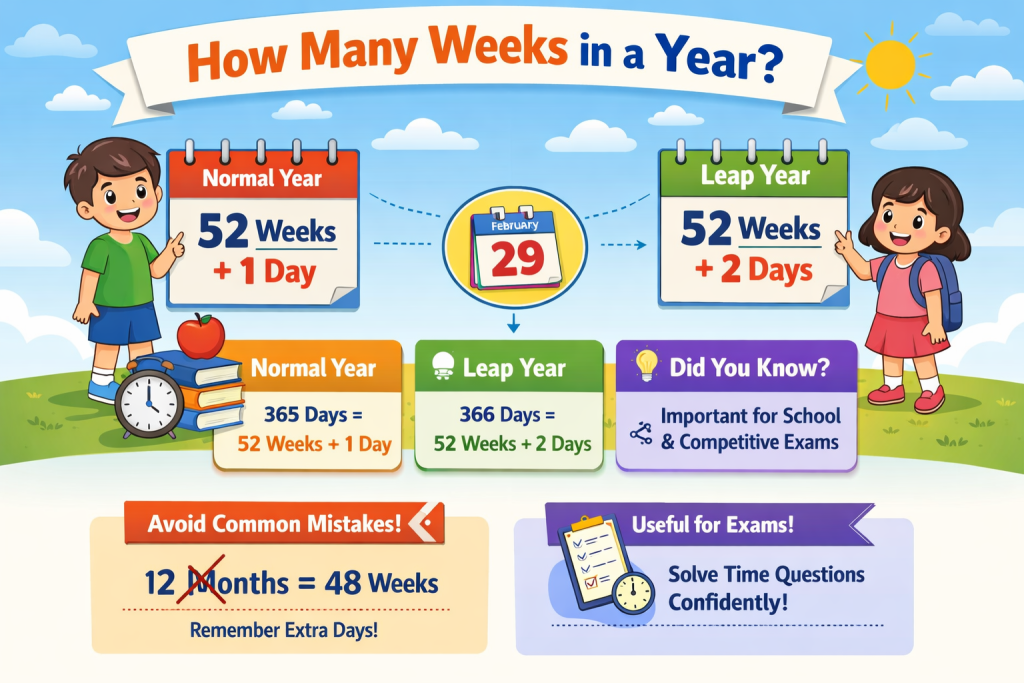
How many weeks in a year is a common question in school maths and daily learning. A normal calendar year has 365 days, and when these days in a year are grouped into sets of seven, we get 52 full weeks. After counting these 52 weeks, 1 extra day is left.

This is why a year is not made of exactly 52 weeks. For students, this explanation is enough to solve exam questions correctly. For parents, it helps in guiding children during homework without confusion. The idea is simple and follows the school syllabus directly.
Why Isn’t a Year Exactly 52 Weeks?
How many weeks in a year often confuses students because 52 weeks do not fully cover all the days in a calendar year. A normal year has 365 days, and when these days in a year are divided into groups of seven, one day remains unused. This extra day is the main reason the total does not fit neatly into weeks.
Another common doubt comes from months. Months are not equal in length, so they cannot be counted as exact four-week blocks. Understanding this clears many exam and homework mistakes related to weeks in a year and time calculation.
How Many Weeks Are There in a Leap Year?
How many weeks in a year changes slightly when the year is a leap year. A leap year has 366 days instead of 365, as one extra day is added in February. When these days are divided into weeks, the result is 52 full weeks and 2 extra days.
This small difference is important for students, especially in school maths and exam questions related to time calculation. Parents should also note that leap year weeks do not change the basic idea of weeks, but only add one more day to the year. This explanation is fully exam-safe and easy to remember.
How This Concept Is Used in School Maths (Classes 6-8)
How many weeks in a year is not just a general knowledge fact; it is a regular part of school maths learning. In Classes 6 to 8, students use this concept while solving time calculation problems that involve days, weeks, and months. Questions based on timetables, school schedules, holidays, and activity plans often depend on correct understanding of weeks in a year.
In exams, word problems may ask students to convert days into weeks or plan events over a given time period. A clear grip on school maths time calculation helps students avoid common mistakes and saves time during exams. For parents, this understanding makes it easier to guide children during daily practice and revision.
Common Mistakes Students Make About Weeks in a Year
How many weeks in a year is often answered wrongly in exams because of a few common misunderstandings. One frequent mistake is assuming that 12 months always equal 48 weeks, which is not correct. Another error is ignoring the extra days that remain after counting full weeks.
Students also lose marks by misreading exam questions, especially when days and weeks are mixed in word problems. A clear understanding of how weeks in a year actually work helps students avoid these errors. For parents, knowing these mistakes makes it easier to correct children during practice and revision at home.
FAQs – “Frequently Asked Questions”
How many weeks in a year is a question that appears simple, but it often creates confusion for students and parents. Below are clear, exam-safe answers to the most common doubts, explained in simple language and aligned with school learning.
Q. Is a year always exactly 52 weeks?
No, a year is not exactly 52 weeks. A normal year has 365 days, which makes 52 full weeks and 1 extra day. Because of this extra day, the total does not fit perfectly into weeks. Students should remember this detail, as many exam questions are based on this small difference.
Q. How many weeks are there in a leap year?
A leap year has 366 days because one extra day is added to February. When these days are counted in weeks, there are 52 full weeks and 2 extra days. This difference is small but important for time-based questions in school maths.
Q. Is this concept important for school exams?
Yes, it is important. Questions related to days, weeks, and months are common in Classes 6 to 8. Understanding how many weeks are there in a year helps students solve word problems correctly and avoid calculation errors.
Q. Do competitive exams ask such time calculations?
Basic time calculations are often used in foundation-level competitive exams and reasoning sections. A clear understanding at the school level helps students handle these questions with confidence later on.