

Introduction
Picture this: You’re in science class, measuring ingredients for a chemistry experiment. The recipe calls for 2 pounds of a compound, but your scale only shows ounces. Your lab partner looks at you, and suddenly everyone’s wondering how many ounces are in a pound?
This isn’t just a classroom question. Understanding weight conversions helps you follow recipes, solve math problems, understand nutrition labels, and even ace standardized tests. Whether you’re shopping, cooking, or completing homework, knowing this simple conversion makes life easier.
Let’s break down everything you need to know about pounds and ounces in a way that actually makes sense.
Quick Answer: Ounces in a Pound
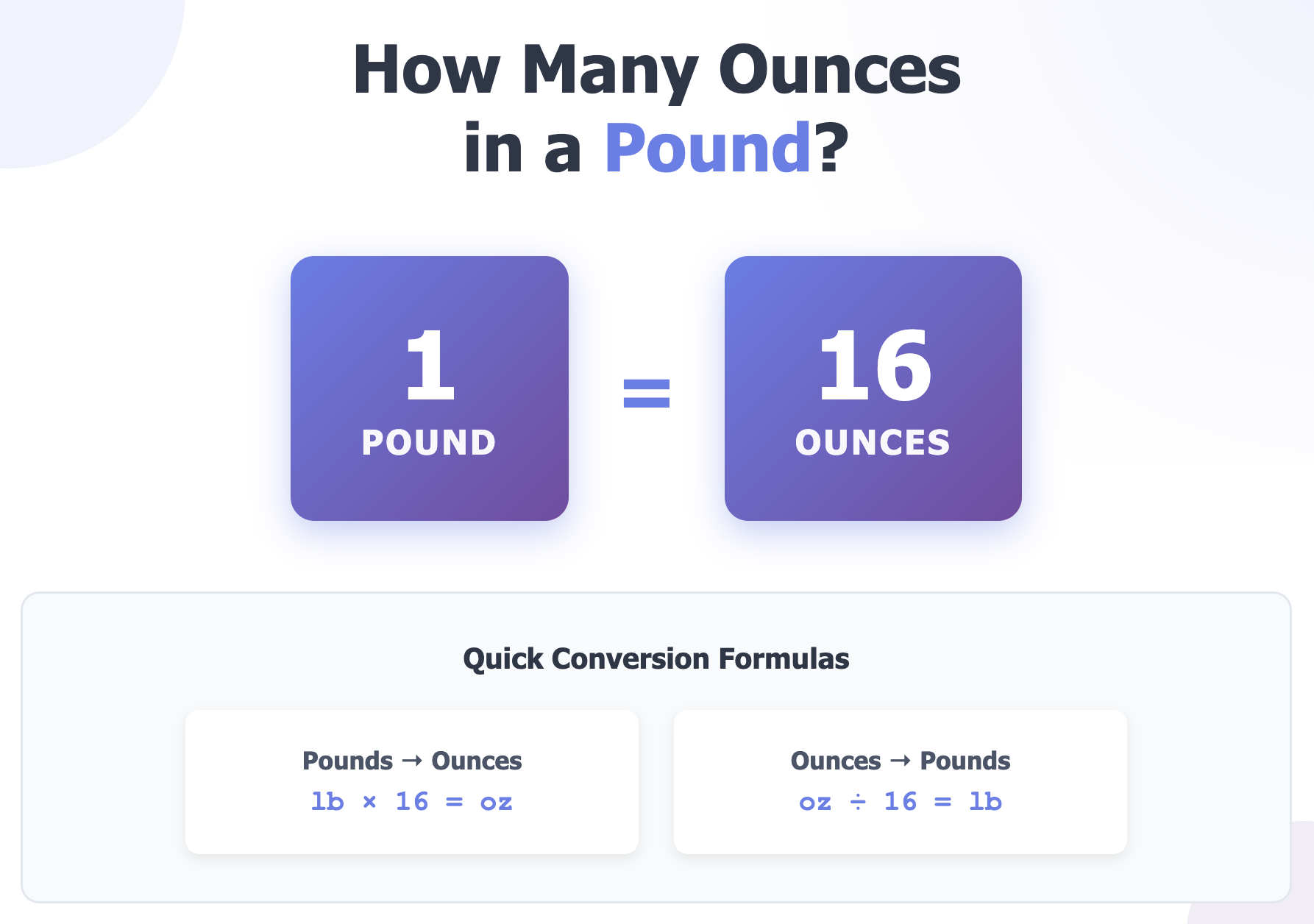
There are 16 ounces in 1 pound.
This is the fundamental conversion you need to remember. Whether you’re solving a word problem or measuring ingredients, this 1:16 ratio is your starting point.
Understanding Pounds and Ounces
Before diving into conversions, let’s understand what we’re working with.
What is a Pound (lb)?
A pound is a unit of weight commonly used in the United States. It measures how heavy something is. The abbreviation “lb” comes from the Latin word “libra.”
What is an Ounce (oz)?
An ounce is a smaller unit of weight. It’s perfect for measuring lighter items. The abbreviation “oz” comes from the Italian and Spanish word “onza.”
Why 16 ounces?
The number 16 comes from the avoirdupois system, which is the standard weight system used in the U.S. for everyday items. This system has been used for centuries in English-speaking countries.
The Basic Conversion Formula
Converting between pounds and ounces uses simple multiplication or division.
Pounds to Ounces:
Ounces = Pounds × 16Ounces to Pounds:
Pounds = Ounces ÷ 16That’s it! No complicated formulas or advanced math required.
Common Weight Conversions Students Need
Here’s a quick reference table for conversions you’ll see in homework and tests:
| Pounds | Ounces |
|---|---|
| 0.25 lb (1/4 pound) | 4 oz |
| 0.5 lb (1/2 pound) | 8 oz |
| 0.75 lb (3/4 pound) | 12 oz |
| 1 lb | 16 oz |
| 1.5 lb | 24 oz |
| 2 lb | 32 oz |
| 3 lb | 48 oz |
| 5 lb | 80 oz |
Quick conversions to memorize:
- Half a pound = 8 ounces
- Quarter pound = 4 ounces
- 2 pounds = 32 ounces
Real-Life Examples from School and Home
Example 1: Cooking Class
Your culinary arts teacher asks you to measure 3 pounds of flour, but the container only has an ounce scale.
Calculation: 3 pounds × 16 = 48 ounces
You need 48 ounces of flour.
Example 2: Science Lab
You’re conducting a density experiment. The instructions require 24 ounces of salt, but your shopping list is in pounds.
Calculation: 24 ounces ÷ 16 = 1.5 pounds
You need to buy 1.5 pounds of salt.
Example 3: Health Class
Your nutrition assignment mentions a 16 oz water bottle. How many pounds of water is that?
Calculation: 16 ounces ÷ 16 = 1 pound
That’s exactly 1 pound of water.
Example 4: Math Word Problem
“A bag of apples weighs 2.5 pounds. How many ounces is that?”
Calculation: 2.5 pounds × 16 = 40 ounces
The apples weigh 40 ounces.
How to Convert Pounds to Ounces (Step-by-Step)
Follow these simple steps every time:
Step 1: Identify the number of pounds you have
Step 2: Multiply that number by 16
Step 3: The result is your answer in ounces
Practice Problem:
Convert 4.5 pounds to ounces.
- Start with: 4.5 pounds
- Multiply: 4.5 × 16 = 72
- Answer: 72 ounces
How to Convert Ounces to Pounds
The reverse process is just as simple:
Step 1: Identify the number of ounces you have
Step 2: Divide that number by 16
Step 3: The result is your answer in pounds
Practice Problem:
Convert 64 ounces to pounds.
- Start with: 64 ounces
- Divide: 64 ÷ 16 = 4
- Answer: 4 pounds
Dealing with remainders:
If you get 40 ounces: 40 ÷ 16 = 2.5 pounds (or 2 pounds 8 ounces)
Common Mistakes Students Make
Mistake 1: Confusing Fluid Ounces with Ounces
Fluid ounces (fl oz) measure volume, while ounces (oz) measure weight. They’re different! A fluid ounce of water weighs about 1 ounce, but a fluid ounce of honey weighs more.
Mistake 2: Forgetting to Multiply or Divide
Some students add or subtract instead. Remember: you’re converting between units, not combining them.
Mistake 3: Mixing Up the Formula
Always multiply when going from pounds to ounces (bigger to smaller unit). Divide when going from ounces to pounds (smaller to bigger unit).
Mistake 4: Rounding Too Early
If you’re working with decimals, keep them throughout your calculation. Only round your final answer.
Mistake 5: Using the Wrong Conversion Factor
There are 16 ounces in a pound not 12, not 10, not 8. Don’t confuse this with other conversions like inches to feet.
Memory Tricks
The Sweet Sixteen Trick
Think of “sweet sixteen”—16 is the magic number for this conversion.
The Half Pound Trick
Remember that 8 ounces is half a pound. From there, you can figure out other conversions easily.
The Quarter Pound Connection
A quarter-pound burger is 4 ounces. Four quarters make a whole pound (4 × 4 = 16).
Counting by 8s
8 oz = 0.5 lb 16 oz = 1 lb 24 oz = 1.5 lb 32 oz = 2 lb
This pattern helps you estimate quickly.
FAQs about How Many Ounces in a Pound
Q. Is 8 oz the same as 1 pound?
No, 8 ounces equals half a pound. You need 16 ounces to make one full pound, so 8 ounces is exactly half that amount.
Q. Is 16 oz equal to 1 pound?
Yes, 16 ounces equals exactly 1 pound. This is the standard conversion in the U.S. customary system used for weighing everyday items.
Q. Is 32 ounces the same as 1 pound?
No, 32 ounces equals 2 pounds. Since each pound contains 16 ounces, 32 ounces is double that amount, making it 2 pounds total.
Q. How much do 24 ounces of water weigh?
24 ounces of water weighs 1.5 pounds. To convert, divide 24 by 16, which gives you 1.5 pounds. This applies specifically to water where fluid ounces equal weight ounces.
Q. What does “lbs” stand for?
“Lbs” is the abbreviation for pounds. It comes from the ancient Roman unit “libra pondo,” which means a pound by weight. That’s why “lb” doesn’t match the English spelling.
Q. Is a 16 oz steak 1 lb?
Yes, a 16-ounce steak weighs exactly 1 pound. Steaks are often described by ounces, so knowing this conversion helps you understand portion sizes when ordering or cooking.
Q. How many ounces are in a lb for a baby?
The same conversion applies there are 16 ounces in 1 pound for babies. Newborn weights are often given in pounds and ounces, like 7 pounds 2 ounces.
Q. Is 40 oz 2.5 lbs?
Yes, 40 ounces equals 2.5 pounds. Divide 40 by 16 to get 2.5, which can also be expressed as 2 pounds and 8 ounces.
Conclusion
Understanding that there are 16 ounces in a pound opens doors to solving countless real-world problems. From completing homework assignments to following recipes and understanding product labels, this simple conversion is a life skill you’ll use repeatedly.
Remember the key points:
- 1 pound = 16 ounces
- Multiply by 16 when converting pounds to ounces
- Divide by 16 when converting ounces to pounds
- Half a pound is 8 ounces
Don’t worry if you need to reference this guide at first. With practice, these conversions become automatic. Keep a conversion chart handy during homework sessions, and soon you’ll be calculating confidently without one.
You’ve got this! Weight conversions are just another tool in your academic toolkit, making you more capable in math, science, cooking, and everyday decision-making. The more you practice, the easier it becomes.