

How many countries are there in the world is a very common question asked by students during school exams, GK tests, and quizzes. Parents also search this to help children with homework and projects.
Quick answer for students and parents
As of now, how many countries are there in the world 2025 has a clear and accepted answer for exams. Most schools and competitive exams follow the United Nations list, which recognises 195 countries.
In this guide, you will not just get the correct number, but also understand why this number is used, so students can write the right answer confidently in exams without confusion.
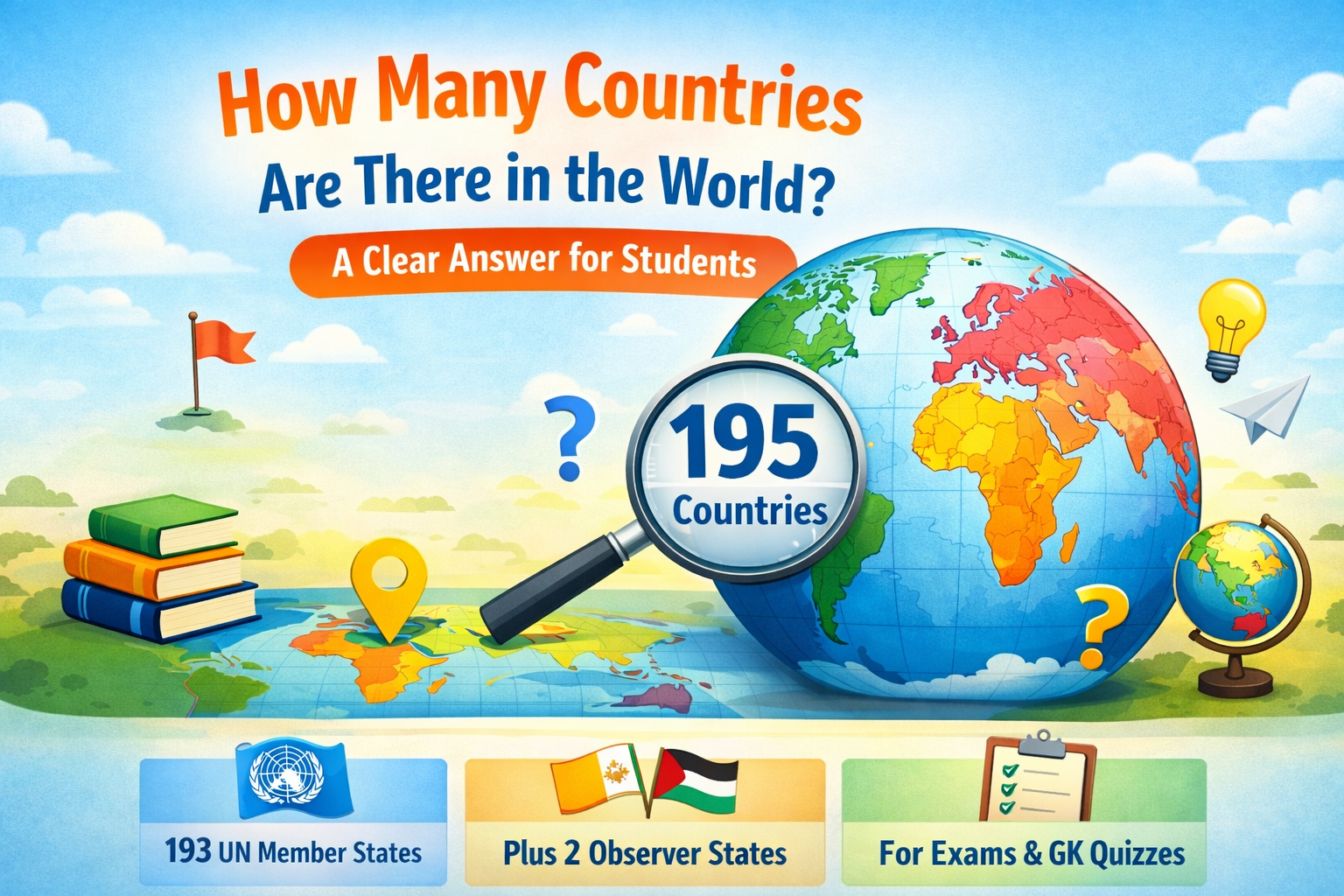
How Many Countries Are There in the World?
Official and exam-accepted answer
For school exams, GK quizzes, and competitive tests, the accepted answer is 195 countries in the world. This number is widely followed by schools and exam boards because it is based on the United Nations list.
How this number is counted
Out of these 195 countries, 193 are full members of the United Nations. These countries take part in UN meetings and decision-making.
The remaining 2 are non-member observer states. They are recognised internationally but do not have full voting rights in the UN. This is why they are counted separately.
What students should remember
If a student is asked how many countries are there in the world, writing 195 is safe and correct for exams. Parents can also rely on this number while helping children with homework or projects, without worrying about different figures shown online.

Why Do Different Sources Show Different Numbers?
Many students and parents get confused because different websites show different answers for the total how many countries are there in the world. This happens mainly because not everyone uses the same rules to count a country.
What does the United Nations count?
The United Nations follows a clear system. It counts only independent and recognised nations that meet international rules. Countries that are accepted as UN member countries are included in the official list used by schools and exams.
This is why most textbooks, GK books, and exam papers follow the UN number.
Why are some regions not counted as countries?
Some places have their own government but are still linked to another country. These are called territories or regions, not fully independent nations.
Because they do not have full international recognition, they are not counted as separate countries. This difference in definition is the main reason why online sources sometimes show different numbers, which can confuse students during exam preparation.
What Number Should Students Write in Exams?
Clear guidance for school and competitive exams
For most school exams, GK quizzes, Olympiads, and entrance tests, students should write 195 countries. This number is accepted by schools and exam boards because it follows the official United Nations list.
Teachers and examiners expect this answer, so students do not need to worry about other numbers seen on random websites.
Advice for parents and students
Parents helping with homework can safely guide children to use this number in answers, projects, and oral tests. Students should also remember that exams focus on standard and recognised facts, not debates or online opinions.
Writing the accepted number shows clarity and avoids losing marks due to confusion.
List of Countries – Should Students Memorise All Names?
Is memorising every country really needed?
Many students feel pressure to memorise the full list of countries in the world, but this is usually not required. School exams rarely ask students to write all country names from memory.
Instead, questions focus more on understanding, not mugging up long lists.
What students should focus on instead
Students should learn how countries are grouped by continents and understand their locations on the world map. This helps in map work, MCQs, and GK questions.
Parents can guide children to build concepts first. When the basics are clear, learning important country names becomes easier and less stressful.
List of Countries in the World (UN-Recognised)
Total: 195 countries
(193 UN member states + 2 observer states)
Asia (49)
Afghanistan, Armenia, Azerbaijan, Bahrain, Bangladesh, Bhutan, Brunei, Cambodia, China, Cyprus, Georgia, India, Indonesia, Iran, Iraq, Israel, Japan, Jordan, Kazakhstan, Kuwait, Kyrgyzstan, Laos, Lebanon, Malaysia, Maldives, Mongolia, Myanmar, Nepal, North Korea, Oman, Pakistan, Philippines, Qatar, Saudi Arabia, Singapore, South Korea, Sri Lanka, Syria, Tajikistan, Thailand, Timor-Leste, Turkey, Turkmenistan, United Arab Emirates, Uzbekistan, Vietnam, Yemen
Africa (54)
Algeria, Angola, Benin, Botswana, Burkina Faso, Burundi, Cabo Verde, Cameroon, Central African Republic, Chad, Comoros, Congo, Costa Rica, Côte d’Ivoire, Djibouti, Egypt, Equatorial Guinea, Eritrea, Eswatini, Ethiopia, Gabon, Gambia, Ghana, Guinea, Guinea-Bissau, Kenya, Lesotho, Liberia, Libya, Madagascar, Malawi, Mali, Mauritania, Mauritius, Morocco, Mozambique, Namibia, Niger, Nigeria, Rwanda, São Tomé and Príncipe, Senegal, Seychelles, Sierra Leone, Somalia, South Africa, South Sudan, Sudan, Tanzania, Togo, Tunisia, Uganda, Zambia, Zimbabwe
Europe (44)
Albania, Andorra, Austria, Belarus, Belgium, Bosnia and Herzegovina, Bulgaria, Croatia, Czech Republic, Denmark, Estonia, Finland, France, Germany, Greece, Hungary, Iceland, Ireland, Italy, Latvia, Liechtenstein, Lithuania, Luxembourg, Malta, Moldova, Monaco, Montenegro, Netherlands, North Macedonia, Norway, Poland, Portugal, Romania, Russia, San Marino, Serbia, Slovakia, Slovenia, Spain, Sweden, Switzerland, Ukraine, United Kingdom, Vatican City*
North America (23)
Antigua and Barbuda, Bahamas, Barbados, Belize, Canada, Cuba, Dominica, Dominican Republic, El Salvador, Grenada, Guatemala, Haiti, Honduras, Jamaica, Mexico, Nicaragua, Panama, Saint Kitts and Nevis, Saint Lucia, Saint Vincent and the Grenadines, Trinidad and Tobago, United States
South America (12)
Argentina, Bolivia, Brazil, Chile, Colombia, Ecuador, Guyana, Paraguay, Peru, Suriname, Uruguay, Venezuela
Oceania (14)
Australia, Fiji, Kiribati, Marshall Islands, Micronesia, Nauru, New Zealand, Palau, Papua New Guinea, Samoa, Solomon Islands, Tonga, Tuvalu, Vanuatu
UN Observer States (2)
- Vatican City
- Palestine
FAQs on How Many Countries Are There in the World
Q. How many countries are there in the world in 2025?
As per the latest and accepted records, there are 195 countries in 2025. This number is followed by schools, GK books, and exam authorities. It is based on international recognition, not on opinions or travel websites.
Q. Are there 195 or 193 countries in the world?
The confusion comes from counting methods. 193 countries are full members of the United Nations, while 2 more are recognised observer states. Together, this makes the commonly accepted total of 195 used in exams.
Q. Is this question important for school exams?
Yes, this question is important for classes 6–10, especially in Geography and General Knowledge. It is often asked in objective questions, short answers, and oral tests. Parents helping with homework should also know this standard answer.
Q. Do competitive exams ask this question?
Many competitive exams and Olympiads include basic GK questions like this. Knowing how many countries are there in the world today helps students answer MCQs quickly and correctly, without confusion during the exam.
Q. Does this number change every year?
This number does not change regularly. It changes only when a new country is officially recognised internationally. For exams, students should always follow the number given in textbooks and current GK references.
Q. What students should remember
For school exams, GK quizzes, and competitive tests, the accepted and safe answer is 195 countries. This number is based on international recognition and is followed by exam boards.
Students should focus on understanding concepts and maps, not online confusion. Parents can confidently guide children with this answer, helping them study with clarity and less stress.