

Introduction
Why do students ask this question?
Many Class 10 students search how do the characteristics of mother and father because this question is directly linked to exams and often appears in homework, tests, and board question papers. Students usually get confused about genes, chromosomes, and how both parents contribute to a child’s traits. Parents also want a clear explanation to help their child revise correctly.
What you will understand in this topic
In Class 10 Biology (Heredity and Evolution), students learn how do the characteristics of mother and father get transmitted in a human embryo through a simple biological process. This section explains the concept in an exam-oriented way, using easy words and clear steps, so students can understand the topic well and write accurate answers in board exams.
What Does Transmission of Characteristics Mean?

Meaning of characteristics in biology
In biology, characteristics mean the features or traits of a living organism. These traits can be physical, such as eye colour, height, or hair type, and they can also include biological features like blood group. In heredity in humans, these characteristics explain why children show similarities with their parents.
Inherited traits vs acquired traits
Inherited traits are the characteristics passed from parents to their child through genes. These traits are present from birth and remain throughout life. Examples include eye colour or natural hair texture.
Acquired traits, on the other hand, develop during a person’s lifetime. These may be due to environment, habits, or learning, such as muscle strength or skills. Acquired traits are not passed to the next generation.
NCERT-aligned understanding
According to NCERT, transmission of characteristics refers to the passing of traits from parents to offspring through genes during reproduction. This process ensures continuity of life and explains both similarity and variation seen among individuals.
Role of Sexual Reproduction in Humans
Involvement of two parents
In sexual reproduction in humans, a new individual is formed with the help of two parents. The father and the mother both play an equal role in this process. This is why children do not look exactly like only one parent. Instead, they show a mix of features from both sides of the family.
Formation of male and female gametes
The male parent produces male gametes called sperm, while the female parent produces female gametes called ovum or egg. Each gamete carries important genetic information. These gametes are formed in a special way so that they carry only half of the required information for a new life.
Why offspring shows traits of both parents
When the sperm and ovum join during fertilisation, their genetic material comes together. As a result, the child receives characteristics from both parents. This explains why some traits may resemble the mother, while others may be similar to the father.
How Do the Characteristics of Mother and Father Get Transmitted in a Human Embryo?
Formation of Gametes (Sperm and Ovum)
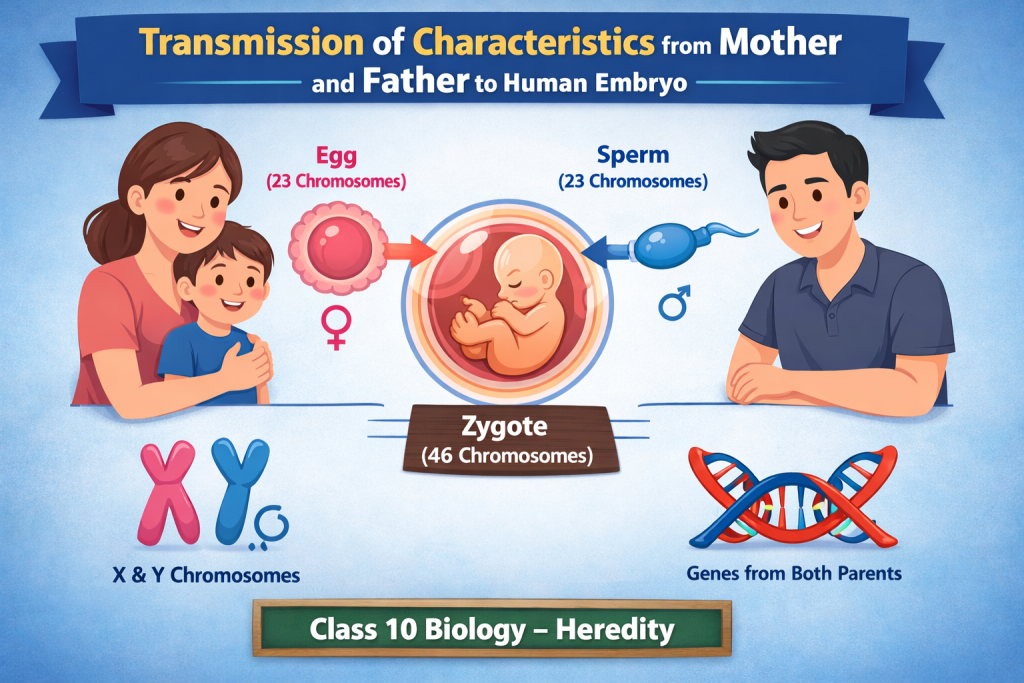
In humans, the process begins with the formation of gametes. The father produces sperm and the mother produces ovum. Each gamete is haploid, which means it carries only 23 chromosomes.
These chromosomes contain genes that carry information for different traits. This step is important because it ensures that the child receives genetic material from both parents.
Fertilisation and Zygote Formation
During fertilisation, the sperm and ovum fuse with each other. This fusion forms a single cell called a zygote.
At this stage, the number of chromosomes becomes complete again. The zygote now has 46 chromosomes, restoring the diploid condition. This is the base of chromosomes inheritance, where traits from both parents come together in one cell.
Role of Chromosomes and Genes
Chromosomes carry genes, and genes decide the characteristics of a child. Humans have X and Y chromosomes, which also play a role in deciding the sex of the baby.
Both parents contribute equally to this process. One set of chromosomes comes from the mother and one from the father. This explains how do the characteristics of mother and father get transmitted in a human embryo in a balanced way.
For students and parents, this concept helps explain why a child may look like both parents and not just one.
Why Does a Child Resemble Both Parents?
Role of genes from both parents
A child resembles both parents because genes from mother and father come together during fertilisation. These genes combine in different ways, which makes every child unique. The mixing of genes happens naturally and cannot be fully predicted.
Dominant and recessive traits
Some genes are stronger and show their effect easily. These are called dominant traits. Other genes may stay hidden and are called recessive traits. A trait will appear in the child depending on how these genes combine.
Everyday examples
Eye colour, hair type, and height are common examples. A child may have the mother’s eye colour and the father’s height. This is why children often show a mix of features from both sides of the family.
How to Write This Answer in Class 10 Board Exams
Ideal answer length
For board exams, students should write this answer in 3-5 clear points. Each point should be short and to the point. Parents can guide students to avoid writing long paragraphs and focus on correct steps.
Keywords examiners expect
Examiners look for terms like gametes, fertilisation, zygote, chromosomes, and genes. Using these words correctly shows that the concept is understood.
Simple structure to follow
Start by mentioning the role of mother and father. Then explain the formation of gametes, fertilisation, and how traits are passed. End with a short line on equal contribution from both parents.
FAQs on Characteristics of Mother and Father
Q. Is this question important for Class 10 board exams?
Yes. This question is part of Class 10 Biology – Heredity and Evolution. It is often asked in short and long answers. Students should prepare it properly, as it checks basic understanding of inheritance.
Q. How do the characteristics of mother and father get transmitted in a human embryo class 10?
In Class 10 level, the answer focuses on gametes, fertilisation, and chromosomes. Traits are passed when sperm and ovum combine to form a zygote carrying genes from both parents.
Q.Do both parents contribute equally to a child’s traits?
Yes. One set of chromosomes comes from the mother and one from the father. This equal sharing explains why children show features of both parents.
Q. What is the role of X and Y chromosomes in inheritance?
X and Y chromosomes decide the sex of the child. They also carry genes that influence certain traits. The combination depends on which chromosome comes from the father.
Q. Can acquired traits be passed to the next generation?
No. Traits developed due to habits or environment, like muscle strength or skills, are not inherited. Only traits controlled by genes are passed on.
Q. What characteristics come from mom and dad?
Traits such as eye colour, height tendency, and blood group come from both parents. The final feature depends on how genes combine.
Q. Is this topic asked in competitive exams?
Yes. Basic questions from heredity are asked in exams like NTSE and foundation-level tests. Understanding the concept helps beyond board exams.
Q. Why do parents and students often get confused in this topic?
The confusion usually comes from mixing biological traits with daily habits. This topic only deals with genetic traits, not behaviour or upbringing.