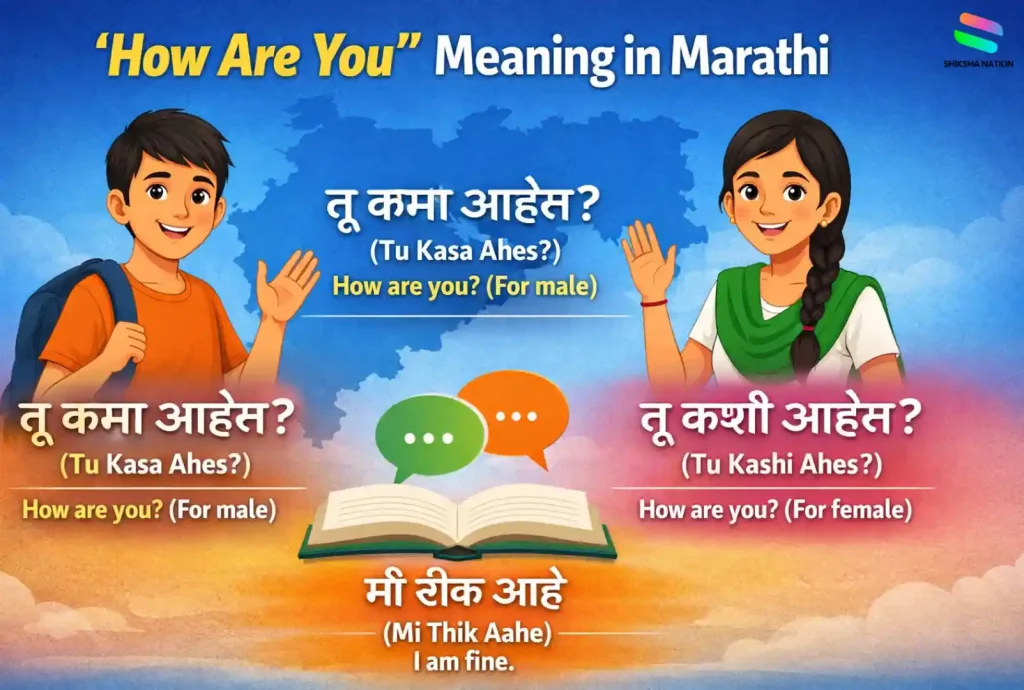
How to Say “How Are You” in Marathi
In daily conversations, Marathi speakers use slightly different forms of this greeting based on gender and respect. Understanding these small differences helps students use the language correctly.
Here are the common ways to say it:
| English |
Marathi |
Pronunciation |
| How are you |
तू कसा आहेस |
Tu kasa ahes |
| How are you (female) |
तू कशी आहेस |
Tu kashi ahes |
| How are you (formal) |
तुम्ही कसे आहात |
Tumhi kase aahat |
Simple points to remember:
- Use तू कसा आहेस when speaking to a male friend or classmate.
- Use तू कशी आहेस when speaking to a female friend.
- Use तुम्ही कसे आहात when speaking to elders, teachers, or respected people.
These variations help students understand the correct how are you Marathi translation used in everyday Marathi conversations.
How Are You in Marathi for Male and Female
In Marathi, greetings often change slightly depending on whether you are speaking to a male or a female. This is a common grammar rule in many Indian languages. Because of this, the sentence used for asking “How are you?” can be different for boys and girls.
For students learning basic Marathi phrases, understanding this difference helps in using the language correctly during conversations.
How Are You in Marathi for Male
When you ask a male friend, classmate, or younger person, the sentence commonly used is:
तू कसा आहेस
Pronunciation: Tu kasa ahes
Key points to remember:
- Used for boys or men
- Usually used in informal conversations
- Common among friends, classmates, or siblings
So, if a student wants to know how are you in marathi for male, this is the phrase most people use in daily conversations.
How Are You in Marathi for Female
When speaking to a female friend, sister, or classmate, the word changes slightly.
तू कशी आहेस
Pronunciation: Tu kashi ahes
Important points:
- Used when asking a girl or woman
- Only one word changes: कसा → कशी
- This change shows the gender of the person you are talking to
Students often search how are you in marathi to female to understand this small grammar difference.
How to Reply to “How Are You” in Marathi
After someone asks “How are you?”, the next step in conversation is giving a reply. In Marathi, the replies are simple and similar to English greetings.
Here are some common replies students usually learn first:
| English Reply |
Marathi Reply |
Pronunciation |
| I am fine |
मी ठीक आहे |
Mi thik aahe |
| I am good |
मी चांगला आहे |
Mi changla aahe |
| I am very well |
मी खूप छान आहे |
Mi khup chan aahe |
Simple things students should remember:
- मी ठीक आहे is the most common reply.
- It is used in daily conversations with friends, teachers, or family members.
- Marathi replies are usually short and polite, similar to English greetings.
For example:
- Person 1: तू कसा आहेस?
- Person 2: मी ठीक आहे.
Understanding these small responses helps learners know the how are you meaning in marathi reply and continue a simple conversation in Marathi. Students who are learning basic Indian languages also recognize that “I am fine meaning in Marathi” is मी ठीक आहे, which is one of the most commonly used responses.
Example Conversation Using “How Are You” in Marathi
Learning a phrase becomes easier when students see how it is used in a real conversation. The greeting “How are you?” is commonly used when friends, classmates, or relatives meet.
Here is a simple example:
Person 1: Hi, how are you?
Person 2: मी ठीक आहे, तू कसा आहेस?
Meaning in English:
- Person 1 is asking about the other person’s well-being.
- Person 2 replies “I am fine” and politely asks the same question back.
Students often see this type of greeting in school language lessons or while talking with friends from Maharashtra.
Another simple example:
Person 1: Hi!
Person 2: नमस्कार, तुम्ही कसे आहात?
This example helps learners understand how are you meaning in marathi with example, making it easier to remember the phrase in daily conversations.
How R U in Marathi (Informal Chat Meaning)
In text messages and social media chats, people often shorten sentences. Instead of writing the full sentence “How are you?”, many students type “How r u?”
In Marathi conversations, the meaning remains the same.
Example:
How r u → Marathi meaning → तू कसा आहेस
Important things to know:
- Used mainly in WhatsApp or online chats
- Common among friends or classmates
- It is an informal way of greeting someone
So, when students search how r u in marathi, they are usually looking for the Marathi form of this short texting phrase.
Why Students Learn Basic Marathi Phrases
Learning simple Marathi phrases helps students communicate better with people who speak the language. Many children study or travel in different parts of India, so knowing basic greetings can make conversations easier and more comfortable.
Some benefits of learning basic Marathi phrases include:
- Improved communication: Students can greet friends, neighbours, or classmates who speak Marathi.
- Language learning skills: Understanding small phrases helps children learn how different Indian languages work.
- Cultural understanding: Greetings like “How are you?” are part of daily social interaction in Maharashtra.
- Useful for school learning: Many schools introduce regional languages or basic translation exercises, where such phrases are commonly used.
For parents, encouraging children to learn simple greetings can also help them feel more confident when interacting with people from different regions.
Quick Summary
Here are the key points students should remember about this Marathi greeting:
- “How are you” in Marathi can be said as तू कसा आहेस (for male) or तू कशी आहेस (for female).
- A respectful form used for elders or teachers is तुम्ही कसे आहात.
- This phrase is commonly used when greeting someone and asking about their well-being.
- A common reply is मी ठीक आहे, which means “I am fine.”
- These phrases are often used in daily conversations, school language lessons, and friendly greetings.
Learning small expressions like this helps students understand how basic conversations work in Marathi.
FAQs About “How Are You” Meaning in Marathi
Q. What is the Marathi meaning of “How are you”?
The Marathi meaning of “How are you” is a greeting used to ask about someone’s well-being. It can be said as तू कसा आहेस (Tu kasa ahes) for a male and तू कशी आहेस (Tu kashi ahes) for a female. When speaking respectfully to elders or teachers, people usually say तुम्ही कसे आहात (Tumhi kase aahat).
Q. How do you say “How are you” in Marathi language?
In Marathi, “How are you” can be expressed in a few simple ways depending on the situation. Common examples include तू कसा आहेस for a male friend and तू कशी आहेस for a female friend. For elders or respected people, speakers often say तुम्ही कसे आहात, which sounds more polite and formal.
Q. What is the reply to “How are you” in Marathi?
A common reply to “How are you?” in Marathi is मी ठीक आहे (Mi thik aahe), which means “I am fine.” Other replies include मी चांगला आहे meaning “I am good” and मी खूप छान आहे meaning “I am very well.” These short responses are often used in everyday conversations among friends and family.
Q. What does “I am fine” mean in Marathi?
The Marathi meaning of “I am fine” is मी ठीक आहे (Mi thik aahe). It is one of the most common replies used after someone asks “How are you?” Students often learn this phrase early while studying simple greetings in different Indian languages or practising small conversations in language lessons.
Q. What is “Hi how are you” in Marathi?
The sentence “Hi, how are you?” can be translated into Marathi as नमस्कार, तू कसा आहेस? when speaking to a male friend. For a female friend, it becomes नमस्कार, तू कशी आहेस? In respectful situations, people may say नमस्कार, तुम्ही कसे आहात? which sounds polite and appropriate for elders.
Q. Is there a formal way to say “How are you” in Marathi?
Yes, Marathi has a respectful form used for elders, teachers, or people you do not know well. Instead of using तू कसा आहेस, speakers usually say तुम्ही कसे आहात (Tumhi kase aahat). This form shows politeness and respect, which is an important part of communication in many Indian languages.
Q. Why does “How are you” change for male and female in Marathi?
In Marathi grammar, some words change depending on the gender of the person being addressed. That is why the greeting becomes कसा आहेस for a male and कशी आहेस for a female. This small change helps the sentence match the person you are talking to.
Q. Can students use Marathi greetings in daily conversation?
Yes, students can easily use basic Marathi greetings when talking with friends, neighbours, or classmates who speak the language. Simple phrases like तू कसा आहेस and मी ठीक आहे help beginners practise small conversations and understand how everyday greetings work in Marathi communication.