

In Class 11 Chemistry, students study how substances behave when different phases interact with each other. One such important interaction is the solubility of gases in liquids, which plays a key role in understanding equilibrium systems. When a gas comes in contact with a liquid, a part of it dissolves until a balance is established between the gas phase and the dissolved state.
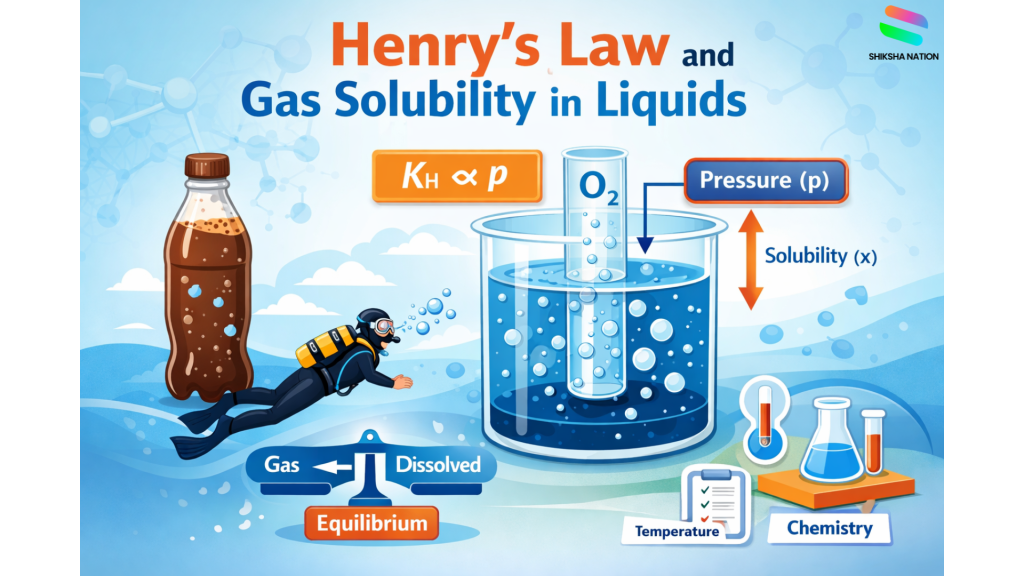
In chemistry, this behaviour is not random but governed by well-defined principles. Henry’s Law explains how the amount of a gas that dissolves in a liquid depends on external conditions, particularly pressure, when temperature is kept constant. This law forms an essential part of physical chemistry and helps students link theoretical concepts with observable behaviour in real systems.
Before studying its mathematical form, it is important to understand Henry’s Law in chemistry as a conceptual rule that connects pressure, solubility, and equilibrium. This provides a clear foundation for its formal statement and explanation.
What Is Henry’s Law?
Henry’s Law is a fundamental principle of physical chemistry that describes the behaviour of gases when they come in contact with liquids. It explains how a gas dissolves in a liquid phase under specific conditions and helps in understanding gas–liquid equilibrium systems studied in Class 11 Chemistry. The law applies when temperature remains constant and the gas does not react chemically with the liquid.
In simple terms, Henry’s Law shows that the extent to which a gas dissolves in a liquid is controlled by the pressure exerted by that gas. This relationship allows chemists to predict and compare the solubility of different gases in liquids under varying pressure conditions.
Statement of Henry’s Law
Henry’s Law states that at a constant temperature, the solubility of a gas in a liquid is directly proportional to the partial pressure of the gas above the liquid.
This statement is commonly used in examinations to state Henry’s Law or explain Henry’s Law in a clear and precise manner, as prescribed in NCERT.
Explanation of Henry’s Law
Henry’s Law describes how a gas behaves when it comes in contact with a liquid and gradually dissolves until a stable condition is reached. When a gas is present above a liquid surface, its molecules continuously enter the liquid while some dissolved molecules escape back into the gaseous phase. This two-way movement continues until an equilibrium is established between the gas phase and the liquid phase.
At constant temperature, the extent to which a gas remains dissolved depends on how strongly the gas phase presses on the liquid surface. A higher pressure forces more gas molecules into the liquid, while a lower pressure allows dissolved gas to escape. This behaviour explains why the amount of gas retained in a liquid changes with pressure.
Relationship Between Pressure and Solubility
The partial pressure of a gas above a liquid plays a decisive role in determining how much of that gas dissolves. As the pressure of the gas increases, the number of gas molecules entering the liquid also increases, making the solubility proportional to pressure.
This leads to a dynamic balance known as equilibrium between gas and liquid, where the rate of gas dissolving equals the rate of gas escaping. This relationship forms the basis for understanding how gases dissolved in liquids respond to changes in pressure under constant temperature conditions.
Mathematical Expression of Henry’s Law
The relationship described by Henry’s Law can be expressed in a mathematical form to show how the solubility of a gas depends on pressure. When temperature is kept constant, the amount of gas dissolved in a given volume of liquid increases in direct proportion to the pressure exerted by the gas above the liquid. This proportional relationship helps in comparing gas solubility under different pressure conditions in a systematic way.
To represent this relationship quantitatively, a proportionality constant is introduced. This allows the law to be written in an equation form, making it useful for conceptual understanding as well as numerical applications studied in higher classes.
Henry’s Law Constant
The proportionality constant used in the equation is known as the Henry’s law constant. It represents the tendency of a particular gas to dissolve in a particular liquid at a fixed temperature. Different gas–liquid pairs have different values of this constant.
The units of this constant vary depending on how pressure and solubility are expressed. Its value depends on the nature of the gas, the nature of the liquid, and the temperature, indicating that gas solubility is not the same for all systems.
Factors Affecting Solubility of Gases in Liquids
The extent to which a gas dissolves in a liquid does not remain constant under all conditions. Several factors influence this process, and understanding them helps students apply the concept correctly while solving numerical problems. These factors explain why the same gas may show different solubility behaviour in different situations.
Effect of Pressure
An increase in pressure applied by a gas above a liquid forces more gas molecules into the liquid phase. As pressure rises, the frequency of gas molecules striking the liquid surface increases, leading to greater dissolution. This effect is most significant when temperature remains constant.
Effect of Temperature
In general, the solubility of gases in liquids decreases with an increase in temperature. Higher temperature provides more kinetic energy to gas molecules, allowing them to escape more easily from the liquid phase into the gaseous state.
Nature of Gas and Liquid
The nature of the gas and the liquid also influences solubility. Gases that interact weakly with the liquid dissolve less, while gases with higher affinity for the liquid show greater solubility. Similarly, different liquids vary in their ability to dissolve gases.
Examples of Henry’s Law in Daily Life
Henry’s Law is not limited to laboratory systems; it also explains several familiar processes observed in everyday life. These real-world situations help students connect abstract chemical principles with observable phenomena. By understanding such cases, the application of gas solubility concepts becomes clearer and more meaningful.
Carbonated Beverages
In soft drinks and soda water, carbon dioxide gas is dissolved in the liquid under high pressure during bottling. Under these conditions, a large amount of gas remains dissolved in the liquid phase.
When the bottle is opened, the pressure above the liquid suddenly decreases. As a result, the dissolved gas escapes in the form of bubbles, producing the characteristic fizz seen in carbonated beverages.
Deep-Sea Diving and Bends
During deep-sea diving, a diver is exposed to high external pressure, which increases the solubility of nitrogen from the breathing air into the blood. Under these conditions, nitrogen remains dissolved in body fluids.
If the diver ascends too quickly, the pressure decreases rapidly. The dissolved nitrogen then comes out of solution as bubbles, causing a painful and dangerous condition known as the bends.
Solved Conceptual Questions Based on Henry’s Law
Solved questions based on Henry’s Law help students understand how the law is applied in real situations commonly asked in board examinations. Such questions usually test whether the student can connect pressure, temperature, and gas solubility without relying only on definitions. This section first explains the concept qualitatively and then shows how the same situation can be handled numerically.
Oxygen Is Bubbled Through Water at 293 K
Question:
O₂ is bubbled through water at 293 K. Explain what happens using Henry’s Law.
Conceptual Explanation:
When oxygen gas is bubbled through water at a constant temperature of 293 K, oxygen molecules start dissolving into the water. At the same time, some dissolved oxygen molecules escape back into the gaseous phase. This continuous process continues until a balance is established between the gas present above the liquid and the gas dissolved in it.
Henry’s Law explains that, at constant temperature, the amount of gas dissolved in a liquid depends on the pressure exerted by that gas. As oxygen is bubbled continuously, its pressure above the water surface increases, which forces more oxygen molecules into the liquid. Dissolution continues until equilibrium is reached, after which the solution becomes saturated.
Numerical Solution (For Better Understanding)
According to Henry’s Law,
p = Kₕ × x
where
p = partial pressure of oxygen
Kₕ = Henry’s law constant
x = mole fraction of oxygen in water
Given:
p = 0.98 bar
Kₕ = 34 × 10³ bar
So,
x = p / Kₕ
x = 0.98 / (34 × 10³)
x ≈ 2.9 × 10⁻⁵
For 1 litre of water, the number of moles of water is approximately 55.5 mol.
Moles of O₂ dissolved
= 2.9 × 10⁻⁵ × 55.5
≈ 1.6 × 10⁻³ mol
Molar mass of O₂ = 32 g mol⁻¹
Solubility of O₂ in water
= 1.6 × 10⁻³ × 32
≈ 0.05 g L⁻¹
Final Result:
The solubility of oxygen in water at 293 K under the given conditions is 0.05 g L⁻¹.
Importance of Henry’s Law in Chemistry
Henry’s Law holds significant importance in chemistry because it explains the fundamental behaviour of gases when they come in contact with liquids. This understanding is essential for analysing systems in which gases and liquids coexist, especially under varying pressure conditions. It provides a clear link between external conditions and the amount of gas that remains dissolved in a liquid.
In physical chemistry, this law helps students interpret gas–liquid equilibrium and predict how changes in pressure affect solubility. It forms a conceptual bridge between theoretical principles and practical observations, strengthening the study of solution behaviour.
Henry’s Law is also closely connected to equilibrium studies in Class 11 Chemistry. It supports the broader idea that chemical systems adjust to maintain balance, making it an important foundation for learning advanced topics related to equilibrium and solution chemistry.
Summary of Henry’s Law
- Henry’s Law explains how gases dissolve in liquids under constant temperature conditions.
- The amount of gas dissolved depends on the pressure exerted by the gas above the liquid.
- An increase in pressure increases gas solubility, while a decrease in pressure reduces it.
- A proportionality constant is used to represent the pressure–solubility relationship for a given gas–liquid system.
- The law is important for understanding gas–liquid equilibrium in physical chemistry.
- It provides a conceptual foundation for solving board-level and competitive exam questions.
Frequently Asked Questions (Exam-Oriented)
Q. Is Henry’s Law applicable at high temperatures?
Henry’s Law is applicable only when the temperature of the system remains constant. At high temperatures, gas molecules gain higher kinetic energy and tend to escape more easily from the liquid phase. As a result, the simple pressure–solubility relationship described by the law does not hold accurately. Therefore, in examinations, Henry’s Law is always considered under constant temperature conditions.
Q. Why does gas solubility decrease with increase in temperature?
The dissolution of most gases in liquids is an exothermic process. When temperature increases, the added heat provides energy to the dissolved gas molecules, enabling them to overcome attractive forces and escape into the gaseous phase. This is why gas solubility generally decreases with rise in temperature, even if pressure remains unchanged.
Q. In which chapter is Henry’s Law studied in Class 11?
In Class 11 Chemistry, Henry’s Law is studied in the chapter “Equilibrium” under the topic related to solutions and gas solubility. It forms part of physical chemistry and is linked with concepts of dynamic equilibrium and solution behaviour.
Q. Does Henry’s Law apply to all gases?
Henry’s Law is applicable mainly to gases that do not react chemically with the liquid in which they dissolve. Gases such as oxygen and nitrogen follow the law reasonably well, whereas gases like ammonia or hydrogen chloride show deviations because they undergo chemical interactions with water.
Q. Why is partial pressure important in Henry’s Law?
Partial pressure represents the effective pressure exerted by a particular gas in a mixture. Henry’s Law relates gas solubility specifically to this pressure because it determines how frequently gas molecules strike the liquid surface. Higher partial pressure leads to greater dissolution of the gas.
Q. Is Henry’s Law valid for highly soluble gases?
For highly soluble gases, Henry’s Law shows deviations because such gases tend to interact strongly with the liquid. In these cases, chemical effects dominate over physical dissolution, making the law less accurate. This limitation is often highlighted in conceptual questions.
Q. How is Henry’s Law useful in equilibrium studies?
Henry’s Law supports the idea of dynamic equilibrium between the gas phase and the dissolved state. It shows that equilibrium shifts in response to pressure changes, helping students understand how physical systems adjust to external conditions.
Q. Is Henry’s Law important for numerical problems in exams?
Yes, Henry’s Law is frequently used in numerical questions where pressure, mole fraction, or solubility is calculated. A clear understanding of the concept and its mathematical form helps students solve such problems accurately in board and competitive examinations.