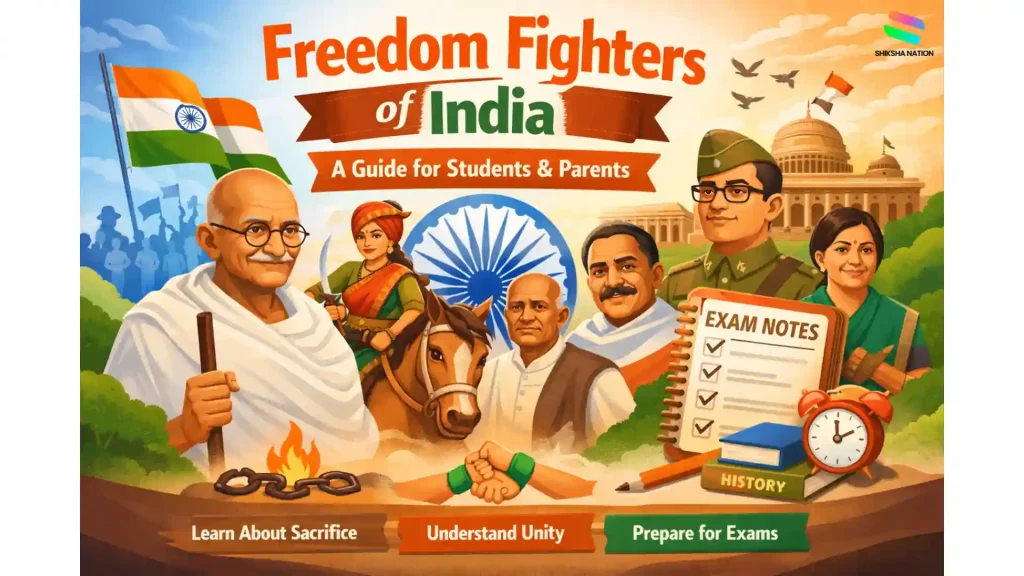
The freedom fighters of India are an important part of school history for Classes 6-10. These were the people who worked for many years to free India from British rule. They came from different regions and backgrounds but shared one goal-an independent India.
For students, this topic helps in understanding how the nation was formed and why freedom was not easy to achieve. It explains the meaning of sacrifice, unity, and responsibility in a simple way. Many questions in history exams are directly based on this chapter.
For parents, this topic supports value-based learning. It helps children learn respect for the country and understand the efforts made by earlier generations. Knowing about Indian freedom fighters also improves a child’s general knowledge and confidence during exams.
This guide is freedom fighters of India explained for students, written in clear and easy language. It focuses on important names, their contributions, and exam-relevant points. The content is aligned with the school syllabus and helps students revise better without confusion.
This way, students learn with clarity, and parents can trust the learning process.
Book a Counseling Session
Freedom fighters of India explained for students with key leaders, values, and exam-focused learning
Who Are Freedom Fighters of India?
Indian freedom fighters were people who worked to make India free from British control. They did not belong to one group or profession. Some were students, some were teachers, lawyers, farmers, and even common villagers. What united them was their love for the country and their wish to see India govern itself.
These people worked during different periods and followed different paths. Some believed in peaceful methods like meetings, marches, and protests. Others felt that strong action was needed to oppose unfair laws. Together, they became the leaders of India’s freedom struggle, guiding people to stand together against injustice.
For students, this topic explains who helped shape India’s future. It shows that freedom did not come suddenly but was earned through long and continuous efforts. For parents, it teaches children values such as courage, honesty, and responsibility toward the nation.
Freedom fighters can be understood as:
People who opposed foreign rule for the nation’s good
Individuals who inspired others to join the freedom movement
Leaders who worked selflessly without thinking of personal gain
Their efforts slowly prepared India for independence.
Why Are They Called Freedom Fighters?
They are called freedom fighters because they fought to make India free. Their actions were against unfair rules and foreign control.
During the struggle against British rule:
Many faced jail and punishment
Some gave up comfort and safety
All worked for the country’s freedom
Because they risked everything for independence, history remembers them as freedom fighters.
Why Freedom Fighters Are Important in Indian History
The role of freedom fighters is very important in Indian history because they changed the direction of the country. Without their efforts, India would not have become a free nation. They helped people understand their rights and encouraged them to stand against unfair control.
The contribution to India’s independence was made through years of hard work and sacrifice. Freedom fighters brought people together from different regions, languages, and communities. They created a sense of unity and confidence among Indians.
For students, this topic explains how ordinary people can create big changes through determination. For parents, it helps children learn values like discipline, bravery, and respect for the nation.
Freedom fighters were important because they:
Raised awareness against injustice
Motivated people to participate in national movements
Built a strong foundation for a free and democratic India
Showed the power of unity and sacrifice
Their actions slowly weakened foreign control and prepared India for self-rule.
Connection with the Indian Independence Movement
Freedom fighters played active roles in major national movements.
Non-Cooperation Movement encouraged people to stop supporting British institutions.
Civil Disobedience Movement showed how unfair laws could be challenged peacefully.
Quit India Movement united Indians with a clear demand for freedom.
These movements show how organised efforts led India towards independence.
Famous Freedom Fighters of India (20 Leaders Students Must Know)
Learning about famous freedom fighters of India helps students clearly understand how India achieved independence through different ideas, methods, and leadership styles. For Classes 6-10, schools focus on selected leaders whose lives explain the freedom struggle in a simple and exam-friendly way.
This section is designed as famous freedom fighters of India for Class 6-10, where each name is explained briefly. Parents can use this list for quick revision, while students can remember key points without confusion.
National Leaders Who Shaped India’s Freedom Struggle
Mahatma Gandhi He led the freedom struggle through truth and non-violence. His methods inspired millions of Indians to participate peacefully.
Jawaharlal Nehru He played a major role during the final phase of the freedom struggle and later helped shape independent India’s future.
Subhas Chandra Bose He believed freedom needed strong action. He motivated Indians abroad and organised forces to fight British rule.
Bhagat Singh A young revolutionary known for his courage and sacrifice. He became a symbol of bravery among Indian youth.
Sardar Vallabhbhai Patel He supported national movements and later helped unite different regions into one strong nation.
Bal Gangadhar Tilak He awakened national awareness through his writings and speeches. He strongly demanded self-rule for Indians.
Lala Lajpat Rai He actively opposed British policies and inspired people through protests and public movements.
Bipin Chandra Pal He encouraged the use of Indian goods and promoted national education and self-respect.
Dadabhai Naoroji He explained how British rule affected India’s economy and demanded fair governance.
Rajendra Prasad He supported the freedom movement and worked closely with national leaders during important phases.
Lal Bahadur Shastri He joined the freedom struggle at a young age and believed in honesty and simplicity.
Chandra Shekhar Azad A fearless revolutionary who chose freedom over capture and became a symbol of courage.
Ram Prasad Bismil He inspired people through patriotic writings and took part in revolutionary activities.
Maulana Abul Kalam Azad He promoted unity and education and played an important role in national leadership.
Sarojini Naidu She inspired people through speeches and represented women’s participation in the freedom struggle.
Annie Besant She supported Indian self-rule and encouraged national awareness through education and activism.
Gopal Krishna Gokhale He believed in gradual reform and guided young leaders with his ideas.
Rash Behari Bose He worked from outside India to support revolutionary efforts against British rule.
Sri Aurobindo He inspired national thought through his writings and early revolutionary activities.
Khan Abdul Ghaffar Khan He promoted peace and unity and supported non-violent methods for freedom.
These leaders help students understand that India’s freedom came through sacrifice, unity, and strong leadership.
Women Freedom Fighters of India (10 Important Names)
Women freedom fighters of India played a strong and meaningful role in the country’s struggle for independence. At a time when women had limited public roles, many stepped forward with courage and confidence. They led movements, organised protests, and inspired people across the country.
For students, learning about women freedom fighters shows that India’s freedom struggle was inclusive. For parents, this section helps children understand equality, leadership, and social change through real examples.
Women Who Played a Key Role in the Freedom Struggle
Rani Lakshmibai She led armed resistance against British forces and became a symbol of bravery and sacrifice.
Sarojini Naidu She motivated people through speeches and leadership and represented women in national movements.
Kasturba Gandhi She actively supported national movements and faced imprisonment during protests.
Annie Besant She promoted self-rule and spread national awareness through education and public work.
Aruna Asaf Ali She showed courage by leading protests during critical phases of the freedom struggle.
Begum Hazrat Mahal She played a key role in opposing British control during the uprising of 1857.
Kamaladevi Chattopadhyay She encouraged women’s participation and supported social reform along with national causes.
Usha Mehta She helped spread messages of freedom using underground communication methods.
Matangini Hazra She continued to lead protests despite danger and became a symbol of determination.
Vijaya Lakshmi Pandit She represented India internationally and supported the freedom movement through leadership.
Why Women Freedom Fighters Are Important
Women freedom fighters are important because:
They are included in school textbooks and exams
Questions often ask to name or explain their contributions
They teach students about courage, equality, and leadership
Understanding their role helps students prepare confidently for exams and life.
Unsung Heroes of Indian Freedom Struggle (10 Names)
The unsung heroes of Indian freedom struggle are those brave individuals whose efforts are not widely discussed but were deeply important. They worked at the local level, organised people, and stood against British rule without expecting recognition.
For students, learning about these heroes shows that freedom was not achieved by famous leaders alone. For parents, this section helps children learn values like honesty, service, and responsibility.
Freedom Fighters Not Often Highlighted in Textbooks
Alluri Sitarama Raju He led tribal people in resisting British laws and inspired local movements in forest regions.
Birsa Munda He worked for the rights of tribal communities and opposed unfair land rules.
Matangini Hazra She continued to lead protests with courage and became a symbol of determination.
Kanaklata Barua She showed fearless leadership at a young age while participating in national movements.
Peer Ali Khan He spread messages of freedom secretly and helped organise resistance efforts.
Tirot Sing He united tribal groups to oppose British control in hilly regions.
Rani Gaidinliu She guided people to resist foreign rule and preserve local culture.
Puli Thevar He led early resistance against company control in southern regions.
Veeran Sundaralingam He supported early leaders and fought bravely against British forces.
Bagha Jatin He organised revolutionary activities and inspired youth through his courage.
Why Students Should Know About Unsung Heroes
Students should know about unsung heroes because:
It encourages learning beyond popular names
It highlights teamwork and local leadership
It supports value-based education by teaching dedication and sacrifice
Knowing these stories helps students understand that every effort matters in building a nation.
First / Early Freedom Fighters of India (10 Names)
The first freedom fighters of India were the early leaders who opposed British control even before the national freedom movement became organised. Their resistance showed that Indians were not willing to accept unfair foreign rule from the very beginning.
For students, this section explains how the idea of freedom started growing in different regions. For parents, it helps children understand that India’s struggle for independence began much earlier than 1857.
Early Resistance Against British Rule
Mangal Pandey He challenged British authority as a soldier and inspired others to resist unfair control.
Rani Chennamma She led armed resistance to protect her kingdom and became one of the earliest women leaders.
Pazhassi Raja He used local support and strategy to oppose British forces in forest regions.
Veerapandiya Kattabomman He refused to accept British authority and stood firmly for local independence.
Velu Nachiyar She organised resistance and fought against company control with courage and planning.
Kunwar Singh He led soldiers and common people in resisting British forces during early uprisings.
Tatya Tope He played an important role in organising resistance and leading forces during conflicts.
Begum Hazrat Mahal She led opposition against British control and protected the interests of her region.
Sidhu & Kanhu They led tribal resistance against unfair laws and inspired people to fight injustice.
Dheeran Chinnamalai He organised local resistance and stood strongly against foreign authority.
These early fighters laid the foundation for India’s larger freedom movement.
Freedom Fighters of India – Exam Notes (Consolidated List)
These freedom fighters of India notes are created for quick revision before school exams. The list includes important names that commonly appear in Class 6–10 history papers. Each freedom fighter is explained in one clear line to help students remember easily.
For students, this section works like last-minute notes. For parents, it helps in checking revision without confusion. This list of freedom fighters of India focuses only on exam-relevant information.
Consolidated List: Freedom Fighters of India and Their Contributions
Freedom Fighter
One-Line Contribution
Mahatma Gandhi
Led India’s freedom struggle through non-violence and mass movements
Jawaharlal Nehru
Guided the nation during the final phase of independence
Subhas Chandra Bose
Organised Indian forces to fight British rule from outside India
Bhagat Singh
Became a symbol of courage and sacrifice among Indian youth
Sardar Vallabhbhai Patel
Strengthened national unity and leadership
Bal Gangadhar Tilak
Spread national awareness and demanded self-rule
Rani Lakshmibai
Led armed resistance against British forces
Sarojini Naidu
Inspired people through leadership and speeches
Dadabhai Naoroji
Explained economic impact of British rule on India
Chandra Shekhar Azad
Represented fearless revolutionary spirit
Ram Prasad Bismil
Inspired people through patriotic writing and action
Annie Besant
Supported self-rule and national education
Birsa Munda
Worked for tribal rights and opposed unfair control
Mangal Pandey
Inspired early resistance against British authority
Begum Hazrat Mahal
Led opposition during early uprisings
How to Use These Notes for Exams
Read the table daily for quick memory
Focus on name + one contribution
Useful for short answers and objective questions
These notes are designed specially as freedom fighters of India for school exams, keeping revision simple and effective.
FAQ’s on Freedom Fighters of India
Q. Who are the top 10 freedom fighters of India?
The top 10 freedom fighters of India usually include Mahatma Gandhi, Jawaharlal Nehru, Subhas Chandra Bose, Bhagat Singh, Sardar Vallabhbhai Patel, Rani Lakshmibai, Bal Gangadhar Tilak, Lala Lajpat Rai, Sarojini Naidu, and Chandra Shekhar Azad. These names are commonly taught in schools.
Q. Why are freedom fighters important for students?
Freedom fighters help students understand how India became free. Their stories teach courage, discipline, unity, and responsibility. Many exam questions are also based on their contributions, making this topic important for both learning and scoring well.
Q. How many freedom fighters should students remember for exams?
Students should focus on 15-20 important names. Knowing the names of freedom fighters of India along with one key contribution for each is enough to answer most school exam questions confidently.
Q. What is the easy explanation of freedom fighters of India?
Freedom fighters of India were people who worked to free the country from British rule. They used peaceful protests, leadership, and sacrifice to help India become an independent nation.
Q. Are women freedom fighters important for exams?
Yes, women freedom fighters are important for exams. Schools often ask questions about leaders like Rani Lakshmibai and Sarojini Naidu to highlight women’s role in the freedom struggle.
Q. Why are unsung heroes included in school history?
Unsung heroes show that freedom was achieved through teamwork. Learning about them helps students go beyond popular names and understand that many people contributed to India’s independence.
Q. How can parents help children learn this topic better?
Parents can help by asking children to revise names daily, discuss one contribution per freedom fighter, and connect lessons with values like honesty, courage, and respect for the nation.
Conclusion
Learning about the freedom fighters of India for students is not only a history lesson but also a way to understand how the nation was built. These stories help students learn about courage, unity, and responsibility in a simple and meaningful way.
This guide has presented freedom fighters of India explained for students with clear names, short contributions, and exam-focused points. It is designed to help students remember important facts without confusion or extra pressure.
For parents, this content supports guided learning at home. It makes revision easier and helps children build confidence before exams. For students, it provides a clear path to score better by understanding key names and ideas.
To revise effectively:
Focus on names with one main contribution
Read notes regularly instead of memorising at the last moment
Connect lessons with values and real-life learning
With the right approach, students can learn history with confidence and clarity.