

Introduction
Why fractions need regular practice in Class 6
Fractions is one of the first chapters in Class 6 Maths where students move from whole numbers to parts of a whole. Many students understand the idea in class but feel confused while doing homework or revision. This is where regular and guided practice becomes important.
Using a fraction worksheet for class 6 helps students practise concepts step by step, without pressure. It also allows parents to see clearly what the child has understood and where help is needed.
How this worksheet helps students and parents
This page is created for daily practice, homework support, and exam revision. The questions follow the same learning flow as the NCERT Class 6 Maths Fractions chapter, so students practise exactly what is taught in school.
The worksheet on fractions for class 6 focuses on understanding concepts like equal parts, number line, and simple operations, instead of memorising rules. Parents can easily sit with the child and revise using these questions.

Sample practice questions (for understanding)
Students may come across questions like these in worksheets:
- Write the fraction for one part of a shape divided into 4 equal parts
- Shade 3/5 of a given figure
- Write the numerator and denominator of 7/9
- Mark 1/2 on a number line
- Convert 6/3 into a whole number
- Write one equivalent fraction of 2/4
- Compare 3/8 and 1/8
- Add 1/4 + 2/4
- Subtract 5/6 − 1/6
- Solve a simple fraction word problem
These examples show the type of practice students need to become confident in fractions.

Class 6 Maths Fractions Chapter Overview (NCERT)
How the Fractions chapter is structured
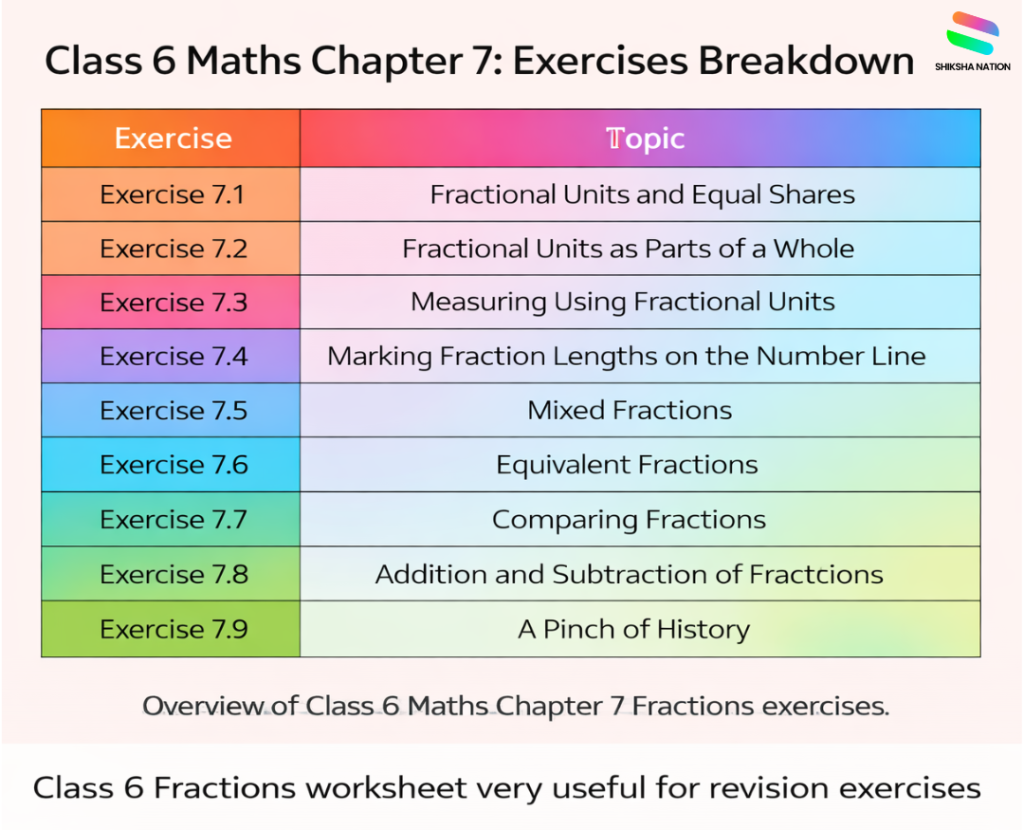
The Fractions chapter in Class 6 Maths is planned in a gradual and student-friendly way. It begins with very basic ideas, such as sharing objects equally, and slowly moves towards solving fraction sums. This step-by-step flow helps students build confidence instead of feeling confused.
As students move ahead, they learn how fractions are shown on a number line, how mixed fractions work, and how different fractions can represent the same value. In the later part of the chapter, the focus shifts to comparing fractions and doing simple addition and subtraction.
This clear learning order makes a class 6 fractions worksheet very useful for practice and revision. Parents can also use this flow to understand which topic their child is studying and where extra help may be needed.
The image below shows the topic flow of the Class 6 Maths Fractions chapter as per NCERT.
Sample exercises covered across the chapter
Students may practise questions such as:
- Divide a shape into equal parts and write the fraction
- Identify the numerator and denominator
- Measure a length using fractional units
- Mark a fraction on the number line
- Convert a mixed fraction into an improper fraction
- Find two equivalent fractions
- Compare two given fractions
- Arrange fractions in ascending order
- Add two like fractions
- Subtract one fraction from another
These examples reflect the type of practice students need throughout the chapter.
Understanding Fractions Through Equal Sharing
What equal sharing means in fractions
Fractions start with the simple idea of sharing things equally. When one object is divided into equal parts, each part is called a fractional unit. If the parts are not equal, they do not form a proper fraction. This basic idea is very important for Class 6 students.
Understanding equal sharing helps students see why fractions are written the way they are, instead of learning rules by heart.
Learning fractional units with daily-life examples
Students often understand fractions better when they see them in real life. Sharing a chocolate, a roti, or a pizza into equal pieces makes the concept clear. Each equal piece represents a part of the whole.
This section of the fractions worksheet for class 6 focuses on helping students connect fractions with real situations they see every day.
Worksheet practice for equal sharing
The worksheet questions in this part are simple and visual.
Students will practise:
- Identifying equal and unequal parts
- Shading the correct fraction of a shape
- Writing fractions based on pictures
These activities build a strong base before moving to harder fraction topics.
Example exercises for practice
- A circle is divided into 4 equal parts. Write the fraction of one part.
- Shade 2 out of 5 equal parts of a rectangle.
- A chocolate is broken into 8 equal pieces. What fraction is one piece?
- Identify whether the parts shown are equal or not.
- Write the fraction shown by the shaded parts.
- A square is divided into 6 equal sections. Write the fraction of 3 sections.
- Colour one-half of a given shape.
- How many equal parts make one whole?
- Write the fraction for one slice of a pizza cut into 10 slices.
- Tick the correct fraction for the shaded figure.
Support for parents
Parents can ask children to explain how many equal parts are made before writing the fraction. If a child can explain this clearly, the concept is well understood.
Fractions as Parts of a Whole
Understanding the whole and its equal parts
A fraction always starts with one complete whole. When this whole is divided into equal parts, each part becomes a fraction. The number of parts taken and the total number of equal parts together decide the fraction.
In every fraction, the numerator tells how many parts are chosen, and the denominator tells how many equal parts the whole is divided into. Understanding this difference helps students read and write fractions correctly.
Learning through pictures and simple questions
Pictures make fractions easy to understand. When students see a shape divided into equal parts, they can clearly identify the whole and its parts. This section uses visual questions so students do not feel confused.
A good fraction class 6 worksheet includes picture-based and fill-in-the-blank questions that help students practise without stress.
Students will practise:
- Identifying the whole in a given figure
- Writing the numerator and denominator
- Completing missing numbers in fraction statements
Example exercises for practice
- A circle is divided into 8 equal parts. Write the fraction for 3 shaded parts.
- Identify the numerator and denominator in 5/9.
- Fill in the blank: 1 whole = ___ / 4
- A rectangle has 6 equal parts. Write the fraction for 1 part.
- Colour 4 out of 10 equal parts and write the fraction.
- Write the denominator if a whole is divided into 7 equal parts.
- Write the fraction shown in the picture.
- Fill in: 3/___ = three parts of a whole
- Identify the whole object in the given figure.
- Write the fraction name for 2/5.
Parent guidance
Parents can ask children to explain which part shows the whole and which shows the parts. Clear explanation means the concept is understood properly.
Measuring Using Fractional Units
How fractions are used in measurement
Fractions are often used when a full unit is too large to measure exactly. In this part of the chapter, students learn how a unit can be divided into equal parts and used for measuring length. For example, half a metre, one-fourth of a strip, or three-fourths of a rope.
This helps students understand that fractions are not only numbers but also tools used in real life.
Understanding measurement with simple examples
Instead of only reading values, students learn to measure and compare lengths using fractional units. They observe how smaller parts together make a whole unit. This builds accuracy and clear thinking.
Parents can help by showing measurements using books, pencils, or rulers at home.
Worksheet practice: length-based questions
The worksheet questions in this section focus on practical use.
Students will practise:
- Measuring given objects using fractional parts
- Comparing two lengths written as fractions
- Writing measurements in fraction form
Example exercises for practice
- Measure a ribbon that is half a metre long. Write the fraction.
- A pencil is 3/4 of a ruler. Write its length in fractions.
- Which is longer: 1/2 metre or 1/3 metre?
- Write the fraction for a strip cut into 5 equal parts.
- Measure 2 pieces of length, each 1/4 metre.
- Compare 3/4 metre and 2/4 metre.
- Write the total length of two pieces, each 1/6 metre.
- Identify the unit used in the measurement.
- Write the fraction shown on the scale.
- Draw a line of length 1/2 unit.
Parent support tip
Parents can ask children to explain how many parts make one unit. If the child explains clearly, it shows good understanding of fractional measurement.
Fractions on the Number Line
Understanding fractions using a number line
A number line helps students see where fractions fit between whole numbers. Instead of only reading fractions, students learn to place them at the correct position. This makes it easier to understand the size and order of fractions.
When fractions are shown visually, confusion reduces and learning becomes clearer.
Practice with number line worksheets
This section focuses on hands-on practice with number lines.
Students will practise:
- Marking given fractions at the correct place
- Finding missing fractions between two points
- Arranging fractions in the right order
These activities improve comparison skills.
Example exercises for practice
- Mark 1/2 on a number line from 0 to 1.
- Show 3/4 on the number line.
- Which fraction lies between 1/4 and 3/4?
- Mark 2/3 between 0 and 1.
- Arrange 1/3, 2/3, and 1/6 on a number line.
- Find the missing fraction between 0 and 1.
- Mark 5/4 on the number line.
- Compare positions of 1/5 and 4/5.
- Draw a number line and show 1/8.
- Identify the fraction closest to 1.
Parent guidance
Parents can draw a simple number line at home and ask children to mark fractions with equal spacing. Correct spacing shows clear understanding.
Mixed Fractions and Improper Fractions
Understanding the two forms of fractions
A mixed fraction is written using a whole number and a fraction together, such as 1½ or 3¼. An improper fraction has a numerator greater than the denominator, like 7/4. Even though they look different, both forms can show the same value.
Learning this concept helps students read fractions correctly and avoid mistakes in calculations. This part is important before moving to fraction operations.
Converting between mixed and improper fractions
In this section, students learn how to change one form into the other. Conversion is done step by step, using simple multiplication and addition. Writing each step clearly helps students understand the process instead of memorising it.
A mixed fraction worksheet for class 6 gives enough practice to make these conversions easy and familiar.
Students will practise:
- Changing mixed fractions into improper fractions
- Converting improper fractions into mixed form
- Checking answers by reversing the steps
Example exercises for practice
- Convert 2½ into an improper fraction.
- Write 9/4 as a mixed fraction.
- Change 3⅓ into an improper fraction.
- Convert 11/5 into a mixed fraction.
- Write 4⅔ as an improper fraction.
- Change 7/3 into a mixed fraction.
- Convert 5¼ into an improper fraction.
- Write 13/6 as a mixed fraction.
- Convert 6⅖ into an improper fraction.
- Change 10/3 into a mixed fraction.
Support for parents
Parents should ask children to explain each step while converting. If a child can explain the method clearly, it shows real understanding and not just practice.
Equivalent Fractions Worksheet
Understanding fractions with the same value
Equivalent fractions are fractions that look different but represent the same part of a whole. For example, 1/2 and 2/4 are written differently, but both show half of something. This idea helps students understand that changing numbers does not always change value.
An equivalent fraction worksheet for class 6 helps students learn this concept in a simple and clear way.
Learning through simple methods
Students learn to find equivalent fractions by multiplying or dividing both the numerator and the denominator by the same number. Doing this step by step helps avoid mistakes and builds confidence.
Parents can support learning by asking children to explain why two fractions are equal.
Example exercises for practice
- Write one equivalent fraction for 1/3.
- Find an equivalent fraction of 2/5 by multiplying by 2.
- Fill in the blank: 3/4 = ___ / 8.
- Which fraction is equal to 4/6?
- Write two equivalent fractions for 2/7.
- Complete: 5/10 = ___ / 2.
- Check if 6/9 and 2/3 are equal.
- Find the missing number: 7/___ = 14/20.
- Circle the pair of equivalent fractions.
- Draw a figure to show two equal fractions.
Parent guidance
Parents can use paper folding or simple drawings to show equal parts. When children see equal areas, the idea of equivalent fractions becomes easier to understand.
Comparing Fractions
Understanding which fraction is bigger or smaller
Comparing fractions means finding out which fraction is greater, smaller, or equal. Students learn that fractions with the same denominator are easy to compare, while different denominators need careful thinking. Visual methods and simple reasoning help make this clear.
This topic builds logical thinking and helps students avoid guessing.
Learning through reason-based comparison
Instead of shortcuts, students are encouraged to explain why one fraction is bigger. This makes learning stronger and long-lasting.
Students will practise:
- Comparing fractions with the same denominator
- Comparing fractions with different denominators
- Arranging fractions in correct order
Parents can ask children to explain their answers to check understanding.
Example exercises for practice
- Compare 3/7 and 5/7.
- Which is greater: 2/5 or 4/5?
- Compare 1/4 and 1/6.
- Arrange 3/8, 1/8, and 5/8 in ascending order.
- Which is smaller: 2/3 or 3/4?
- Compare 4/9 and 7/9.
- Arrange 1/2, 1/3, and 1/4 in descending order.
- Write >, <, or = between 5/6 and 3/6.
- Compare 6/10 and 3/5.
- Explain which fraction is closer to 1.
Parent support
Parents should encourage children to give reasons for their answers. Clear explanation shows proper understanding of fraction comparison.
Addition and Subtraction of Fractions
Adding and subtracting fractions is an important part of the Class 6 Fractions chapter. Students first learn to work with fractions that have the same denominator and then slowly move to simple cases with different denominators. Understanding the steps clearly helps avoid common mistakes.
Parents can support learning by checking whether the child understands why the steps are used, not just the final answer.
Fraction Addition Worksheet for Class 6
When adding fractions, students learn that like fractions (same denominator) are added easily by adding the numerators. For fractions with different denominators, students first make the denominators the same before adding.
A fraction addition worksheet for class 6 helps students practise this method step by step and build confidence.
Students will practise:
- Adding fractions with the same denominator
- Adding simple fractions with different denominators
- Checking answers by simplifying if needed
Example exercises (Addition):
- Add 2/7 + 3/7
- Find the sum of 1/5 and 2/5
- Add 3/4 + 1/4
- Find 1/6 + 2/6
- Add 4/9 + 3/9
Fraction Subtraction Worksheet for Class 6
Subtraction of fractions follows a similar idea. Students subtract the numerators when the denominators are the same. Careful writing of steps is important to avoid errors.
A fraction subtraction worksheet for class 6 allows students to practise calmly and understand each step clearly.
Students will practise:
- Subtracting fractions with the same denominator
- Solving simple word-based subtraction sums
- Writing answers in the correct form
Example exercises (Subtraction):
6. Subtract 3/8 from 5/8
7. Find 7/10 − 2/10
8. Subtract 1/4 from 3/4
9. Find 6/9 − 4/9
10. Subtract 2/5 from 4/5
Support for students and parents
Students should always check the denominator before adding or subtracting. Parents can ask children to explain the steps aloud. If the explanation is clear, the concept is understood properly.
Fraction Word Problems for Class 6
Understanding fractions in daily life
Fractions are used in many daily activities like sharing food, measuring lengths, and dividing time. Word problems help students see how fractions work outside the classroom. Instead of solving only numbers, students learn to read, understand, and apply fractions in real situations.
This practice improves thinking skills and prepares students for exam-based questions.
How to approach fraction word problems
Students should first read the question carefully and understand what is given. Identifying whether the problem involves addition, subtraction, or comparison makes solving easier. Writing the fraction clearly before solving helps avoid mistakes.
Parents can guide children by asking them to explain the problem in their own words before solving it.
Example exercises for practice
- Riya ate 2/5 of a chocolate. What fraction of the chocolate is left?
- A ribbon is 3/4 metre long. How much is left if 1/4 metre is cut?
- Aman read 1/3 of a book in the morning and 1/3 in the evening. How much did he read in total?
- A cake is cut into 8 equal pieces. If 3 pieces are eaten, what fraction remains?
- Meena walks 2/6 km in the morning. Simplify the distance she walked.
- A water tank is filled up to 4/5 part. How much is empty?
- Raj buys 3/10 kg of apples. How many grams is this?
- A rope is 5/6 metre long. How much rope is left after cutting 2/6 metre?
- Sita spends 1/4 of an hour on homework. How many minutes is this?
- A class has 20 students. If 1/5 are absent, how many students are present?
Parent support tip
Parents should encourage children to draw or write steps for word problems. Clear steps show clear understanding and reduce mistakes.
Fraction Practice Worksheet for Class 6 (Full Chapter)
Why full-chapter practice is important
After learning all fraction concepts, students need mixed practice to check their overall understanding. A full-chapter worksheet brings all topics together and helps students revise calmly before tests or exams.
A fraction practice worksheet for class 6 is useful for daily revision, weekend practice, and exam preparation. Parents can also use it to see which topic needs more attention.
What this practice worksheet covers
This section includes questions from all parts of the Fractions chapter, so students revise everything in one place.
Students will practise:
- Writing and identifying fractions
- Number line and equivalent fractions
- Mixed fractions and comparisons
- Addition, subtraction, and word problems
This mix helps students connect concepts instead of learning them separately.
Example exercises for practice
- Write the fraction for 3 shaded parts out of 8.
- Mark 2/3 on a number line.
- Convert 3½ into an improper fraction.
- Write one equivalent fraction of 4/6.
- Compare 3/5 and 2/5.
- Add 1/4 + 2/4.
- Subtract 3/7 from 5/7.
- Arrange 1/6, 1/2, and 1/3 in ascending order.
- A ribbon is 4/5 metre long. How much is left after using 2/5 metre?
- Simplify the fraction 6/12.
Support for parents and students
Students should try these questions without rushing. Parents can ask children to explain their answers. Clear explanation means the concept is well understood.
Fraction Worksheet for Class 6 With Answers
How answers help in learning fractions
A fraction worksheet for class 6 with answers helps students check their work and understand mistakes. Answers are given with short and clear steps so students can see how a problem is solved, not just the final result.
Parents can use the answers to guide children without giving direct solutions.
Sample answers with brief steps
Below are examples of how answers are explained:
- 1/2 + 1/2 = 2/2 = 1
Add numerators, denominator stays same. - 3/4 − 1/4 = 2/4
Subtract numerators, keep denominator. - 2/3 = 4/6
Multiply numerator and denominator by 2. - 5/6 > 3/6
Same denominator, compare numerators. - 7/3 = 2⅓
Divide numerator by denominator. - 6/8 = 3/4
Simplify by dividing by 2. - 1/4 of 20 = 5
Divide 20 by 4. - 4/5 − 1/5 = 3/5
Same denominator rule. - 2/6 = 1/3
Simplify fully. - 3/4 on number line
Divide into 4 equal parts, mark 3rd.
Common mistakes to avoid
- Adding or subtracting denominators
- Skipping simplification
- Wrong placement on number line
Parents should encourage children to review mistakes calmly and correct them step by step.
Download Fraction Worksheet for Class 6 (PDF)
Use the PDF for revision, not just downloading
Worksheets are most useful when students first understand the concept and then practise. The printable option is given only to support revision and offline practice, especially for students who prefer writing answers by hand.
The fractions class 6 worksheet pdf should be used after going through the explanations and examples on this page.
Fraction Worksheet for Class 6 – NCERT Chapter 7 Practice
How parents and students can use the PDF
Parents can print the worksheet for weekend practice or test revision. Students should try all questions on their own before checking answers. This method helps in building confidence and improving accuracy in fractions.
Tip: Treat the PDF as a practice tool, not a shortcut.
How Parents Can Help Children Learn Fractions
Focus on understanding, not speed
Fractions become easy when children understand the idea behind them. Parents should encourage small daily practice instead of long study hours. Even 15–20 minutes a day is enough if the child is focused and calm.
Ask children to explain how they reached an answer. If they can explain clearly, it shows understanding, not memorisation.
Simple ways to support learning at home
Parents do not need to teach new methods. Small actions can help a lot.
You can:
- Use food items to explain equal sharing
- Ask children to draw shapes and shade fractions
- Encourage writing steps neatly
This builds confidence and reduces fear of maths.
Sample practice you can ask at home
- Share a fruit into 4 equal parts. What fraction is one part?
- Ask the child to explain 2/3 in their own words
- Draw a number line and mark 1/2
- Compare 3/5 and 1/5
- Convert 5/2 into a mixed fraction
- Find one fraction equal to 1/2
- Add 1/4 + 1/4
- Subtract 3/6 − 1/6
- Ask which fraction is bigger and why
- Ask the child to check and correct one mistake
Calm guidance and regular practice help children feel confident with fractions.
Fraction worksheet for class 6 (FAQs)
Q. Are these worksheets based on NCERT Chapter 7?
Yes, these worksheets follow the learning flow of Class 6 Maths Chapter 7 – Fractions. The questions are designed to match what students study in school, starting from basic fraction ideas and moving towards operations like addition and subtraction. This helps students practise exactly what is required at their level.
Q. How many fraction questions should a Class 6 student practice daily?
Daily practice should be short and regular. Around 10–15 questions per day are enough for most students. The focus should be on understanding the steps instead of solving many questions at once. Parents can increase practice slowly if the child is comfortable.
Q. Are answers provided with proper steps?
Yes, answers are shared with short and clear steps. The aim is to help students understand how a problem is solved, not just see the final answer. Parents can use these steps to guide children without directly giving solutions.
Q. Can these worksheets be used for exam revision?
Yes, these worksheets are useful for exam preparation and revision. The mixed practice questions help students revise all fraction topics in one place. They are especially helpful before unit tests and school exams.
Q. Are the questions suitable for beginners?
Yes, the worksheets start with simple questions and slowly move to slightly challenging ones. This helps beginners gain confidence step by step. No advanced methods are used.
Q. Can parents use these worksheets without a tutor?
Yes, parents can easily use these worksheets at home. The language is simple, and the steps are clear. Parents only need to ask children to explain their answers.
Q. Do these worksheets help in reducing mistakes?
Yes, regular practice helps students spot and correct common errors. When children explain their steps, mistakes reduce naturally over time.
Q. How should students revise using these worksheets?
Students should revise in small parts. One topic at a time works best.