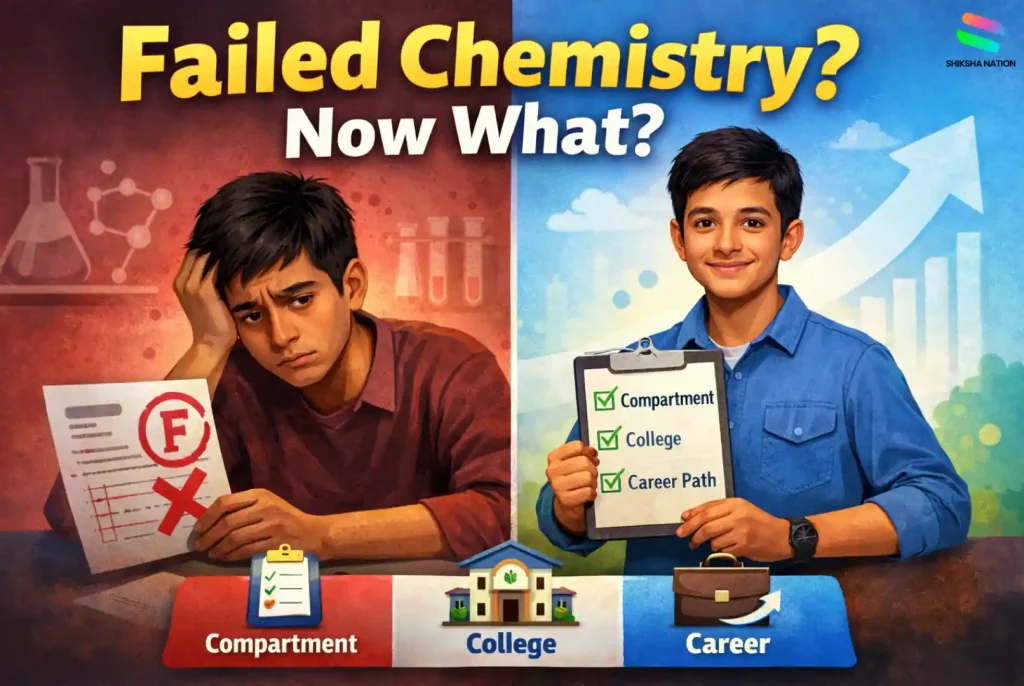
Did You Actually Fail Your Chemistry Exam?
A bad paper does not automatically mean you have failed. Many students walk out thinking, “will I fail if exam went bad?” – but CBSE evaluation is more flexible than most people assume.
Before jumping to conclusions, understand this: final results depend on total marks after evaluation, not how you felt in the exam hall.
How CBSE Evaluates Your Paper
CBSE follows a structured evaluation process that often works in the student’s favour:
- Step marking: You get marks for correct steps, even if the final answer is wrong
- Grace marks: Given in borderline cases to help students reach passing marks
- Moderation: Difficulty level of the paper is adjusted across students
- Minimum passing marks: Usually 33% overall, not necessarily in every question
Example: Even if you left a few questions, partial marks in numericals or theory can still help you pass.
Common Mistakes Students Make While Predicting Failure
Students often misjudge their performance due to stress or incomplete recall.
- Focusing only on mistakes, ignoring correct answers
- Assuming strict checking, when CBSE allows step-wise marks
- Comparing with toppers, not with passing criteria
- Panicking right after the exam, without seeing actual marks
In most cases, what feels like “failure” turns out to be average or even passing performance after evaluation.
The key is simple: Don’t decide your result before CBSE does.
What Happens If You Fail in One Subject in CBSE?
If you fail in one subject in CBSE, you usually do not fail the entire year immediately. Instead, CBSE gives you another chance through a compartment exam, allowing you to clear that subject without repeating the full academic year.
This directly answers a common concern: what happens if I fail in one subject CBSE?
You get a second opportunity, not a final failure.
Here’s what typically happens:
- If you fail in only one subject, you are placed in the compartment category
- You can appear for a compartment exam in the same year
- If you pass that exam, your result is updated to pass
- If you fail in multiple subjects, then the situation may be treated as overall failure, depending on board rules
Example: If a Class 12 student fails only in Chemistry but passes other subjects, they can clear Chemistry through a compartment exam and still continue their academic path.
Pass vs Compartment vs Fail – Clear Meaning
| Status |
Meaning |
What It Means for You |
| Pass |
Cleared all subjects |
Eligible for college admissions immediately |
| Compartment |
Failed in 1 subject |
Can reappear in that subject without losing the year |
| Fail |
Failed in multiple subjects |
May need to repeat the year or reappear next cycle |
Based on CBSE guidelines, the system is designed to reduce academic loss and give recovery chances.
So if you’re wondering what happens if I fail board exam, the answer depends on how many subjects are affected – and in most single-subject cases, recovery is straightforward.
CBSE Compartment Exam Process (Step-by-Step)
The CBSE compartment exam process is designed to give students a second chance to pass a failed subject without losing a full academic year. If you fail in one subject, this becomes your immediate and most important next step.
Here’s how the process works, step by step:
- Result Declaration
- Your result shows “Compartment” in the subject you failed
- This confirms you are eligible for reattempt
- Form Filling
- Schools usually guide regular students through the application
- Private candidates apply directly through the CBSE portal
- Admit Card Release
- CBSE issues admit cards before the exam
- Details include exam date, centre, and subject
- Compartment Exam
- Conducted typically within a few months of results
- Syllabus remains the same as the original exam
- Result Declaration
- If you pass, your status is updated to “Pass”
- You can then proceed with admissions or next steps
Eligibility for Compartment Exam
You are eligible if:
- You have failed in only one subject
- You meet CBSE’s minimum criteria for overall assessment
Example: A student failing only in Chemistry but passing all other subjects can directly appear for the compartment exam.
Number of Attempts Allowed
- CBSE usually allows multiple attempts (as per latest guidelines)
- Typically:
- One main compartment attempt in the same year
- Additional chances in the following year (subject to rules)
This ensures you get more than one opportunity to clear the subject.
Do Check : Career Options After 12th for PCM Students
Timeline (Results → Exam → Final Result)
Based on recent trends:
- May-June: Board results declared
- July-August: Compartment exams conducted
- August-September: Results announced
This timeline allows students to recover within the same academic cycle in many cases.
The key takeaway is simple: a compartment is a recovery path, not a dead end. With timely action and focused preparation, most students clear it in the first attempt.
Improvement Exam vs Compartment Exam (Key Difference)
Students often confuse improvement exams with compartment exams, but they serve completely different purposes. Understanding this difference is important because it directly affects your next step after results.
In simple terms:
- Compartment exam = for students who failed
- Improvement exam = for students who passed but want better marks
Key Difference Between Improvement Exam and Compartment Exam
| Factor |
Compartment Exam |
Improvement Exam |
| Purpose |
To pass a failed subject |
To increase marks in a passed subject |
| Eligibility |
Students who failed in one subject |
Students who already passed |
| Timing |
Same year (soon after results) |
Usually next academic cycle |
| Urgency |
High (needed to pass the year) |
Optional (for better percentage) |
| Result Impact |
Changes status from “Compartment” to “Pass” |
Replaces old marks if improved |
When Should You Choose What?
- Choose compartment exam if:
- You failed in one subject (e.g., Chemistry)
- You need to clear it to move forward academically
- Choose improvement exam if:
- You passed but scored low
- You want better marks for college cut-offs
Example:
If you scored 28 in Chemistry (below passing), you must take a compartment exam.
If you scored 55 but need 75+ for a college, you can opt for an improvement exam.
Based on CBSE rules, both options are designed to support students – but for different situations.
The key is simple: first clear failure (compartment), then focus on improving marks if needed.
Can You Still Go to College If You Fail One Subject?
Yes, you can still go to college if you fail one subject – but timing and conditions matter. A single subject failure (like Chemistry) does not permanently block your college admission. It may only delay the process, depending on how quickly you clear it.
This directly answers a common concern: can I go to college if I fail one subject?
Yes, but you must clear the subject through a compartment exam first in most cases.
Regular Admission vs Delayed Admission
Your admission depends on when you clear the failed subject:
- Regular Admission (No Delay)
- You clear the compartment exam quickly (same year)
- Final result is updated before college deadlines
- You can participate in counselling/admissions normally
- Delayed Admission
- If results come after admission deadlines
- You may need to:
- Apply in the next cycle
- Choose colleges with flexible timelines
Example: A student clears the compartment exam in August and still gets admission in colleges with later deadlines.
Private vs Government College Scenarios
- Government Colleges
- Strict cut-offs and timelines
- Require final “Pass” result at the time of admission
- Private Colleges
- More flexible in many cases
- May allow provisional admission, pending compartment result
Based on recent admission trends, many private institutions support students who are waiting for compartment results.
The key point is simple: failing one subject may delay your college admission, but it does not cancel your future. Clearing the compartment exam quickly keeps most options open.
Will Failing Chemistry Affect Your Career?
Failing Chemistry once does not decide your entire career. It may create a short-term delay, but it does not permanently block your future opportunities. This directly addresses a common fear: will failing exam affect my future?
In most cases, the answer is no – if you take the right next steps.
Let’s separate myth from reality:
Myth vs Reality
- Myth: One failed subject means no good college
Reality: You can clear it through a compartment exam and still apply
- Myth: Your career options become limited forever
Reality: Most careers depend on overall qualification, not one attempt
- Myth: Competitive exams are no longer possible
Reality: Exams like JEE/NEET require you to pass Class 12 – not how many attempts you took
What Actually Matters for Your Future
- Final result status (Pass) is more important than one failed attempt
- Skills, entrance exams, and consistency matter more in the long run
- Timely recovery (clearing the subject quickly) keeps your path smooth
Example: A student who clears a compartment exam in the same year can still prepare for entrance exams and join college without major setbacks.
Based on academic trends, many students face setbacks in one subject but still build strong careers later.
The key idea is simple: a temporary academic setback is not a permanent career limitation.
Also Check : Difference Between IIT, NIT and BITS
What to Do Next (30-60 Day Action Plan)
If you’re wondering failed chemistry exam what to do, the next 30-60 days are critical. This period decides whether your situation becomes a small delay or a bigger setback. The goal is simple: stay calm, follow the right steps, and act on verified information.
Here is a clear, practical plan you can follow:
Step 1: Wait for Official Result
Do not assume failure based on how the exam felt.
- CBSE evaluation includes step marking, grace marks, and moderation
- Many students who expect failure actually pass
Action: Wait for the final result before making any decision
Step 2: Choose Compartment or Improvement
Once results are declared, take a clear decision:
- If you failed → Apply for compartment exam
- If you passed but scored low → Consider improvement exam
Focus on:
- Eligibility criteria
- Application deadlines
Step 3: Study Strategy for Reattempt
Preparation for a reattempt should be focused, not broad.
- Identify high-weightage chapters (based on NCERT patterns)
- Practice previous year questions
- Focus on:
- Numericals
- Key reactions
- Important theory points
Example: Instead of reading the full book again, revise exam-oriented topics first
Step 4: Backup Career Planning
While preparing, keep a backup plan ready.
- Explore:
- Alternative courses
- Flexible admission options
- Track:
- College admission timelines
This reduces pressure and gives you control over your next move.
The key idea is simple: don’t panic – plan and act step by step. Most students who follow a structured approach clear their reattempt without long-term impact.
Career Options If Your PCM Marks Are Low
Low marks in Physics, Chemistry, and Maths do not close your career options. They mainly affect high cut-off courses, not your entire future. There are multiple practical paths you can still choose based on your interest and strengths.
If you’re exploring career options after low marks in PCM, focus on flexibility rather than limitation.
Practical Career Options You Can Consider
- B.Sc. Programs (General or Specialized)
- Subjects like Chemistry, Maths, Computer Science
- Available in many universities with moderate cut-offs
- BCA (Bachelor of Computer Applications)
- Good option if you are interested in tech or software
- Does not always require high PCM scores
- Diploma Courses (Engineering / Technical)
- Skill-focused programs with faster entry into jobs
- Example: Polytechnic diplomas
- Private Engineering Colleges
- Some colleges have flexible eligibility criteria
- Admission may be possible even with lower marks
- Skill-Based Careers
- Digital marketing, UI/UX design, data analytics
- Focus on portfolio and skills, not marks
How to Choose the Right Path
- Look at eligibility criteria, not assumptions
- Match your choice with:
- Keep backup options ready during admission season
Example: A student with low PCM marks may skip high cut-off engineering colleges but still pursue BCA and move into IT careers.
Based on recent trends, careers are becoming skill-driven rather than marks-driven.
The key takeaway: low PCM marks may change your path, but they do not end your opportunities.
Common Myths About Failing Board Exams
Many students and parents form strong opinions about failure based on fear, not facts. These exam myths often create unnecessary panic and wrong decisions.
Let’s clear the most common misconceptions with simple facts:
Myth vs Fact
- Myth: Failing one subject means your year is wasted
Fact: In CBSE, you usually get a compartment exam, so your year is not lost
- Myth: A backlog means you cannot move forward
Fact: Backlog meaning is simply a subject you need to clear later – it does not stop your long-term progress
- Myth: Colleges will reject you permanently
Fact: Most colleges only require a final “Pass” result, even if it comes after a reattempt
- Myth: Only weak students fail
Fact: Based on exam trends, even average and good students can underperform due to exam pressure or paper difficulty
- Myth: One failure defines your career
Fact: Careers depend on overall qualification, skills, and consistency – not one exam result
Why These Myths Are Harmful
- They create unnecessary stress and panic
- They lead to wrong decisions, like giving up early
- They ignore how flexible the education system actually is
Example: A student who believes “my year is wasted” may stop preparing, while another who understands the system clears the compartment and continues normally.
The key idea is simple: don’t base your decisions on myths – understand the actual system and act accordingly.
How Students & Parents Should Handle This Situation
Handling a possible exam setback requires both emotional control and practical action. The way students and parents respond in this phase can directly affect confidence, decisions, and recovery speed.
For students, the first step is to manage exam stress without jumping to conclusions.
- Avoid assuming failure before results are declared
- Focus on what is in your control now (next steps, preparation)
- Talk to someone you trust instead of overthinking alone
Example: A student who stays calm and waits for the result can make better decisions than someone reacting immediately after the exam.
For parents, your reaction matters more than the result itself.
- Stay calm and supportive, not reactive
- Avoid comparisons with other students
- Focus on solutions, not blame
A negative parent reaction can increase pressure, while a balanced approach helps the student recover faster.
Practical Approach for Both
- Wait for the official result before planning next steps
- Understand available options (compartment, improvement)
- Create a simple action plan instead of panicking
Based on student behaviour trends, those who receive calm support and clear guidance handle setbacks much better.
The key idea is simple: this situation needs clarity and support – not panic or pressure.
FAQs About Failing a Chemistry Exam in CBSE
Q1. What if I fail in Chemistry but pass overall?
If you fail in one subject like Chemistry but pass overall, CBSE usually places you in the compartment category. You can appear for a compartment exam in that subject. Once you clear it, your result is updated to “Pass,” and your academic progression continues normally.
Q2. Is compartment exam difficult in CBSE?
The compartment exam is not harder than the board exam. It follows the same syllabus and pattern as CBSE board exams. Based on exam trends, students who focus on key topics and practice previous papers often clear it in the first attempt.
Q3. Can I do engineering after failing Chemistry once?
Yes, you can still pursue engineering if you clear Chemistry later. As per eligibility rules, you need to pass Class 12 with required subjects, not necessarily in one attempt. Clearing the compartment exam ensures you remain eligible for most engineering courses.
Q4. How many attempts are allowed for compartment exams in CBSE?
CBSE generally allows one main compartment attempt in the same year, followed by additional chances in subsequent exams as per latest guidelines. This gives students multiple opportunities to clear the subject without restarting the entire academic year.
Q5. Can I get college admission while waiting for compartment results?
Yes, some colleges – especially private ones – offer provisional admission while you wait for compartment results. However, most government colleges require a final “Pass” result at the time of admission. Always check the specific college’s admission policy.
Q6. What is the difference between compartment and improvement exam?
A compartment exam is for students who failed, while an improvement exam is for students who passed but want better marks. This distinction is important because compartment exams are necessary for passing, while improvement exams are optional for score enhancement.
Q7. Will failing one subject affect my future permanently?
No, failing one subject does not permanently affect your future. What matters is your final passing status and overall qualification. Based on academic trends, many students recover through compartment exams and continue their education without long-term impact.
Q8. How should I prepare for a compartment exam effectively?
Start by focusing on NCERT concepts, important chapters, and previous year questions. Avoid studying everything again. Instead, revise high-weightage topics and practice writing answers. A focused 4-6 week preparation strategy is usually enough to clear the exam.
Q9. What happens if I fail in more than one subject in CBSE?
If you fail in multiple subjects, you may not be eligible for a compartment exam in all cases. As per CBSE rules, this can lead to overall failure, meaning you may need to reappear in the next exam cycle or repeat the year.
Q10. Can I change my stream or career path after failing Chemistry?
Yes, you can change your stream or career path if needed. Many courses like BCA, B.Sc., or skill-based programs do not strictly depend on high Chemistry marks. You can choose options based on your interest and eligibility criteria after passing Class 12.