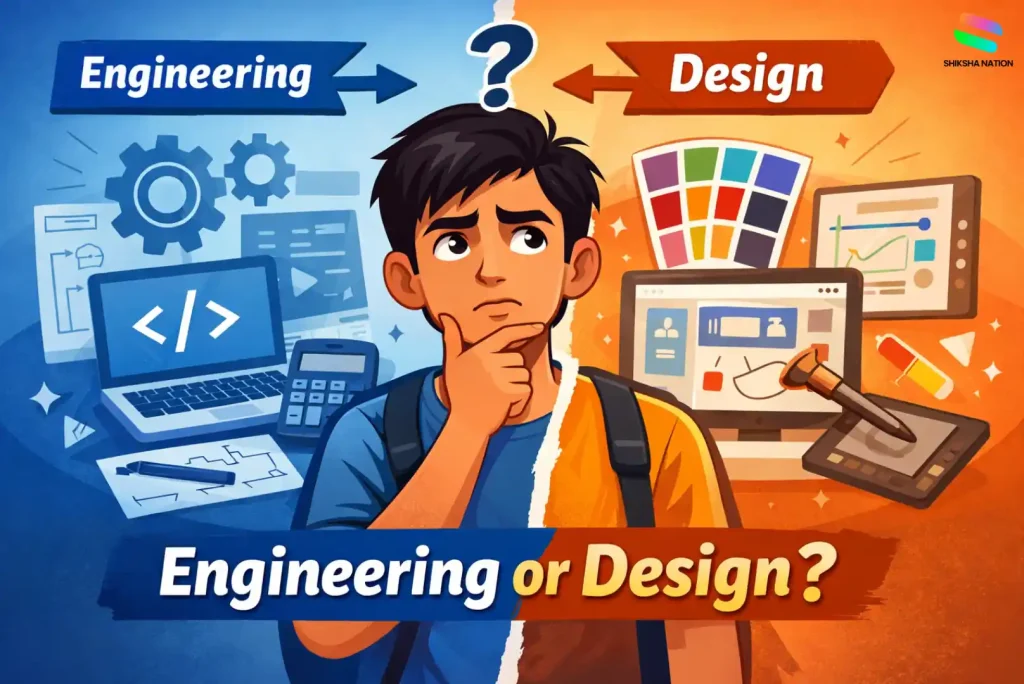
Engineering vs Design: Understanding the Core Difference
Engineering vs design are two very different career paths in India, even though both can lead to stable and high-growth opportunities. The main difference lies in how you solve problems – engineering focuses on technical systems, while design focuses on user experience, creativity, and functionality.
What is Engineering as a Career?
Engineering is a career where you apply science, mathematics, and technical knowledge to build, improve, or maintain systems and products.
In India, the engineering career scope includes:
- Software development (IT, coding, AI)
- Core fields (mechanical, civil, electrical)
- Emerging areas (data science, robotics)
Most students enter through exams like JEE Main/Advanced, and the path is structured – college → job → specialization.
Example: A computer science engineer builds applications or software systems used by millions.
What is Design as a Career?
Design is a career focused on solving problems through creativity, user understanding, and visual thinking.
Popular design fields in India:
- UI/UX design (apps, websites)
- Product design (physical or digital products)
- Graphic design (branding, visuals, marketing)
The design career scope in India has grown rapidly with the rise of digital platforms and startups.
Example: A UI/UX designer decides how an app looks and feels, ensuring it is easy to use.
Key Differences: Engineering vs Design Career India
| Parameter |
Engineering |
Design |
| Core Skills |
Maths, logic, coding |
Creativity, user thinking, visual skills |
| Career Risk |
Lower (structured path) |
Moderate (skill-based growth) |
| Salary Range |
₹3-12 LPA (entry level varies by college) |
₹3-10 LPA (higher with strong portfolio) |
| Flexibility |
Limited early career |
High (freelance, remote work) |
This comparison helps you understand not just what each career offers, but how well it matches your strengths and expectations.
Why Parents Prefer Engineering
In India, many parents prefer engineering because it is seen as a stable and predictable career path. Their decision is usually based on long-term security, not just interest.
Here are the main reasons behind this mindset:
- Perception of stability: Engineering is considered one of the most stable career options in India, with a clear path from college to job. Parents feel it reduces uncertainty.
- High salary potential: Top engineering colleges (like IITs, NITs) offer access to high salary careers in India, especially in fields like software and data science.
- Familiarity and awareness: Most parents are more aware of engineering careers than newer fields like UI/UX or product design. What they understand feels safer.
- Social proof and reputation: Engineering is socially respected. Many families have relatives or neighbors who are engineers, which reinforces trust.
- Backup options: Even if core engineering jobs are limited, graduates can shift to IT, government exams, or MBA. This flexibility makes it appear low-risk.
Example: A parent may prefer engineering because they’ve seen someone secure a stable job through it, even if the student has different strengths.
Understanding this perspective helps you communicate better, instead of seeing it as pressure alone.
Is Design a Good Career in India?
Design is a good career in India if you build the right skills and portfolio. Unlike traditional paths, success in design depends more on practical ability and creativity than just a degree. The demand for digital products, apps, and branding has made design one of the fastest-growing career areas.
However, it is not “easy” or risk-free. Growth depends on consistency, skill level, and real work experience.
Types of Design Careers in India
Design is a broad field with multiple career paths:
- UI/UX Design: Designing apps and websites (high demand in startups and tech companies)
- Product Design: Creating physical or digital products with user focus
- Graphic Design: Branding, social media creatives, marketing visuals
- Animation & Motion Graphics: Used in media, advertising, gaming
Example: A UI/UX designer working on a mobile app directly impacts how users interact with the product.
Salary Range (Freshers to Experienced)
Design salaries vary based on skill, portfolio, and specialization:
- Freshers: ₹3-6 LPA (can be higher from top institutes like NID/NIFT)
- Mid-level (3-5 years): ₹8-15 LPA
- Experienced (5+ years): ₹15-30 LPA+
High paying creative jobs in India are mostly seen in UI/UX and product design, especially in tech companies.
Growth Opportunities (Freelance + Jobs)
Design offers flexible career growth options:
- Full-time roles: Startups, MNCs, product-based companies
- Freelancing: Work with clients globally through platforms or personal network
- Remote work: Common in UI/UX and digital design fields
Based on current industry trends, companies are investing more in user experience, making design a future-relevant career option.
Important: Strong portfolio + real projects matter more than just a degree in design.
Engineering vs Design Salary & Career Scope in India
When comparing engineering vs design salary in India, the difference is not just in numbers but in how careers grow over time. Engineering offers a more structured path, while design growth depends heavily on skills and portfolio strength.
Here is a clear comparison to help you understand both career scope and earning potential:
Engineering vs Design Salary & Career Scope in India
| Factor |
Engineering |
Design |
| Entry Salary |
₹3-8 LPA (higher from IITs/NITs) |
₹3-6 LPA (higher with strong portfolio/NID/NIFT) |
| Mid-Level Salary (3–5 yrs) |
₹8-20 LPA (especially in IT/data roles) |
₹8-15 LPA (UI/UX, product design roles) |
| High-End Salary (5+ yrs) |
₹20-50 LPA+ (top tech roles, management) |
₹15-30 LPA+ (top designers, product companies) |
| Career Structure |
Fixed path (degree → job → promotion) |
Flexible (skills → portfolio → growth) |
| Job Opportunities |
Large volume (IT + core sectors) |
Growing demand (startups + digital economy) |
| Risk Level |
Lower (predictable path) |
Moderate (skill-dependent growth) |
Example: An average engineering graduate may get a stable job early, but a skilled UI/UX designer can match or even exceed that salary within a few years.
Based on current industry trends, engineering provides early stability, while design offers faster growth for skilled individuals. The better choice depends on whether you prefer security or skill-based flexibility.
Decision Framework: How to Choose Between Engineering and Design
Choosing between engineering and design should not be based on pressure or trends. The right approach is to use a simple decision framework that evaluates your interest, skills, and future goals. This makes the choice practical and less emotional.
Here is a step-by-step method to decide clearly:
Step 1 – Identify Your Interest Level
Start by asking what genuinely holds your attention for long hours.
- Do you enjoy problem-solving with logic and numbers? → Engineering
- Do you enjoy creating, designing, and thinking visually? → Design
Example: If you like designing Instagram posts, apps, or visuals, that leans toward design. If you enjoy coding or physics concepts, engineering may suit you better.
Step 2 – Evaluate Skills & Strengths
Interest alone is not enough. Check your current strengths:
- Strong in Maths and Physics → Engineering advantage
- Strong in creativity, observation, and storytelling → Design advantage
You don’t need to be perfect, but your natural strengths should align with the career.
Step 3 – Understand Risk vs Stability
This is where most parents focus.
- Engineering → More stable and predictable path
- Design → Skill-based growth, slightly higher risk in early stages
Ask yourself: Are you comfortable building skills over time, or do you prefer early stability?
Step 4 – Check Career Opportunities
Look at real opportunities, not assumptions.
- Engineering → Large job market (IT, core, government exams)
- Design → Growing demand (UI/UX, product design, digital platforms)
Based on current trends, design roles are increasing with the growth of tech products and startups.
Step 5 – Take a Trial Approach (Portfolio/Projects)
Before making a final decision, test your interest in real conditions.
- Try:
- A basic UI/UX project on Figma
- A small design portfolio (3–5 projects)
- Or explore:
- Basic coding or engineering concepts online
Example: If you enjoy working on design projects consistently, it’s a strong signal.
Quick Decision Checklist
- I enjoy the daily work involved in this field
- My strengths match the skill requirements
- I understand the risks and growth path
- I have tried it practically (not just thought about it)
If most answers are “yes,” you are closer to the right decision.
How to Convince Your Parents (Practical Strategy)
Convincing your parents about your career choice is not about arguing – it is about building trust with logic and proof. Most parents are worried about stability, so your approach should address their concerns clearly.
Here is a practical step-by-step method:
Step 1 – Understand Their Concern First
Before explaining your side, understand theirs.
- They want job security and financial stability
- They may not fully understand design careers
When you acknowledge this, the conversation becomes calmer and more productive.
Step 2 – Do Proper Research
You cannot convince parents with “I like design.” You need facts.
- Show:
- Career options (UI/UX, product design)
- Salary ranges in India
- Colleges like NID, NIFT, IIT design programs
This shows seriousness, not confusion.
Step 3 – Show Practical Proof
This is the most important step.
- Create:
- 3-5 design projects
- A small portfolio (even basic is fine)
Example: If you show an app design you created on Figma, it becomes real for them.
Step 4 – Present a Low-Risk Plan
Parents feel comfortable when risk is controlled.
- Example:
- “Give me 6 months to build skills and try internships”
- “If it doesn’t work, I will consider alternatives”
This reduces fear from their side.
Step 5 – Communicate Calmly and Clearly
- Avoid emotional arguments like “I don’t want engineering”
- Focus on:
- “Here is my plan”
- “Here is the scope”
Quick Tip:
If you’re wondering how to convince parents for career choice, the answer is simple – replace opinions with preparation, and emotions with evidence.
Can You Switch from Engineering to Design Later?
Yes, you can switch from engineering to design later. Many students in India start with engineering and move into design fields like UI/UX or product design after building the right skills.
The key point is this: design careers are skill-based, not degree-restricted.
How the Switch Usually Happens
- Learn design tools (Figma, Adobe XD, etc.)
- Build a portfolio with real projects
- Apply for internships or entry-level roles in design
Example: A computer science student learns UI/UX design in their 2nd year and starts freelancing or gets a design internship before graduation.
Why This Transition Works
- Engineering builds problem-solving and logical thinking
- Design requires user thinking and creativity
- The combination is actually valued in product companies
Many companies prefer candidates who understand both technology and user experience.
Important Things to Keep in Mind
- The switch is possible, but not automatic – you must build skills actively
- A strong portfolio matters more than your engineering degree
- Starting early (during college) makes the transition smoother
If your concern is “can I switch from engineering to design later,” the answer is yes – but it requires effort, consistency, and practical work, not just intention.
Common Mistakes Students Make in Career Decisions
Career decisions after Class 12 often go wrong not because of lack of options, but because of poor decision-making approach. When students face career confusion after 12th about what to choose, they tend to rely on assumptions instead of clarity.
Here are the most common mistakes to avoid:
- Choosing based on pressure, not fit
Many students pick engineering or any “safe” option just because parents or relatives suggest it, without checking their own interest or strengths.
- Following trends blindly
Choosing a career because “everyone is doing it” (like coding or design) without understanding the actual work involved.
- Ignoring real skill requirements
Liking something at a surface level is different from building a career in it. For example, enjoying social media is not the same as being a skilled designer.
- Not researching career scope properly
Decisions are often made without checking salary ranges, job roles, or growth opportunities in India.
- Avoiding practical testing
Many students don’t try small projects (like coding or design tasks) before deciding, which leads to regret later.
Example: A student chooses engineering without interest, struggles in college, and then feels stuck.
Avoiding these mistakes can help you make a more informed and confident career decision, instead of relying on guesswork.
Best Career Options for Creative Students After 12th
Creative students after 12th have multiple career options in India that go beyond traditional paths like engineering or medicine. The key is to choose a field where creativity is applied in a practical, skill-based way.
Here are some of the best creative career options after 12th:
Top Creative Career Paths
- UI/UX Design
Focuses on designing apps and websites. High demand in tech companies and startups.
Example: Designing the layout and user flow of a mobile app.
- Graphic Design
Involves branding, social media creatives, and marketing visuals.
Works well for freelancing and agency jobs.
- Product Design
Combines creativity with problem-solving to design physical or digital products.
Strong demand in product-based companies.
- Animation & Motion Graphics
Used in films, gaming, advertising, and content creation.
Growing demand with digital media expansion.
- Fashion Design
Suitable for students interested in clothing, trends, and styling.
Entry through exams like NIFT.
How to Choose the Right One
- Check what type of creativity you enjoy:
- Visual (graphics, UI)
- Conceptual (product, UX)
- Artistic (fashion, animation)
- Start with small projects or online tools to test your interest.
Based on current industry trends, creative careers are becoming more mainstream, especially with the growth of digital platforms. The right choice depends on your skills, consistency, and willingness to build a strong portfolio.
FAQs: Engineering vs Design Career Choice in India
Q1. What should I do if my parents want me to do engineering but I want design?
Start by understanding both careers and then present a clear plan to your parents. Show design career options, salary range, and your portfolio or learning progress. A structured approach with proof works better than emotional arguments.
Q2. Is design a good career in India compared to engineering?
Yes, design can be a good career in India if you build strong skills and a portfolio. Engineering offers stability early, while design offers flexible and high growth over time. The better option depends on your interest, skills, and risk comfort.
Q3. Can I choose design instead of engineering after 12th?
Yes, you can choose design after 12th through entrance exams like NID, NIFT, and UCEED. As per latest guidelines, students from any stream (Science, Commerce, Arts) can apply for most design courses.
Q4. How to choose between engineering and design career in India?
Choose based on interest, strengths, and career goals. If you prefer logic, maths, and structured paths, engineering fits better. If you enjoy creativity, visual thinking, and flexible careers, design is more suitable. A trial project can help confirm your decision.
Q5. How can I convince my parents to support my design career?
You can convince your parents by showing research, career scope, and practical proof like a portfolio. Explain salary trends and job opportunities in India. A clear plan with low risk, such as trying for 6 months, increases their confidence.
Q6. What happens if I choose the wrong career after 12th?
Choosing the wrong career is not permanent. Many students switch fields later by learning new skills or changing domains. However, it may cost time and effort, so making an informed decision early reduces this risk.
Q7. Can I switch from engineering to design later?
Yes, switching from engineering to design is possible because design is skill-based. Many students move into UI/UX or product design by learning tools and building a portfolio during or after engineering.
Q8. Which is better for the future: engineering or design?
Both careers have good future scope in India. Engineering remains a stable option, while design is growing तेजी due to digital and startup demand. The better choice depends on your skills and how well you adapt to industry needs.
Q9. Is it risky to choose design as a career in India?
Design has moderate risk compared to engineering because growth depends on skills and consistency. However, with strong portfolio and practical experience, it can lead to high-paying roles and freelancing opportunities.
Q10. What are the best design entrance exams in India after 12th?
The top design entrance exams include NID DAT, NIFT Entrance Exam, and UCEED. Based on exam patterns, these tests evaluate creativity, problem-solving, and visual ability rather than only academic knowledge.