

Ellipse Focal Chords at Right Angles - Coordinate Geometry Problem
Learn how to solve perpendicular focal chord problems in an ellipse using key formulas, step-by-step methods, and practical examples. This guide covers ellipse basics, focal chords, eccentricity, latus rectum, perpendicularity conditions, and common mistakes. Ideal for JEE Advanced, board exams, and competitive exams, it helps you approach challenging coordinate geometry questions with greater confidence.
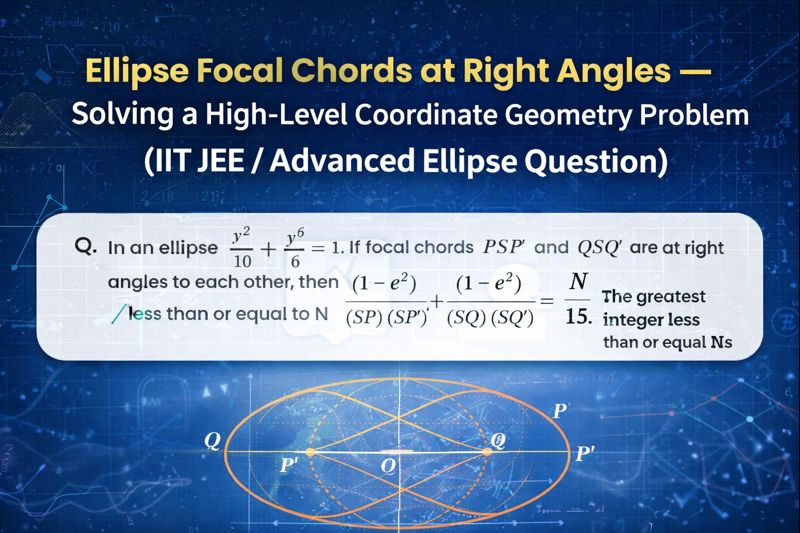
Picture this: You’re sitting in your math class, staring at a coordinate geometry problem about ellipses. The teacher writes “two focal chords at right angles” on the board, and suddenly everyone’s confused. Sound familiar?
If you’ve ever felt lost when ellipse problems get tricky, you’re not alone. Focal chords especially when they meet at right angles are among the most challenging topics in coordinate geometry. But here’s the good news: once you understand the pattern, these problems become surprisingly manageable.
This topic appears frequently in JEE Advanced, board exams, and competitive tests. Mastering it doesn’t just help you score marks it builds your confidence in handling complex geometry concepts. Let’s break it down together, step by step, with real examples and practical tips.
What is an Ellipse?
An ellipse is a stretched circle a smooth, oval-shaped curve. In coordinate geometry, it’s defined as the set of all points where the sum of distances from two fixed points (called foci) remains constant.
Standard equation of an ellipse:
- x²/a² + y²/b² = 1 (when a > b, major axis along x-axis)
- x²/b² + y²/a² = 1 (when a > b, major axis along y-axis)
Main terms:
- Foci: Two fixed points inside the ellipse, denoted as F₁ and F₂
- Major axis: Longest diameter (length = 2a)
- Minor axis: Shortest diameter (length = 2b)
- Eccentricity (e): Measures how “stretched” the ellipse is; e = √(1 – b²/a²)
Understanding Focal Chords
A focal chord is any line segment that passes through a focus of the ellipse and has both endpoints on the ellipse itself.
Think of it like this: if you draw a line through one focus and extend it until it touches the ellipse on both sides, you’ve created a focal chord.
Important properties:
- Every ellipse has infinitely many focal chords
- The latus rectum is a special focal chord perpendicular to the major axis
- Focal chords help solve advanced problems involving tangents, normals, and areas
What Are Perpendicular Focal Chords?
When two focal chords pass through the same focus and intersect at 90 degrees, they’re called perpendicular or orthogonal focal chords.
Imagine drawing two lines through one focus like forming a “+” sign where both lines touch the ellipse. That’s what we’re working with.
Why this matters:
- Common in JEE Advanced and olympiad problems
- Tests your understanding of parametric equations
- Connects multiple geometry concepts in one question
Main Formula for Focal Chords at Right Angles
Here’s the golden rule you need to remember:
If two focal chords of an ellipse x²/a² + y²/b² = 1 are perpendicular to each other and pass through the same focus, then:
1/r₁² + 1/r₂² + 1/r₃² + 1/r₄² = 4a²/(a²b²e²)
Where r₁, r₂, r₃, r₄ are the four segments formed by the two chords.
Simplified version for practice:
For perpendicular focal chords through the same focus:
1/PF₁ + 1/P’F₁ + 1/QF₁ + 1/Q’F₁ = constant value
This constant depends on a, b, and e.
Step-by-Step Problem Solving Approach
- Step 1: Write down the ellipse equation and identify a, b, and the foci.
- Step 2: Use parametric form if points are given as parameters (a cos θ, b sin θ).
- Step 3: Apply the perpendicularity condition slopes multiply to give -1.
- Step 4: Use the focal chord formula or semi-latus rectum properties.
- Step 5: Simplify using algebraic identities (cos²θ + sin²θ = 1 works wonders here!).
- Step 6: Solve for the required quantity could be length, sum, or relationship between parameters.
Worked Example with Solution
Problem: For the ellipse x²/25 + y²/16 = 1, two focal chords are drawn through the focus perpendicular to each other. Find the sum of their reciprocals.
Solution:
Given: a² = 25, b² = 16 So a = 5, b = 4
Calculate eccentricity: e² = 1 – b²/a² = 1 – 16/25 = 9/25 e = 3/5
Foci are at (±ae, 0) = (±3, 0)
For perpendicular focal chords through focus (3, 0), we use:
Semi-latus rectum l = b²/a = 16/5
For two perpendicular focal chords with lengths L₁ and L₂:
1/L₁ + 1/L₂ = a²/(ab²) = 25/(5×16) = 25/80 = 5/16
Answer: The sum of reciprocals = 5/16
Common Mistakes Students Make
- Mistake 1: Confusing foci coordinates Many students mix up (ae, 0) and (0, ae). Always check which axis is major first.
- Mistake 2: Wrong eccentricity formula Remember: for ellipse, e = √(1 – b²/a²) when a > b, NOT √(a²/b² – 1).
- Mistake 3: Forgetting the perpendicularity condition Two lines are perpendicular when m₁ × m₂ = -1. Don’t skip this crucial step.
- Mistake 4: Not simplifying trigonometric terms When using parametric forms, always look for cos²θ + sin²θ = 1 opportunities.
- Mistake 5: Mixing up focal chord and latus rectum Latus rectum is ONE specific focal chord. Not all focal chords equal 2b²/a.
Quick Tips and Memory Tricks
- Tip 1: Always draw a rough sketch. Visual representation prevents 50% of errors.
- Tip 2: Remember “SAFE”—Sum And Focus Equations come first in focal chord problems.
- Tip 3: For perpendicular chords, think “reciprocal sum” most answers involve 1/L₁ + 1/L₂.
- Tip 4: Keep this handy: Length of latus rectum = 2b²/a (appears in almost every solution).
- Tip 5: Parametric equations (a cos θ, b sin θ) make perpendicularity calculations easier.
- Tip 6: PracPractice Problems
Problem 1: Find the latus rectum of ellipse x²/36 + y²/20 = 1.
Problem 2: Two perpendicular focal chords of ellipse x²/9 + y²/5 = 1 are drawn. If their lengths are L₁ and L₂, find 1/L₁ + 1/L₂.
Problem 3: For ellipse 4x² + 9y² = 36, find the foci coordinates.
Challenge Problem: Prove that for any ellipse, perpendicular focal chords satisfy the reciprocal sum relationship.
Conclusion
Ellipse focal chords at right angles might seem intimidating at first glance, but they follow clear, logical patterns. Once you understand the basic ellipse properties, eccentricity, and focal chord relationships, these problems become systematic.
Note:
- Always identify a, b, and foci before starting
- Use parametric forms to simplify calculations
- Remember the perpendicularity condition (m₁ × m₂ = -1)
- The latus rectum formula 2b²/a is your best friend
- Practice visualizing with sketches
Whether you’re preparing for JEE, board exams, or just want to strengthen your coordinate geometry skills, mastering this topic builds problem-solving confidence. Don’t get discouraged if it takes time every expert was once a beginner who kept practicing.
Frequently Asked Questions
What is an ellipse in coordinate geometry?+
An ellipse is the set of all points where the sum of distances from two fixed points (foci) is constant. Its standard equation is x²/a² + y²/b² = 1, representing an oval curve with major and minor axes.
How to find focal chords in an ellipse?+
Identify the foci using c² = a² – b² (or using eccentricity e = c/a). Any line through a focus that intersects the ellipse at two points forms a focal chord. Use parametric or slope forms for calculations.
How to solve ellipse problems quickly?+
Draw a diagram first, identify a and b immediately, calculate e if needed, use parametric forms for points, and remember standard formulas like latus rectum = 2b²/a. Practice recognizes patterns faster than memorization.
What is the latus rectum of an ellipse?+
The latus rectum is a special focal chord perpendicular to the major axis. Its length is always 2b²/a. It’s the shortest focal chord and appears in many formulas for ellipse problems.
How do you prove two focal chords are perpendicular?+
Find the slopes m₁ and m₂ of both chords. They’re perpendicular if m₁ × m₂ = -1. Alternatively, use parametric angles: if points are at θ₁, θ₂, θ₃, θ₄, perpendicularity gives specific angle relationships.
What is eccentricity and why does it matter?+
Eccentricity (e) measures how stretched an ellipse is. For ellipses, 0 < e < 1. Calculate it using e = √(1 – b²/a²). It determines focus positions and appears in focal chord formulas.
Can focal chords be used for tangent problems?+
Focal chord properties connect to tangent equations at endpoints. When you know the focal chord, you can derive tangent slopes and equations using the standard tangent formula xx₁/a² + yy₁/b² = 1.