

Learning e sound words is an important step when children begin to read English with confidence. Many students can recognise letters, but they feel unsure about how the letter “e” should sound while reading different words. This is where phonics plays a helpful role.
Phonics teaches children to listen to sounds and blend them while reading, instead of memorising words. Understanding e sound words in English helps students read clearly and spell better over time.
This guide is written for both students and parents, using simple explanations and familiar examples, so learning at home and in school feels easy, calm, and supportive.

What Are E Sound Words?
E sound words are words where the letter “e” makes a clear sound when we read the word aloud. In phonics, children learn to listen to this sound and blend it with other letters instead of reading each letter separately.
For example, when a child reads a word, the focus is on hearing the “e” sound and saying the word smoothly. This helps students read with less effort and better understanding.
Simple examples of e sound words include pen, bed, red, and me. These are common words that children see often in books and classrooms.
For a e sound word for kids, the goal is not to memorise spelling, but to recognise the sound while reading. Parents can support learning by asking children to say the word slowly and listen to the sound in the middle.
Types of E Sound in English
In English, the letter “e” does not always sound the same while reading. This is one reason why many students feel confused when they start reading new words. Phonics helps children understand that the sound of “e” can change based on the word.
For students, learning these sound types makes reading easier and less stressful. Instead of guessing, children learn to listen carefully and choose the correct sound. Parents also find it helpful because they can guide their child with simple rules.
At the beginner level, children mainly learn two common sounds of “e”. These are taught step by step so that reading becomes smooth and confident.
Short E Sound Words
Short e sound words have a quick and soft “e” sound that is easy to hear. This sound is commonly found in small and familiar words that children read first.
Some clear e sound words examples are bed, pen, red, and ten. The sound of “e” is short and comes in the middle of the word.
For students, practising these words daily improves reading speed. Parents can help by asking the child to say each word slowly and listen to the sound, so reading becomes more accurate and confident.
Long E Sound Words
A long e sound word is a word where the letter “e” is pronounced clearly and for a longer time while reading. The sound feels stretched, which makes it easier for children to notice and repeat.
Some common examples are me, he, tree, and see. In words like tree and see, the sound comes from a double e sound word (ee sound), where two “e” letters work together to make one long sound.
For students, reading these words slowly helps them hear the long sound clearly. Parents can support learning by comparing short and long sounds during practice, so children understand the difference while reading and speaking.
E Sound Words List (By Level)
Learning e sound words becomes easier when words are grouped by level. Children do not learn all sounds at the same speed, so starting with simple words and slowly moving to harder ones helps build confidence.
For students, level-wise word lists reduce confusion and make reading more organised. Parents also find it useful because they know which type of words their child should practise first at home.
This list is designed for regular reading practice. Saying these words aloud every day helps children recognise the “e” sound quickly and read without hesitation.
3-Letter E Sound Words
E sound words 3 letters are perfect for beginners because they are short and easy to read. These words help children clearly hear the “e” sound in the middle.
Common examples include pen, net, hen, bed, and leg. These words are often seen in early reading books and phonics exercises.
For students, reading these words aloud improves confidence. Parents can make practice fun by asking the child to point at the letter “e” and say the word slowly before reading it fully.
Common E Sound Words for Kids
This e sound words list includes simple and familiar words that young learners often see in storybooks and daily reading. These words help children recognise the “e” sound quickly and read with more confidence.
Some common examples are bed, red, leg, pet, and ten. These words are easy to pronounce and suitable as a e sound word for kids.
For students, reading these words aloud every day improves fluency. Parents can help by using these words in short spoken sentences, so children understand how the sound is used naturally while reading and speaking.
Double E (EE) Sound Words
A double e sound word uses two “e” letters together to create one clear and long sound while reading. This sound is easy for children to hear and remember.
Common ee sound word examples include see, bee, tree, free, and green. These words appear often in early reading books.
For students, reading these words slowly helps them stretch the sound correctly. Parents can support learning by asking children to clap once while saying the long “ee” sound, making practice fun and easy.
E Sound Words Used in Sentences
Reading words inside sentences helps children understand how sounds work in real reading. Practising an e sound word sentence makes it easier for students to read smoothly and speak clearly without fear.
Below are some simple sentences that children can read aloud:
- The pen is red.
- I see a tree.
- The hen is on the bed.
- He has a green pen.
- We see a bee on the tree.
For students, reading these sentences slowly improves pronunciation. Parents can support practice by asking the child to read one sentence daily and repeat it once more without looking, which builds confidence and clear speech over time.
E Sound Words with Picture (Learning Tip Section)
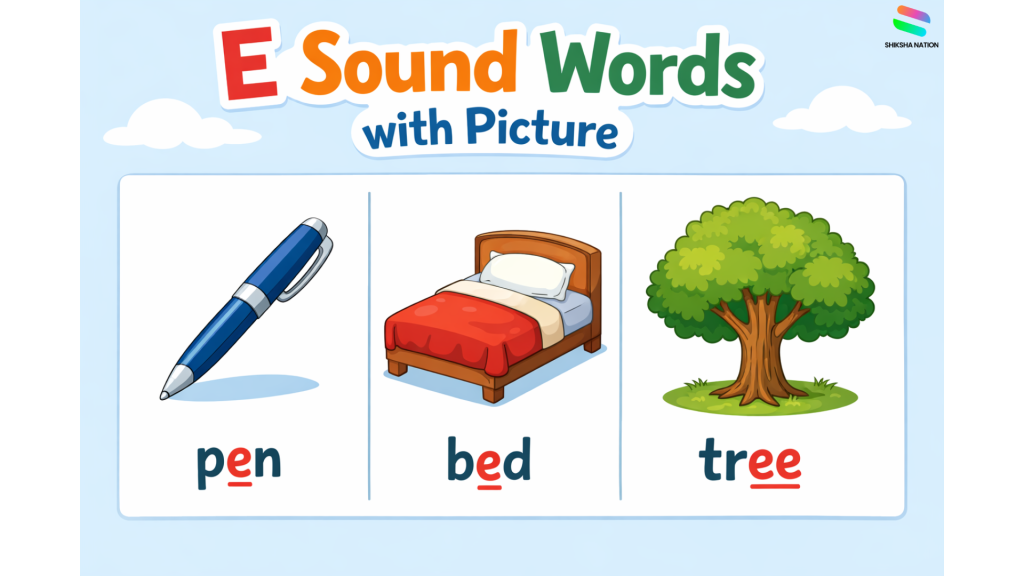
Learning becomes easier when children can see what they are reading. Using an e sound word with picture helps students connect the word, its sound, and its meaning at the same time.
Pictures support memory and help children stay focused during reading practice. When a child sees a picture along with the word, the “e” sound becomes easier to recognise and remember.
Examples that work well with pictures are pen, bed, and tree. Parents can point to the picture and ask the child to say the word aloud, making reading practice more engaging and less stressful for young learners.
How Parents Can Teach E Sound Words at Home
Parents can help children learn e sound words in English through short and regular practice at home. You do not need special books or long study hours. Simple daily activities work best for young learners.
Start by reading small words aloud and asking your child to repeat them slowly. Let the child listen to the “e” sound clearly while reading. Keep the mood calm and encouraging.
Practice ideas for parents:
- Ask your child to read 3–4 words and say the sound of “e” clearly.
- Make one simple sentence together using an e sound word.
- Point to objects or pictures and ask your child to say the word aloud.
With patience and praise, children gain confidence and enjoy reading more each day.
Common Mistakes Students Make with E Sound
Many students face difficulty while reading words with the letter “e”, especially in the early stages. These mistakes are normal and improve with slow and regular practice.
One common error is rushing while reading, which causes children to miss the correct sound. Another mistake is using the same sound in every word, even when it should change.
Common mistakes and corrections:
- Mistake: Reading pen as pan → Correct: pen (clear middle sound)
- Mistake: Saying me with a short sound → Correct: me with a stretched sound
Parents can help by asking children to read slowly and repeat the word correctly. Gentle guidance helps improve pronunciation and reading confidence over time.
Frequently Asked Questions on E Sound Words
Q. What is the e sound in English?
The e sound in English refers to how the letter “e” is spoken while reading a word. In phonics, children learn to listen to this sound instead of spelling each letter separately. This helps students read words smoothly and with better understanding.
Q. How many types of e sound are there?
At the beginner level, children usually learn two main types of e sound. One is the short sound, which is quick and soft. The other is the long sound, which is clear and stretched. Learning these types reduces confusion while reading.
Q. Are ee words always long e sound?
In most cases, yes. Words with “ee” usually make a long sound. This means the sound is held a little longer while speaking. Parents can help children notice this by asking them to say the word slowly and listen carefully.
Q. What are 10 words with an e sound?
Some easy e sound words that children can practise are bed, pen, net, hen, red, leg, pet, me, see, and tree. These words are common and suitable for early reading practice.
Q. What words start with the e sound?
Some words that start with the e sound include egg, end, elf, and elephant. These words help children hear the sound at the beginning of a word, which is useful for phonics learning.
Q. What are the sounds of e in phonics?
In phonics, the letter “e” can make different sounds depending on the word. It may sound short in some words and long in others. Understanding this helps students read new words with confidence.
Q. What are the 42 phonics sounds?
The 42 phonics sounds are basic sounds used to read and speak English clearly. These include letter sounds and common sound patterns. Learning e sound words and long e sound word patterns is an important part of this system, especially for young learners.