

Imagine sitting in your science class, looking up at the night sky through the window, and wondering can India ever reach the stars? In the 1960s, when most countries saw space as an impossible dream, one brilliant scientist believed that even a developing nation like India could explore the cosmos. That visionary was Dr. Vikram Sarabhai.
While your parents might remember black-and-white televisions and hand-written letters, Dr. Sarabhai was already imagining satellites that could broadcast education to remote villages and rockets that could put India on the global map. His story isn’t just about rockets and satellites it’s about dreaming big, working hard, and believing that science can change millions of lives.
Whether you’re a student preparing for competitive exams, a parent explaining India’s scientific heritage, or an educator teaching about national heroes, understanding Vikram Sarabhai’s life will inspire you to believe that education and determination can truly transform a nation.
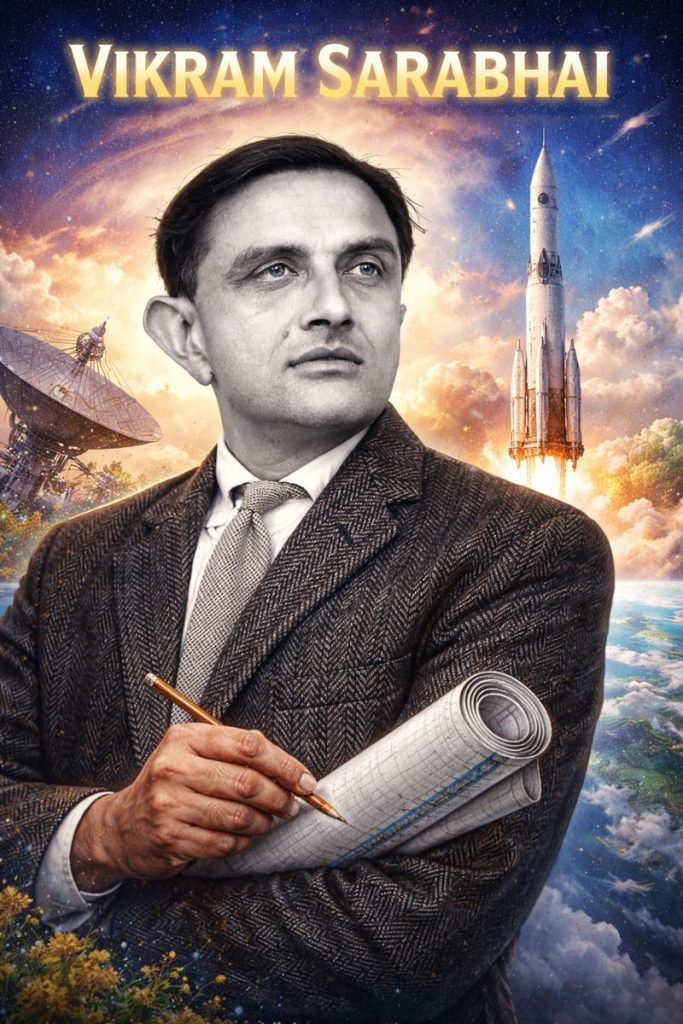
Who Was Dr. Vikram Sarabhai?
Dr. Vikram Ambalal Sarabhai (1919–1971) was an Indian physicist and visionary scientist who founded the Indian Space Research Organisation (ISRO). He is universally recognized as the Father of the Indian Space Program.
Facts About Vikram Sarabhai
| Detail | Information |
|---|---|
| Full Name | Vikram Ambalal Sarabhai |
| Born | August 12, 1919, Ahmedabad, Gujarat |
| Died | December 30, 1971, Kovalam, Kerala |
| Known As | Father of ISRO, India’s Rocket Man |
| Education | PhD from Cambridge University |
| Major Work | Founded ISRO, established space research in India |
| Awards | Padma Bhushan (1966), Padma Vibhushan (1972, posthumous) |
Scientists who only worked in laboratories, Dr. Vikram Sarabhai believed that science should serve society. He wanted technology to reach farmers, students, and common people not just remain in textbooks.
Early Life and Education
Childhood in a Progressive Family
Vikram Sarabhai was born into a wealthy and educated Gujarati family in Ahmedabad. His father, Ambalal Sarabhai, was a successful industrialist, and his mother, Sarla Devi, was a woman ahead of her time who believed in quality education.
Think of it like this: While most children in the 1920s attended traditional schools, Vikram studied at a Montessori school a progressive institution where learning happened through curiosity and experiments, not just memorization. This early exposure to hands-on learning shaped his scientific thinking.
Academic Journey
- 1937: Completed his college education from Gujarat College, Ahmedabad
- 1939: Went to Cambridge University, England to pursue higher studies in natural sciences
- 1940s: Returned briefly to India during World War II but went back to Cambridge
- 1947: Earned his PhD in Cosmic Rays from Cambridge University
Real-Life Connection: Just like today’s students who study abroad to gain global exposure, Vikram Sarabhai understood that learning from the world’s best institutions was crucial for India’s scientific growth.
The Cosmic Ray Research
His PhD thesis focused on cosmic rays high-energy particles from outer space. This research laid the foundation for his future work in space science.
Explanation: Cosmic rays are like invisible bullets from space that constantly hit Earth. By studying them, scientists can understand the universe better.
The Birth of India’s Space Program
Founding the Physical Research Laboratory (PRL)
In 1947, the same year India gained independence, the 28-year-old Vikram Sarabhai established the Physical Research Laboratory (PRL) in Ahmedabad.
Why This Mattered:
- India had just become free from British rule
- The country needed scientific institutions built by Indians
- PRL became India’s first space research center
Student Example: Imagine starting your own science club right after your school gets a new building that’s the kind of pioneering spirit Dr. Sarabhai had.
Launch of India’s First Rocket
On November 21, 1963, India launched its first sounding rocket from Thumba Equatorial Rocket Launching Station (TERLS) in Kerala.
Historic Moment: The rocket parts were transported on bicycles and bullock carts because the facility was in a fishing village. The launch pad was actually a church, and the bishop’s house served as the office.
Life Lesson: You don’t need fancy infrastructure to dream big you need dedication and vision.
Formation of ISRO
In 1969, Dr. Vikram Sarabhai founded the Indian Space Research Organisation (ISRO), making space exploration India’s national mission.
His Vision Statement: “We do not have the fantasy of competing with the economically advanced nations in the exploration of the moon or planets… but we are convinced that if we are to play a meaningful role nationally, and in the community of nations, we must be second to none in the application of advanced technologies to the real problems of man and society.”
Translation for Students: He didn’t want to just copy what America or Russia were doing. He wanted to use space technology to help Indian farmers, students, and villages.
Major Achievements and Contributions
1. Satellite Instructional Television Experiment (SITE)
Dr. Sarabhai conceptualized using satellites for education. Though implemented after his death in 1975-76, SITE brought educational TV programs to 2,400 villages.
Real-World Impact: Rural students who never had access to quality teachers could now learn from the best educators through satellite TV.
2. Establishment of Multiple Institutions
- Indian Institute of Management (IIM), Ahmedabad – 1961
- Nehru Foundation for Development
- Community Science Centre, Ahmedabad
- Darpana Academy of Performing Arts (with his wife Mrinalini)
- Faster Breeder Test Reactor (FBTR) at Kalpakkam
Why This Matters: He didn’t just focus on space he believed in holistic development through management, atomic energy, and arts.
3. Thumba Equatorial Rocket Launching Station
Thumba was chosen because it’s near the magnetic equator ideal for space research.
Geography Connection: The equator receives direct sunlight and has unique atmospheric conditions perfect for studying space weather.
4. Atomic Energy Leadership
After Dr. Homi Bhabha’s tragic death in 1966, Dr. Sarabhai took charge of the Atomic Energy Commission, advancing India’s nuclear program for peaceful purposes.
Vikram Sarabhai Space Centre and Legacy
Vikram Sarabhai Space Centre (VSSC)
Located in Thiruvananthapuram, Kerala, VSSC is ISRO’s main rocket development facility. It was renamed in Dr. Sarabhai’s honor in 1974.
What Happens Here:
- Design and development of launch vehicles (rockets)
- Testing of rocket engines
- Training future space scientists
Picture This: When you see ISRO launching PSLV or GSLV rockets, remember they were developed at VSSC a living tribute to Dr. Sarabhai’s vision.
Vikram Sarabhai Space Exhibition Center
For students interested in visiting, the Vikram Sarabhai Space Exhibition Center showcases:
- Models of satellites and rockets
- Interactive displays about space technology
- Educational exhibits on India’s space journey
- Planetarium shows
Location: Various locations including Ahmedabad and Thiruvananthapuram offer exhibitions and centers named after him.
Personal Life and Values
Family and Relationships
Spouse: Mrinalini Sarabhai, a renowned classical dancer and choreographer
Children: Mallika Sarabhai (famous dancer and activist) and Kartikeya Sarabhai (environmentalist)
Beautiful Balance: Despite being a hard-core scientist, Dr. Sarabhai deeply appreciated arts and culture. His family life reflected this harmony between science and creativity.
Core Values
1. Science for Society He believed technology should solve real problems not stay in ivory towers.
2. Education First He invested heavily in institutions that would train future generations.
3. Self-Reliance India should build its own technology, not depend on others.
4. Multidisciplinary Approach He combined physics, management, arts, and social science in his thinking.
Student Takeaway: Being a well-rounded person good at studies but also interested in sports, arts, and social service makes you more effective, just like Dr. Sarabhai.
How Did Vikram Sarabhai Die?
Dr. Vikram Sarabhai died on December 30, 1971, in Kovalam, Thiruvananthapuram, Kerala.
Cause of Death
He died of cardiac arrest (heart attack) at the age of 52 years. He was staying at the Kovalam Beach Resort when the tragedy occurred.
Context of His Death
Dr. Sarabhai had been working tirelessly, traveling constantly between multiple responsibilities:
- Leading ISRO
- Managing the Atomic Energy Commission
- Overseeing educational institutions
- Attending international conferences
National Mourning
The entire nation grieved his loss. Prime Minister Indira Gandhi personally attended his funeral, recognizing his irreplaceable contribution to India’s scientific progress.
Posthumous Honor: He was awarded the Padma Vibhushan, India’s second-highest civilian award, in 1972.
Impact on Modern India
ISRO’s Evolution
From that bicycle-transported rocket in 1963, ISRO has achieved:
- Chandrayaan missions (Moon exploration)
- Mangalyaan (Mars Orbiter Mission)
- Record 104 satellites launched in one mission
- Cost-effective space solutions admired globally
Educational Broadcasting
His dream of satellite education evolved into:
- EDUSAT – dedicated educational satellite
- DTH (Direct-to-Home) television services
- Online education platforms reaching millions
Remote Sensing
ISRO satellites help:
- Farmers: Weather forecasting, crop monitoring
- Disaster Management: Flood and cyclone prediction
- Urban Planning: City development mapping
- Defense: Strategic surveillance
Common Misconceptions About Vikram Sarabhai
Myth 1: He Only Worked on Rockets
Truth: He established management institutes, supported atomic energy, promoted arts, and worked on education.
Myth 2: ISRO Was His Only Creation
Truth: He founded multiple institutions including IIM Ahmedabad and PRL.
Myth 3: He Wanted India to Compete with NASA
Truth: He wanted India to use space technology for social development, not just prestige.
Myth 4: He Came from a Poor Background
Truth: He was from a wealthy family but chose to serve the nation selflessly.
Important Learning: Privilege doesn’t determine contribution how you use your advantages for society matters.
FAQs about Vikram Sarabhai
Q. Who is known as the father of ISRO?
Dr. Vikram Sarabhai is universally recognized as the Father of ISRO. He founded the Indian Space Research Organisation in 1969 and established India’s space program from scratch, transforming the nation into a spacefaring country with a vision of using space technology for societal development.
Q. What did Vikram Sarabhai discover?
Dr. Vikram Sarabhai conducted pioneering research on cosmic rays and their effects on Earth’s atmosphere. He didn’t make a single “discovery” but developed India’s entire space program, satellite communication systems, and established the framework for applying space technology to solve problems in education, agriculture, and communication.
Q. What did Vikram Sarabhai die of?
Dr. Vikram Sarabhai died of cardiac arrest (heart attack) on December 30, 1971, in Kovalam, Kerala. He was only 52 years old. His untimely death was attributed to extreme work pressure as he was simultaneously leading ISRO, the Atomic Energy Commission, and multiple educational institutions.
Q. Who succeeded Homi Bhabha?
Dr. Vikram Sarabhai succeeded Dr. Homi Bhabha as the Chairman of the Atomic Energy Commission in 1966, after Dr. Bhabha’s tragic death in an airplane crash. Dr. Sarabhai held this position along with his space research responsibilities until his own death in 1971, contributing significantly to India’s nuclear program.
Q. Who gave ISRO to India?
Dr. Vikram Sarabhai “gave” ISRO to India by founding it in 1969. However, he built upon earlier work the Indian National Committee for Space Research (INCOSPAR) was established in 1962 with Dr. Sarabhai as chairman. He transformed it into the formal organization ISRO, creating India’s institutional framework for space exploration.
Q. How does ISRO compare to NASA?
ISRO operates on a fraction of NASA’s budget but achieves remarkable cost-effectiveness. While NASA focuses on cutting-edge exploration, ISRO emphasizes practical applications satellites for communication, weather, agriculture, and education. ISRO’s Mangalyaan reached Mars for just $74 million, while NASA’s MAVEN mission cost $671 million, showcasing different approaches to space exploration.
Q. Who is the biggest scientist of ISRO?
Dr. Vikram Sarabhai remains the most iconic scientist of ISRO as its founder. However, other notable scientists include Dr. APJ Abdul Kalam (known as India’s Missile Man), Dr. U.R. Rao (satellite technology pioneer), and current chairman S. Somanath. Each contributed uniquely, but Dr. Sarabhai’s foundational vision remains unparalleled.
Q. Who was the first rocket man of India?
While Dr. APJ Abdul Kalam is popularly called “Missile Man of India” for developing ballistic missiles, Dr. Vikram Sarabhai deserves the title of India’s first “Rocket Man” as he initiated India’s rocket program. He launched India’s first sounding rocket in 1963 from Thumba, establishing the foundation for all subsequent rocket development.
Q. What did Vikram Sarabhai inspire?
Dr. Vikram Sarabhai inspired the belief that developing nations could achieve technological excellence for social welfare. He showed that science isn’t about competition but service. His vision inspired generations of scientists, the establishment of world-class institutions, and proved that India could dream of space while addressing poverty both goals are compatible.
Conclusion
Dr. Vikram Sarabhai’s life story is more than a biography it’s a roadmap for how education, vision, and determination can transform a nation. From carrying rocket parts on bicycles in a fishing village to establishing an organization that now sends missions to Mars, his journey teaches us that impossible is just a state of mind.
For Students: When you struggle with difficult subjects or doubt your potential, remember that Dr. Sarabhai built a space program in a country that most people thought couldn’t afford it. Your challenges are real, but so is your potential.
For Parents: Dr. Sarabhai’s parents gave him progressive education and freedom to pursue his passions. Your support in your child’s educational journey exposing them to diverse fields, encouraging curiosity, balancing academics with creativity can create the next generation of changemakers.
For Educators: Dr. Sarabhai’s vision of using satellites for education reminds us that teaching is about reaching every student, regardless of their location or background. Technology is a tool, but your dedication is what truly transforms lives.
As you look at pictures of Vikram Sarabhai a gentle smile, thoughtful eyes, and the quiet confidence of someone who knew he was building the future remember that he was once a student just like you. He attended classes, struggled with difficult concepts, and wondered about his purpose.
The difference? He never stopped learning, never stopped dreaming, and never stopped believing that science could make millions of lives better.
His legacy lives on every time an ISRO rocket launches, every time a farmer receives satellite-based weather information, every time a student in a remote village accesses quality education through technology.
That’s the power of one visionary scientist who believed in India’s potential and in doing so, taught us all to believe in our own.
Related Biography Search:
| Sir C.V. Raman | Dr Manmohan Singh | Kabir Das |