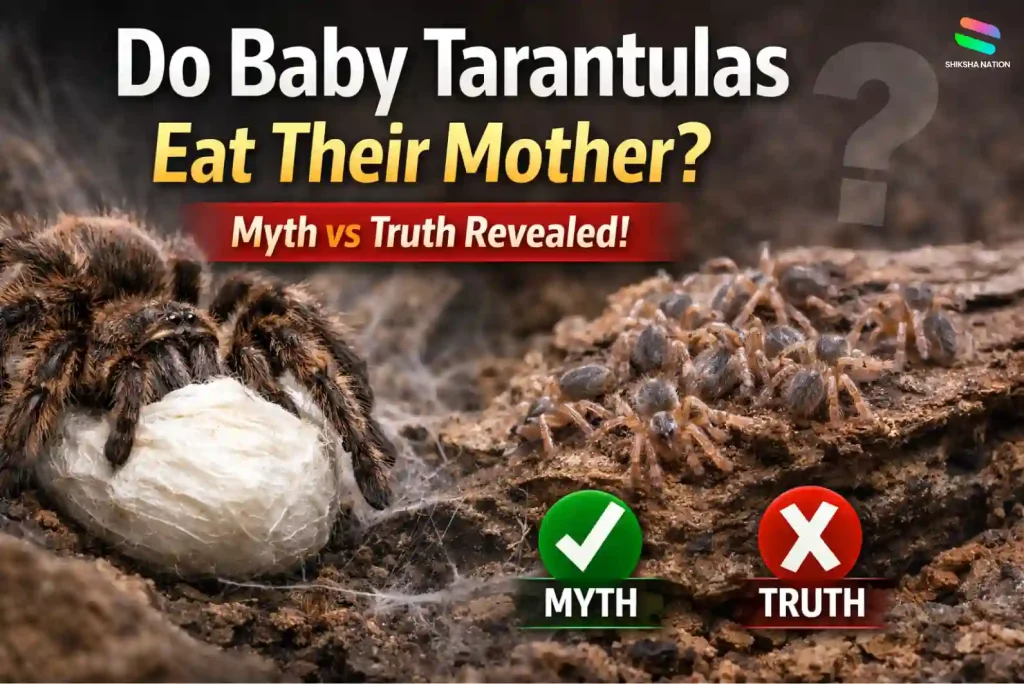
What Happens After Baby Tarantulas Hatch?
Tarantula Life Cycle Explained Simply
To understand this clearly, let’s break down the tarantula life cycle in simple steps:
- The female tarantula lays eggs inside a silk egg sac.
- She protects and carries this sac with great care.
- After a few weeks, tiny babies called spiderlings hatch from the eggs.
- These spiderlings stay near the sac for a short time.
- Soon, they start to move away and become independent.
Unlike what many believe, there is no aggressive behavior at this stage. It is a natural growth process.
Do Mothers Take Care of Their Babies?
When it comes to maternal behavior in spiders, tarantulas show limited but significant care:
- The mother protects the egg sac from predators.
- She may remain close until the babies hatch.
- After hatching, her role is minimal.
This is important for students to know:
Tarantulas do not feed their young like mammals do. Instead, survival relies on their independence.
This helps parents and students see that spider behavior is based on instinct and survival, not human emotions.
Do Tarantulas Eat Their Babies or Each Other?
Many students ask whether tarantulas eat their babies or attack one another. Sometimes yes, but this is not the norm. This behavior relates to survival instincts, not aggression. Cannibalism can happen in rare situations:
- It mostly happens when there’s a lack of food.
- It can also occur due to stress or overcrowding.
- Younger or weaker spiders are more at risk.
So, why do spiders eat each other?
It is a survival strategy, not a habit.
For parents and students, the key point is:
This is not common behaviour in natural conditions
In the wild, tarantulas prefer to avoid conflict and survive independently.
Do Baby Spiders Eat Their Mother? Myth vs. Reality
A common confusion is whether spiders eat their mother or if baby spiders do so. For tarantulas, the answer is no, that’s a myth. However, in some other spider species, rare behaviors have been observed:
- Babies may feed on the mother in extreme cases.
- This usually occurs when food is scarce.
- It is a survival mechanism, not a normal behavior.
An important distinction for students:
Tarantulas do not exhibit this behavior. Some smaller spider species may do so rarely. Thus, it’s incorrect to generalize about all spiders. Understanding this helps students learn how animal behavior can change by species, not assumptions.
Why Do Some Animals Eat Each Other?
What is Cannibalism in Animals?
Cannibalism in animals means one animal eats another of the same species. It may seem unusual, but it is a natural behavior in some cases. Here are some examples of cannibalism in animals:
- Certain insects like praying mantises.
- Some fish species.
- A few spider species.
- Amphibians like tadpoles in crowded conditions.
For students, this isn’t about “cruelty” but how nature functions.
Why Does It Happen in Nature?
This behavior is linked to survival instincts and environmental conditions.
- Food shortages mean animals use any available source.
- Competition leads to stronger individuals surviving.
- Overcrowding limits space and resources.
- Energy needs prompt quick nutrition in extreme situations.
These are part of animal adaptation strategies that help species survive over time.
For parents and students:
This concept connects with topics like natural selection and ecosystem balance, where only the fittest survive.
Is Spider Cannibalism Common in Nature?
- Many students ask if spider cannibalism is common. The answer is no, it’s not very common.
- Most spiders do not regularly show this behavior.
- It occurs only in specific conditions like stress or food shortages.
- Many species prefer to avoid one another.
So, do all spiders exhibit cannibalism?
No, behavior varies from species to species. For students, the key takeaway is:
Animal behavior differs by species, and understanding these differences is more valuable than believing general myths.
Difference Between Spiders and Tarantulas:
Understanding the differences between spiders and tarantulas helps clear up confusion, especially for students.
Here are some straightforward facts about tarantula behavior and differences:
- Size: Tarantulas are larger and heavier, while most spiders are small.
- Body and Hair: Tarantulas have hairy bodies; many spiders have smoother bodies.
- Habitat: Tarantulas usually live in burrows or ground areas. Other spiders are often found in webs, walls, or corners.
- Behavior: Tarantulas are generally slow and less aggressive. Many spiders are quicker and more active.
For students: Not all spiders act the same. Tarantulas are just one type with distinct habits.
What Should Students Take Away From This?
This topic ties into basic animal behavior science taught in Classes 6-8.
Key learning points:
- Animal actions are driven by survival, not emotions.
- The predator vs. prey concept explains how species rely on one another.
- Every species has a role in the food chain and ecosystem balance.
- Behaviors develop over time through the basics of natural selection.
For parents: This encourages children to think scientifically, not emotionally.
For students: Focus on grasping concepts rather than merely memorizing facts.
Quick Summary
Here’s a quick recap for easy review:
- Do baby tarantulas eat their mother? No, this is mostly a myth.
- Tarantulas protect their eggs and show limited care.
- Cannibalism can occur in rare survival situations.
- Not all spiders exhibit the same behavior.
- Animal behavior depends on environment and survival needs.
Final takeaway:
Always understand the science behind behavior, not just surprising facts.
FAQs – Do Baby Tarantulas Eat Their Mother?
Q. Is it true that baby tarantulas eat their mother?
No, this is mostly a myth. Baby tarantulas usually do not eat their mother. The mother protects the eggs, and after hatching, the babies become independent.
Q. Why do some spiders eat their mother after birth?
In a few rare spider species, this can happen due to extreme survival conditions. It provides nutrition to the babies, but this behavior is not seen in tarantulas.
Q. Do all spiders show cannibalism behavior?
No, not all spiders behave this way. Cannibalism depends on species and conditions like food shortages or stress. Most spiders avoid this behavior.
Q. What is cannibalism in spiders? (Explanation for students)
Cannibalism means eating members of the same species. In spiders, it may happen rarely for survival, especially when resources are limited.
Q. Do baby spiders depend on their mother for food?
No, most baby spiders, including tarantulas, do not rely on their mother for food. They begin hunting or finding food on their own after a short time.
Q. Can tarantulas eat each other?
Yes, but only in rare cases like overcrowding or lack of food. It is not a typical behavior in natural environments.
Q. Simple explanation of tarantula behavior for kids
Tarantulas are generally calm spiders. They protect their eggs but do not care for their babies for long. Their behavior is based on survival, not emotions.
Q. Is spider cannibalism common in nature?
No, it is not very common. It happens only under specific conditions and is not normal behavior for most spider species.
Q. Why do spiders eat each other sometimes?
This mainly occurs due to survival needs such as hunger, competition, or lack of space. It is a natural response, not aggressive behavior.