

Worksheets play a very important role when students practise Direct and Inverse Proportion, because this chapter is not about memorising formulas but about understanding when and how to apply them. Many Class 8 students know the formulas but get confused while solving word problems, especially in exams.
This direct and inverse proportion class 8 worksheet is designed to help students practise step by step and avoid common mistakes. Each question is created keeping school exam patterns in mind, so students learn how to identify whether a situation follows direct or inverse proportion before solving it.
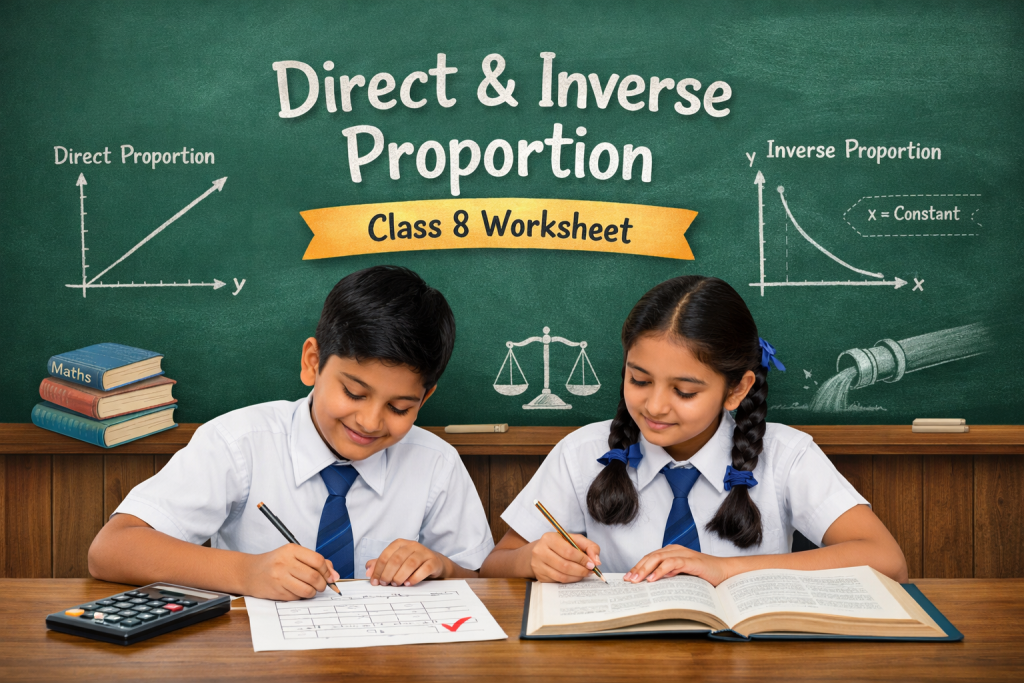
For parents, this worksheet ensures focused practice without overloading the child. It follows the concepts taught in class 8 maths chapter direct and inverse proportion for both CBSE and ICSE boards, making it safe and syllabus-aligned.
On this page, students will find structured questions, exam-level practice, and clear solutions that build confidence and improve accuracy with regular practice.

What Is Direct and Inverse Proportion? (Quick Recap)
Before solving questions, students must clearly understand which type of proportion to apply. This quick recap helps students and parents ensure concept clarity before moving to the worksheet on direct and inverse proportion.
Direct Proportion (Simple Explanation)
Two quantities are in direct proportion when both increase or decrease together. If one value doubles, the other also doubles.
Mini example:
If 5 notebooks cost ₹50, then 10 notebooks will cost ₹100.
Here, cost increases as quantity increases.
Real-life examples:
Speed and distance (at constant time), cost and quantity, wages and days worked.
Inverse Proportion (Simple Explanation)
In inverse proportion, one quantity increases while the other decreases. Both values move in opposite directions.
Mini example:
If 6 workers complete a job in 10 days, more workers will take fewer days.
This contrast between direct and inverse forms the base of direct and inverse variation class 8 questions, especially in exams where students must first identify the relationship before solving.
Direct Proportion Class 8 Worksheet Questions
This section of the worksheet on direct and inverse proportion focuses only on direct proportion questions. Students should first check whether both quantities increase or decrease together before choosing the formula. Parents can use these questions to check whether the child understands the logic, not just the calculation.
Fill in the Blanks (Exam Warm-up)
- If the cost of 3 pens is ₹30, the cost of 6 pens is ₹_____.
- When speed increases, the distance covered in the same time also _____.
- If 8 notebooks cost ₹160, then 1 notebook costs ₹_____.
- If 5 kg of rice costs ₹250, then 10 kg will cost ₹_____.
- When the number of items increases, the total cost increases in _____ proportion.
Table-Based Questions (Concept Clarity)
- Complete the table if x and y are in direct proportion:
| x | 2 | 4 | 6 |
| y | 10 | ? | ? |
- The cost of apples varies directly with quantity.
| Apples (kg) | 3 | 5 | 8 |
| Cost (₹) | 90 | ? | ? |
Students should keep units consistent while filling values, as unit mismatch often leads to wrong answers.
Word Problems (Exam-Level Practice)
- If a car travels 120 km in 3 hours, how much distance will it cover in 5 hours at the same speed?
- The wages earned are directly proportional to the number of days worked. If a worker earns ₹600 in 4 days, how much will they earn in 10 days?
- If 15 notebooks cost ₹300, find the cost of 25 notebooks.
Exam focus:
Always write the relation clearly before solving. Check units carefully and avoid skipping steps, as marks are often cut for incorrect setup even if the final answer seems right.
Inverse Proportion Class 8 Worksheet Questions
This part of the worksheet on direct and inverse proportion covers inverse proportion, where one quantity increases while the other decreases. Before solving, students must check whether the total work, distance, or task remains fixed. Parents can guide children to ask this question first, as it prevents most mistakes.
Pipes and Tanks Questions
- If 4 pipes can fill a tank in 12 hours, how long will 6 similar pipes take?
- A tank is filled by 5 pipes in 20 hours. Find the time needed if only 4 pipes are used.
- If 8 pipes fill a tank in 15 hours, how many hours will 10 pipes take?
- If 6 identical pipes empty a tank in 9 hours, how long will 3 pipes take to empty it?
- A tank is filled by 12 pipes in 6 hours. Find the time taken by 4 pipes.
Speed and Time Questions
- A train covers a fixed distance in 5 hours at a speed of 60 km/h. How long will it take at 75 km/h?
- A car takes 4 hours to travel a certain distance at 50 km/h. Find the time taken at 100 km/h.
- A bus completes a journey in 6 hours at 40 km/h. How much time will it take at 80 km/h?
- A cyclist covers a distance in 3 hours at 20 km/h. Find the time if speed is increased to 30 km/h.
- A truck covers a fixed route in 10 hours at 45 km/h. Calculate the time taken at 60 km/h.
Workers and Days Questions
- If 6 workers complete a job in 15 days, how many days will 10 workers take?
- A group of 8 workers can finish a task in 12 days. Find the time needed by 16 workers.
- If 20 workers finish a job in 9 days, how long will 15 workers take?
- A piece of work is completed by 5 workers in 24 days. How many days will 12 workers take?
- If 9 workers can complete a job in 18 days, find the time taken by 6 workers.
Important Student Tip
Do not apply inverse proportion if the total work, distance, or task is not fixed. This clarity is essential for solving direct and inverse variation class 8 questions correctly, especially in exams where step selection and unit consistency carry marks.
Direct and Inverse Proportion Extra Questions (Exam Level)
These direct and inverse proportion class 8 extra questions are meant for students who have completed basic practice and want stronger exam readiness. Such questions often appear in unit tests and final exams, where students must first identify the type of proportion and then apply the correct steps. Parents can use this section to check conceptual clarity before exams.
Mixed Concept Questions
- The cost of 12 chairs is ₹6,000. Find the cost of 20 chairs at the same rate.
- A car covers a certain distance in 8 hours at 45 km/h. How long will it take at 60 km/h?
- If 15 workers can complete a task in 20 days, how many days will 10 workers take?
- The cost of 7 kg of sugar is ₹315. Find the cost of 11 kg of sugar.
- A train travels 180 km in 3 hours. How much distance will it cover in 5 hours at the same speed?
Higher-Difficulty Exam Questions
- If 9 taps can fill a tank in 6 hours, how long will 12 taps take to fill the same tank?
- A group of 18 workers can finish a job in 15 days. Find the time needed by 12 workers.
- The cost of 8 m of cloth is ₹1,200. How much cloth can be bought for ₹1,800 at the same rate?
- A cyclist covers a fixed distance in 4 hours at 18 km/h. Find the speed required to cover the same distance in 3 hours.
- If 20 machines produce 800 items in a day, how many items will 30 machines produce in the same time?
Exam tip:
Always write the relation clearly before solving. Marks are often given for correct setup, so choosing the right proportion is as important as the final answer.
Case-Based Questions on Direct and Inverse Proportion
These case based questions direct and inverse proportion class 8 follow the CBSE competency-based pattern, where students must read a situation carefully and apply the correct logic. Such questions test understanding more than calculation, which is why parents should ensure children practise these before exams.
Case 1: Cost and Quantity
A school buys notebooks for students. The cost increases as the number of notebooks increases at a fixed rate.
- Identify the type of proportion between cost and quantity.
- If 10 notebooks cost ₹200, find the cost of 25 notebooks.
- What will be the cost of 1 notebook?
- If the price per notebook remains same, will the relation change?
- Write the formula used to solve this case.
Case 2: Speed and Time
A bus travels a fixed distance between two towns. When the speed increases, the time taken decreases.
- Identify the relationship between speed and time.
- If the bus takes 6 hours at 40 km/h, find the time at 60 km/h.
- Will the distance change in this case?
- What happens to time if speed is doubled?
- Mention one real-life situation similar to this case.
Case 3: Workers and Work
A construction job needs a fixed amount of work to be completed.
- Identify whether workers and days are in direct or inverse proportion.
- If 12 workers complete the job in 15 days, find the time taken by 20 workers.
- What will happen if the number of workers is reduced?
- Which quantity remains constant here?
- Why is inverse proportion applied in this case?
Case 4: Pipes Filling a Tank
A water tank is filled using identical pipes.
- Identify the type of proportion between number of pipes and time.
- If 5 pipes fill the tank in 10 hours, how long will 8 pipes take?
- What remains constant in this situation?
- Will the relation change if pipe size changes?
- Mention one mistake students often make in such questions.
Case 5: Wages and Days
Daily wages depend on the number of days worked.
- Identify the relationship between wages and days.
- If a worker earns ₹450 in 5 days, how much will they earn in 9 days?
- What assumption is made about daily wages?
- Will this relation change if daily wages vary?
- State the formula used to solve this case.
Answers and Step-by-Step Solutions
This section of the direct and inverse proportion class 8 worksheet with answers is designed to help students understand how to solve questions, not just reach the final number. Parents can use these steps to check whether the child is following the correct method and not skipping important logic.
Example 1: Direct Proportion (Cost and Quantity)
Question:
If 6 notebooks cost ₹120, find the cost of 15 notebooks.
Step 1:
More notebooks mean more total cost, so this is a direct proportion.
Step 2:
Write the relation: Cost ∝ Quantity
Step 3:
Cost per notebook = 120 ÷ 6 = ₹20
Step 4:
Cost of 15 notebooks = 15 × 20 = ₹300
Why this works:
The price of each notebook is fixed, so cost increases at the same rate.
Example 2: Inverse Proportion (Workers and Days)
Question:
If 8 workers complete a job in 12 days, how many days will 16 workers take?
Step 1:
More workers mean less time, so this is an inverse proportion.
Step 2:
Write the relation: Workers × Days = constant
Step 3:
8 × 12 = 96
Step 4:
Days = 96 ÷ 16 = 6
Why this works:
The total work remains the same, only the number of workers changes.
Example 3: Inverse Proportion (Speed and Time)
Question:
A car covers a distance in 5 hours at 60 km/h. Find the time taken at 75 km/h.
Step 1:
Distance is fixed, so speed and time are inversely related.
Step 2:
Speed × Time = constant
Step 3:
60 × 5 = 300
Step 4:
Time = 300 ÷ 75 = 4 hours
Exam reminder:
Always write the relation first. Even if the calculation is correct, missing steps can reduce marks in school exams.
Example 4: Direct Proportion (Distance and Time)
Question:
A train travels 180 km in 3 hours. How much distance will it travel in 5 hours at the same speed?
Step 1:
Speed is constant, so distance increases with time. This is direct proportion.
Step 2:
Write the relation: Distance ∝ Time
Step 3:
Distance per hour = 180 ÷ 3 = 60 km
Step 4:
Distance in 5 hours = 60 × 5 = 300 km
Why this works:
When speed does not change, distance grows at a fixed rate with time.
Example 5: Inverse Proportion (Pipes and Time)
Question:
If 6 pipes can fill a tank in 10 hours, how long will 12 similar pipes take?
Step 1:
More pipes will take less time, so this is inverse proportion.
Step 2:
Write the relation: Pipes × Time = constant
Step 3:
6 × 10 = 60
Step 4:
Time = 60 ÷ 12 = 5 hours
Why this works:
The amount of water needed to fill the tank stays the same, only the number of pipes changes.
Student tip:
Always check what remains constant in the question. This simple check helps avoid wrong formula selection in exams.
Download Direct and Inverse Proportion Class 8 Worksheet PDF
Students and parents who prefer offline practice can download the direct and inverse proportion class 8 worksheet pdf from this section. The PDF is useful for regular revision, homework practice, and quick pre-exam preparation without screen time.
This worksheet PDF includes direct proportion questions, inverse proportion problems, and exam-level practice in a clear and printable format. Parents can easily track progress by checking completed questions, while students can revise important patterns anytime.
The PDF is best used after understanding the concepts explained above, so practice becomes accurate and confidence improves with each attempt. Direct and Inverse Proportion Class 8 Worksheet with Answers
Common Mistakes Students Make in This Chapter
Many students lose easy marks in this chapter not because the sums are hard, but because of small thinking errors. Parents often notice that children rush to apply a formula without checking the relationship first.
Confusing Direct and Inverse Proportion
Students sometimes apply direct proportion where inverse proportion is needed. A simple check helps—if one value increases and the other decreases, it is inverse. Skipping this check leads to wrong answers even when calculations are correct.
Using the Wrong Formula
Some students memorise formulas but forget when to use them. Writing the relation first, such as cost ∝ quantity or workers × days = constant, reduces confusion and builds accuracy.
Ignoring Units
Marks are often lost due to unit mismatch, like mixing hours with minutes or kilograms with grams. Parents can remind students to convert all units before starting the solution.
Tip:
When students explain their steps aloud, their understanding improves and exam mistakes reduce naturally.
Exam Tips for Direct and Inverse Proportion (CBSE & ICSE)
In CBSE and ICSE exams, marks are given not only for the final answer but also for the method used. Parents should ensure students practise writing steps clearly, as even small skips can lead to mark cuts.
How Answers Are Checked
Examiners first check whether the correct type of proportion is chosen. Then they look for the proper relation, correct formula, and accurate calculation. A correct setup often earns partial marks even if the final value is wrong.
Marks Distribution and Presentation Tips
Usually, 1-2 marks are given for steps and the remaining for the answer. Students should write the relation, show calculations neatly, and mention units clearly. Clean presentation and proper spacing make answers easy to check and improve scoring chances.
Frequently Asked Questions (FAQs)
Q. Is this worksheet suitable for both CBSE and ICSE students?
Yes, the questions are based on the core concepts taught in Class 8 Maths for both CBSE and ICSE boards. The structure and difficulty level match school exams, making it safe for regular practice and revision.
Q. Does this worksheet include answers and solutions?
Yes, students can refer to the direct and inverse proportion class 8 worksheet with answers section to understand the correct steps. Parents can use the solutions to check whether the method followed by the child is correct.
Q. Is NCERT practice enough for this chapter?
NCERT examples help build the base, but many exams include extra and mixed questions. Additional practice through worksheets improves speed, accuracy, and confidence, especially for word problems.
Q. Should students practise from PDF worksheets or online questions?
Both are useful. A direct and inverse proportion class 8 worksheet pdf is good for offline practice and revision, while online practice helps with guided learning. Using both gives better results.
Q. How many questions should a Class 8 student practise daily?
Students can start with 8–10 questions daily and increase before exams. Parents should focus more on correct steps than on the number of questions attempted.
Q. How can students avoid confusing direct and inverse proportion?
Students should first check what remains constant in the question. Writing the relation before solving helps in choosing the correct method and reduces mistakes.
Q. Are case-based questions important for exams?
Yes, case-based questions test understanding and are common in recent exam patterns. Practising such questions helps students apply concepts to real-life situations.
Q. Can parents use this worksheet for self-check at home?
Yes, parents can easily track progress by checking steps, units, and final answers. Regular review builds confidence and improves exam performance over time.