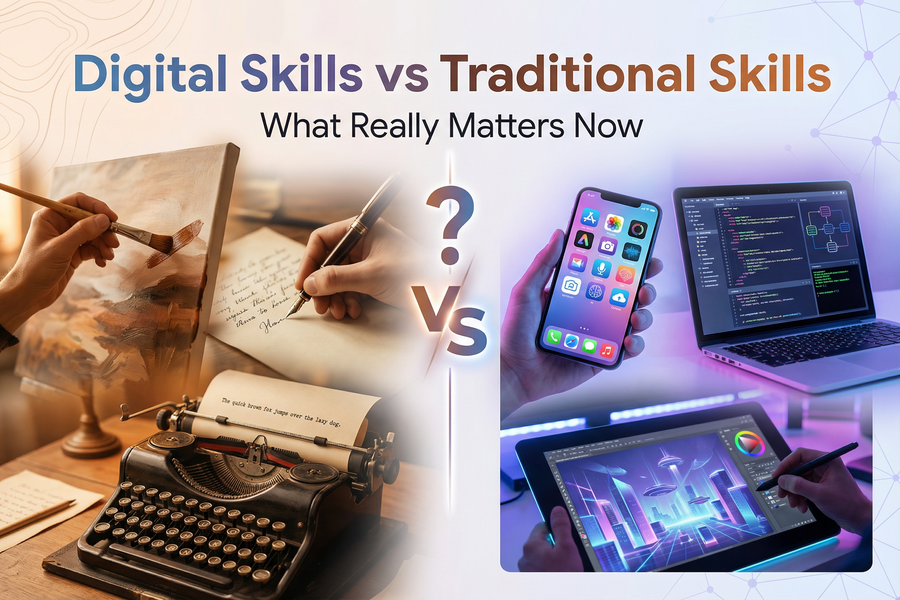

In today’s fast-shifting world of marketing, the debate around digital skills vs traditional skills has become more relevant than ever. Every business, from a small local shop to a global brand, now faces the same challenge how to stay visible, connect with customers, and grow in a marketplace that is evolving faster than anyone expected. While traditional marketing skills are still valuable, the rise of digital platforms has completely transformed how brands communicate.
In this blog, we break down what really matters today, why digital skills have become essential, and how traditional skills still play a role—but not always in the way they used to.

What Are Digital Skills?
Digital skills refer to the abilities needed to create, manage, and optimise marketing activities on online platforms. These skills include:
- Social media marketing
- SEO (Search Engine Optimisation)
- SEM (Search Engine Marketing)
- Content marketing
- Email marketing
- Analytics and data interpretation
- Digital advertising
- Marketing automation
- Website management
- AI-powered marketing tools
Digital skills help marketers reach customers across channels such as Google, Instagram, Facebook, LinkedIn, YouTube, and even emerging platforms like Threads or OTT ads.
What Are Traditional Marketing Skills?
Traditional marketing skills are based on offline platforms, including:
- Print advertising
- TV and radio ads
- Outdoor marketing (hoardings, banners, billboards)
- Event marketing
- Direct mail
- Telemarketing
- PR and media relations
- Branding through physical materials
These skills focus on mass reach, emotional impact, and brand recall through physical or broadcast media.
Why Digital Skills Matter More Today
The shift from traditional to digital did not happen overnight. It happened because consumer behaviour changed. People now spend more time online than watching TV, reading newspapers, or listening to radio ads.
Here are the reasons why digital skills matter more today:
1. Consumers Have Moved Online
More than 60% of daily consumer decisions now start online. Whether it’s buying a product, searching for a service, or reading reviews, digital platforms influence everything.
This shift means marketers must understand how to reach people where they spend their time on social media, Google, YouTube, and apps.
2. Digital Marketing Is Measurable
One major advantage of digital skills is the ability to measure everything:
- Who clicked your ad
- What time they engage?
- Which age group converted
- How many leads were generated
- How your content performed
Traditional marketing cannot provide this level of accuracy. You cannot measure how many people saw a billboard or how many listeners acted on a radio ad.
3. Digital Skills Offer Higher ROI
Digital marketing is more cost effective because:
- Campaigns can start with low budgets
- Ads can be optimised in real time.
- You pay only for results (like clicks or conversions)
- There is no wastage of budget
Traditional marketing, on the other hand, involves high costs for printing, production, or media buying.
4. Digital Allows Personalisation
Today, personalisation is everything. Customers expect communication that speaks directly to them.
Digital skills allow marketers to target audiences based on:
- Age
- Location
- Interests
- Behaviour
- Buying patterns
Traditional marketing cannot achieve this level of precision.
5. Digital Skills Align With the Future of Work
As AI, automation, and digital tools grow, companies need professionals who can handle:
- CRM systems
- AI chatbots
- Data dashboards
- Digital funnels
- Automated email sequences
- Lead scoring systems
These skills are becoming core requirements for modern marketing teams.
Where Traditional Skills Still Matter
While digital skills dominate today, traditional skills are not useless. They still matter in several ways:
1. Brand Building and Emotional Impact
Print ads, TV commercials, and brand events create emotional connections that digital platforms struggle to match. Traditional skills help build:
- Brand trust
- Brand heritage
- Mass visibility
- Long-term recall
2. Offline Marketing Works Better for Certain Industries
Industries like FMCG, real estate, retail, and automobiles still rely heavily on:
- Newspaper ads
- Showroom marketing
- Outdoor boards
- Local events
Traditional methods support the overall customer experience.
3. Traditional Skills Strengthen Strategic Thinking
Skills like storytelling, communication, creative design, and consumer psychology are timeless. They are not digital or traditional—they are universal.
Great marketers combine digital knowledge with classic marketing principles.
4. Traditional + Digital = Hybrid Marketing
The real magic happens when brands integrate both worlds. Examples include:
- Using QR codes on print ads
- TV ads driving viewers to Instagram pages
- Billboard campaigns supported by Google Ads
- Offline events promoted through Facebook Ads
This hybrid approach delivers the strongest results.
Digital Skills vs Traditional Skills: Key Differences
Here is a quick comparison to understand what really matters now:
| Aspect | Digital Skills | Traditional Skills |
|---|---|---|
| Reach | Global & targeted | Local & mass reach |
| Cost | Low to moderate | High |
| Tracking | 100% measurable | Limited |
| Speed | Instant | Slow |
| Personalisation | High | None |
| Tools Needed | Digital tools, software, AI | Print, media, production |
| Future Demand | Very high | Medium |
| Scalability | Easy to scale | Expensive to scale |
This comparison shows that while both are useful, digital skills have become core, essential, and future-proof.
The Rise of Digital-First Careers
Companies now hire digital savvy professionals far more than traditional marketing experts. Top in demand roles include:
- Digital marketing manager
- SEO specialist
- Performance marketer
- Social media strategist
- Content creator
- Paid ads manager
- Marketing automation expert
- Data and analytics specialist
- Funnel builder
- AI-driven marketing specialists
These roles simply didn’t exist 10-15 years ago. That’s how fast the industry is evolving.
Why Digital Skills Are Becoming Mandatory
Here is the simple truth: digital is where the customers are, where the data is, and where the future is heading.
Digital skills are becoming mandatory because:
-
Every business now wants online visibility
-
Marketing budgets are shifting to digital platforms
-
AI is making digital work smarter and faster
-
Companies need measurable results
-
Skills like SEO, ads, and automation have become the backbone of marketing
-
Digital platforms update daily continuous learning is essential
Traditional skills alone cannot match the speed and scale of digital capabilities.
Why Traditional Skills Are Becoming Optional
Traditional marketing skills still matter, but they are no longer mandatory for most roles. Why?
- Fewer brands rely solely on offline promotions
- Traditional campaigns cost more
- Younger audiences prefer digital content
- Offline measurement is difficult
- Digital results are faster
This doesn’t mean traditional marketing is dead it simply means digital marketing has become the default, and traditional is now an additional skill, not a required one.
What Really Matters Now?
In today’s marketing world, what truly matters is a blend of digital expertise and traditional wisdom. To stand out, marketers should aim for:
- Strong digital execution
- Solid understanding of marketing fundamentals
- Ability to integrate online and offline campaigns
- Creativity + data-driven decision-making
- Continuous learning and adaptability
This combination creates the most powerful marketing professionals.
Final Thoughts
The debate between digital skills vs traditional skills is not about choosing one over the other. It’s about understanding the role each plays in today’s marketing landscape.
Digital skills have become essential because they align with modern consumer behaviour, offer better control, and deliver measurable results. Traditional skills still matter, but they no longer define the core of marketing they enhance it.
If you want to grow in your career or scale your business, mastering digital skills is no longer optional. It’s the key that unlocks future opportunities.
As shared in the Adobe Digital Trends Report, data-driven marketing is now essential.
Also Read: Best AI Tools for Marketers in 2025