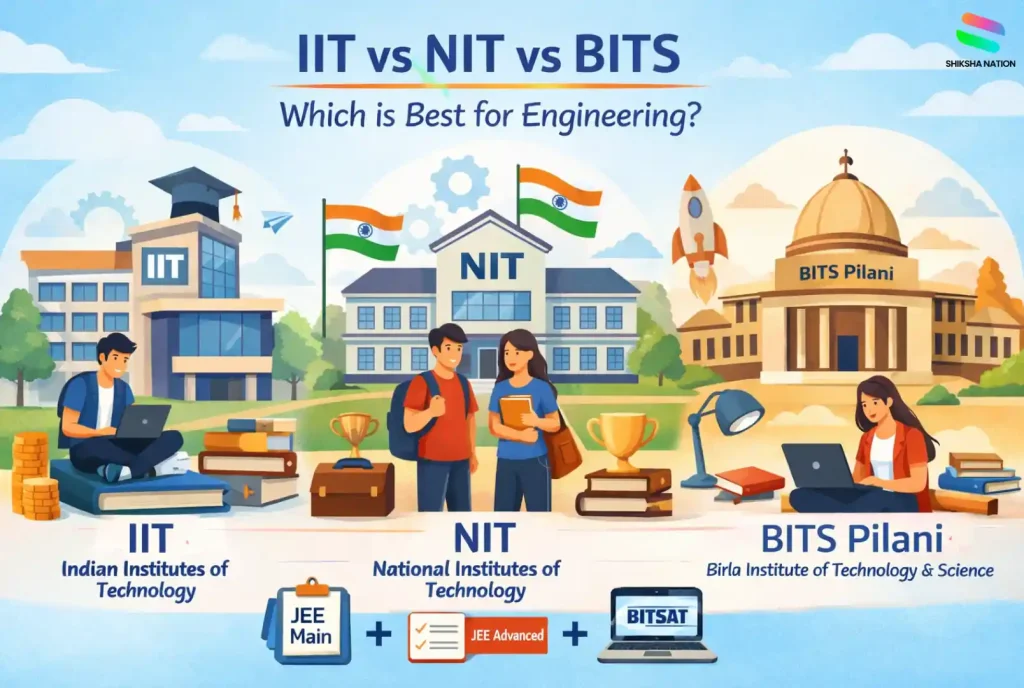
What Are IIT, NIT and BITS?
IITs, NITs, and BITS are among the top engineering colleges in India, but they are managed differently and follow different admission systems. For students planning engineering after Class 12, understanding these institutes helps in deciding which entrance exam to prepare for and what college options may be available.
Two of these – IITs and NITs – are government engineering colleges in India, funded and supported by the central government. BITS Pilani, on the other hand, is one of the most reputed private engineering colleges in India, known for its independent admission process and flexible campus culture.
Although all three focus on engineering education, their admission exams, fee structure, and learning environment are different. Understanding these basics helps students and parents evaluate realistic college pathways after school.
What are IITs?
The Indian Institutes of Technology (IITs) are a group of premier engineering institutes established by the Government of India. They are widely known for their strong academic standards, research culture, and competitive admissions.
Admission to IITs happens through a two-step process:
- Students first appear for JEE Main.
- The top qualifying students then take JEE Advanced, which is required for IIT admission.
There are currently 23 IITs across India, including IIT Bombay, IIT Delhi, IIT Madras, and IIT Kanpur. These institutes offer undergraduate, postgraduate, and research programs in engineering, technology, and sciences.
For many students preparing for JEE, IITs represent the most competitive goal in engineering education because of limited seats and a highly selective admission process.
What are NITs?
The National Institutes of Technology (NITs) are also government engineering colleges in India, but their admission process is slightly different from IITs.
Students can enter NITs directly through their JEE Main rank, without taking JEE Advanced. Admissions are conducted through the JoSAA counselling process, which allocates seats based on rank, category, and preferences.
There are 31 NITs across India, including well-known institutes such as NIT Trichy, NIT Surathkal, and NIT Warangal. These colleges offer undergraduate and postgraduate programs in engineering, technology, and management.
For many students, NITs are considered a strong and realistic option after JEE Main, especially if they secure a good rank but do not qualify for IIT admission.
What is BITS Pilani?
BITS Pilani (Birla Institute of Technology and Science) is one of the most respected private engineering colleges in India. It operates campuses in Pilani, Goa, and Hyderabad, along with an international campus in Dubai.
Unlike IITs and NITs, admission to BITS does not depend on JEE scores. Instead, students must appear for a separate entrance test called BITSAT (Birla Institute of Technology and Science Admission Test).
BITS Pilani is known for several unique features:
- Flexible academic structure
- Strong industry-oriented programs
- A well-known practice school internship system
Because of its infrastructure, placements, and academic freedom, BITS Pilani is often compared with top government engineering institutes when students evaluate different engineering college options.
Key Differences Between IIT, NIT and BITS
Students and parents often compare these institutes while planning engineering after Class 12. Although all three are among the top engineering institutes students aim for, there are clear differences in admission exams, ownership, fees, and campus structure.
The IIT NIT BITS comparison becomes important when students decide which entrance exams to prepare for and what college options they may realistically get based on their rank.
Below is a simple comparison that explains the IIT vs NIT difference and how BITS Pilani fits into the picture.
Basic Comparison of IIT, NIT and BITS
| Feature |
IIT (Indian Institutes of Technology) |
NIT (National Institutes of Technology) |
BITS Pilani |
| Type of Institute |
Government |
Government |
Private |
| Entrance Exam |
JEE Advanced (after JEE Main) |
JEE Main |
BITSAT |
| Number of Institutes |
23 IITs |
31 NITs |
3 main campuses in India |
| Admission Process |
Through JEE Advanced rank and JoSAA counselling |
Through JEE Main rank and JoSAA counselling |
Through BITSAT score and BITS counselling |
| Fees (Approx) |
Medium |
Lower compared to IITs |
Higher than most government colleges |
| Reservation Policy |
Government reservation system |
Government reservation system |
No reservation policy |
| Reputation |
Highest brand value in engineering |
Strong reputation among government colleges |
Highly reputed private engineering institute |
What This Means for Students
For most students preparing for engineering, the difference mainly comes down to which exam they qualify for and the rank they achieve.
- Students with top JEE Advanced ranks usually get IITs.
- Students with good JEE Main ranks may get admission in NITs.
- Students who perform well in BITSAT can secure seats in BITS Pilani campuses.
Parents also look at factors like fees, campus exposure, and placements when comparing these institutes. Understanding these differences helps families make more informed decisions during counselling and college selection.
Admission Process: JEE Main vs JEE Advanced vs BITSAT
For students planning engineering after Class 12, the admission pathway depends on the entrance exam they take. The three main routes involve JEE Main, JEE Advanced, and the BITSAT entrance exam.
Understanding JEE Main vs JEE Advanced is important because the exam you qualify for determines whether you can apply to IITs, NITs, or BITS Pilani. Parents also often look at this pathway early so students can prepare for the correct exam from Class 11.
Below is a simple explanation of how the admission process works for each institute.
IIT Admission Process
The IIT admission process involves two major exams and a national counselling system.
Step-by-step process:
- Students first appear for JEE Main, conducted by the National Testing Agency (NTA).
- The top-performing students qualify to appear for JEE Advanced.
- Students who clear JEE Advanced receive an All India Rank (AIR).
- Based on this rank, students participate in JoSAA counselling to choose IIT branches and campuses.
Because seats in IITs are limited, the selection process is considered one of the most competitive engineering admissions in India.
NIT Admission Through JEE Main
Unlike IITs, NIT admission through JEE Main happens directly without JEE Advanced.
The process generally follows these steps:
- Students appear for JEE Main after Class 12.
- Based on their JEE Main rank, they become eligible for NIT admissions.
- Students then participate in JoSAA counselling, where they select preferred NITs and engineering branches.
- Seats are allotted based on rank, category, and seat availability.
For many students, NITs are a strong option if they secure a good JEE Main rank, even if they do not qualify for IIT admission.
BITS Pilani Admission Process
The BITS Pilani admission process is different because the institute conducts its own entrance test.
Steps involved:
- Students register for the BITSAT entrance exam after completing Class 12 with Physics, Chemistry, and Mathematics.
- BITSAT is an online computer-based test that checks speed and accuracy in multiple subjects.
- After the exam, students submit their campus and branch preferences.
- Seats are allotted through BITS counselling based on BITSAT scores.
Since BITS does not use JEE scores, many students attempt both JEE exams and BITSAT to keep more college options open. This approach helps families evaluate different admission possibilities during the counselling stage.
Fees and Cost Comparison
For many families, the cost of engineering education is an important factor while comparing colleges. When students look at different institutes, the IIT NIT BITS fees comparison helps them understand how much they may need to invest during four years of study.
Government institutes like IITs and NITs usually have lower tuition fees because they receive central government funding. Private institutes such as BITS Pilani generally have higher academic fees, but they also provide strong infrastructure and campus facilities.
Parents also consider factors like hostel charges, scholarships, and return on investment (ROI) while evaluating these options.
Approximate Annual Fees in IIT, NIT and BITS
The numbers below are approximate and may vary slightly by campus and year.
| Institute |
Approx Annual Fees |
| IIT (Indian Institutes of Technology) |
₹2,00,000 – ₹2,50,000 |
| NIT (National Institutes of Technology) |
₹1,25,000 – ₹2,00,000 |
| BITS Pilani |
₹4,50,000 – ₹6,00,000 |
These figures usually include tuition fees, but additional expenses such as hostel, mess, and personal costs may increase the total yearly expense.
What This Means for Students and Parents
When comparing NIT vs BITS fees, many families notice that NITs are generally more affordable because they are government-funded institutes.
However, cost should not be the only factor while choosing a college. Students and parents often also look at:
- Placement opportunities
- Quality of education
- Campus exposure and internships
Understanding the overall financial picture helps families make a more practical decision during engineering college counselling.
Placements and Career Opportunities
When students and parents compare engineering colleges, placements are often the biggest deciding factor. In India, institutes like IITs, NITs, and BITS Pilani have built strong reputations in engineering college placements in India because many companies regularly recruit from their campuses.
However, placement outcomes can vary depending on branch, institute reputation, and student skills. While top institutes often attract leading companies, individual performance and practical knowledge also play an important role in final job offers.
Placement Trends in IITs
IITs generally attract large national and international recruiters across technology, consulting, finance, and research roles.
Some common placement trends in IITs include:
- High average packages in branches like Computer Science and Electrical Engineering
- Recruiters such as Google, Microsoft, Amazon, and major consulting firms
- Opportunities for research roles and international placements
Because of their long academic history and industry connections, IITs are often seen as leaders when students compare IIT vs NIT placements.
Placement Trends in NITs
NITs also have a strong placement ecosystem, especially in well-established institutes such as NIT Trichy, NIT Surathkal, and NIT Warangal.
Typical placement patterns include:
- Strong recruitment from IT services and product companies
- Competitive packages for branches like Computer Science and Electronics
- Good industry connections with Indian and multinational companies
While the overall packages may vary across campuses, many NITs still offer solid career opportunities for engineering graduates.
Placement Trends in BITS Pilani
BITS Pilani has developed a strong placement reputation among private engineering institutes.
Some notable features include:
- High recruiter participation in technology and analytics roles
- A well-known Practice School internship program, which connects students with companies during their degree
- Competitive packages in branches like Computer Science and Electronics
Because of these factors, students often compare IIT vs BITS placements, especially when deciding between newer IITs and top branches in BITS Pilani.
Quick Placement Comparison
| Institute |
Placement Reputation |
Common Recruiters |
| IIT |
Very strong national and global reputation |
Tech companies, consulting firms, research organizations |
| NIT |
Strong placements, especially in top NITs |
IT companies, engineering firms, product companies |
| BITS Pilani |
Strong placements among private institutes |
Technology companies, startups, analytics firms |
For students, placements should be seen as one part of the bigger picture. Skills, internships, projects, and networking during college often have a major impact on career outcomes after graduation.
Campus Culture and Learning Environment
While comparing engineering colleges IIT NIT BITS, students and parents often focus on exams, fees, and placements. However, the campus culture and learning environment also play an important role in a student’s overall experience.
Each institute has its own academic structure, student activities, and lifestyle. These factors influence how students learn, manage academic pressure, and grow during their four years of engineering education.
Academic Pressure and Competition
In most top engineering institutes, the academic environment is competitive because students come from strong academic backgrounds.
- IITs are often known for intense academic competition and challenging coursework.
- NITs also maintain strong academic standards but the pressure can vary depending on the campus and branch.
- BITS Pilani focuses on continuous evaluation, where assignments, quizzes, and projects contribute to final grades.
For many students, managing academics along with personal well-being becomes an important part of college life.
Flexibility in Academic Structure
Another difference in engineering colleges IIT NIT BITS is the level of flexibility in course selection and attendance policies.
- IITs and NITs generally follow structured academic schedules with defined attendance requirements.
- BITS Pilani is known for offering more flexibility in certain academic rules, including optional attendance in some cases.
Students who prefer a self-driven learning environment may find this flexibility helpful, but it also requires good discipline and time management.
Student Life and Campus Activities
Apart from academics, these institutes offer a wide range of clubs, technical societies, and cultural events.
Students can participate in activities such as:
- Technical festivals and coding competitions
- Cultural festivals, music and art clubs
- Entrepreneurship cells and startup communities
These activities help students develop communication skills, teamwork, and leadership abilities alongside their technical education.
For parents and students evaluating colleges, understanding the campus culture helps ensure that the institute supports both academic growth and personal development during the engineering journey.
Which One Should You Choose?
Many students and parents eventually ask the question: NIT vs IIT which is better, or should BITS Pilani also be considered? The answer usually depends on factors such as exam rank, branch preference, and financial planning.
Instead of thinking about one institute as universally better, it is more practical to match your rank, interests, and priorities with the right college option. For some students, IIT may be the best fit, while others may find strong opportunities in NITs or BITS Pilani.
A simple decision framework can help students understand which option may suit their situation.
Simple Decision Guide for Students
| Situation |
Best Option |
| Very high rank in JEE Advanced |
IIT |
| Good rank in JEE Main but not qualifying for top IITs |
NIT |
| Strong BITSAT score and comfortable with higher fees |
BITS Pilani |
This framework does not mean one institute is always better than another. The final choice should consider branch preference, campus reputation, and career goals.
When Should You Choose IIT?
IITs are usually the first preference for students who secure a top JEE Advanced rank.
You may prefer an IIT if:
- You get a good branch in an established IIT
- You want strong research exposure and global recognition
- You prefer a government institute with a long academic history
These factors are why many comparisons such as BITS Pilani vs IIT often come up during counselling discussions.
When Should You Consider NIT?
NITs can be a strong choice for students who perform well in JEE Main but may not secure IIT admission.
NIT may be suitable if:
- You get a top branch like Computer Science or Electronics
- You prefer a government engineering college with lower fees
- You secure admission in well-known campuses such as NIT Trichy or NIT Surathkal
For many students, NITs provide a balanced combination of affordability, quality education, and good placements.
When Does BITS Pilani Become a Good Option?
BITS Pilani is often considered when students perform well in the BITSAT exam and are open to studying in a private institute.
BITS may be a good option if:
- You secure a top branch in BITS Pilani, Goa, or Hyderabad campus
- You value flexible academic systems and industry exposure
- Your family is comfortable with the higher fee structure
For some students, a strong branch at BITS can even become a competitive option when compared with mid-tier IITs or NITs, depending on individual priorities.
Branch vs College: A Common Student Confusion
During engineering counselling, many students face a difficult question: should I choose branch or college? This confusion usually appears when a student gets a well-known college but a less preferred branch, or a good branch in a different institute.
Parents and students often compare options like IIT with a lower branch vs NIT Computer Science, or BITS CS vs a newer IIT branch. The decision is not always straightforward, because both branch and college reputation can influence future opportunities.
Understanding a few practical rules can help students make a more balanced choice.
Why Branch Matters for Career Direction
The engineering branch you choose usually shapes the subjects you study and the career fields available after graduation.
For example:
- Computer Science often leads to careers in software development, data science, and technology companies.
- Mechanical or Civil Engineering may lead to roles in manufacturing, infrastructure, or research sectors.
Students who are clear about their career interest may prefer a strong branch even if the college is slightly lower in ranking.
Why College Reputation Also Matters
College reputation can influence:
- Quality of faculty and academic resources
- Exposure to competitions, projects, and internships
- Company participation during placements
This is why institutes like IITs are often considered the best engineering college after IIT-level reputation, while some top NITs and BITS Pilani campuses are also highly respected in the engineering community.
A Simple Rule Many Students Follow
While there is no universal rule, many students use a practical approach:
| Situation |
Possible Choice |
| Lower branch in a top IIT vs good branch in NIT |
Depends on interest and career goals |
| Computer Science in BITS vs lower branch in a new IIT |
Many students prefer the stronger branch |
| Similar branch in multiple institutes |
Choose the better campus reputation |
Students should also consider personal interest, long-term career plans, and learning environment before making a final decision.
Talking with seniors, mentors, or counsellors can help families evaluate these options more clearly during the admission process.
FAQs About IIT, NIT and BITS
Q. Which is better: IIT, NIT or BITS?
There is no single answer because it depends on rank, branch, and personal priorities. IITs are usually considered the most prestigious engineering institutes in India. However, top branches in BITS Pilani or leading NITs can also offer strong academics and placements. Students should compare branch, campus reputation, and career goals before choosing.
Q. Is BITS better than NIT?
In some situations, BITS Pilani can be comparable or even preferred over certain NITs, especially for branches like Computer Science or Electronics. BITS is known for strong industry exposure and internships. However, top NITs such as NIT Trichy, Surathkal, and Warangal are also highly respected government engineering colleges.
Q. Is BITS easier than IIT?
Admission to BITS Pilani happens through the BITSAT exam, while IIT admission requires clearing JEE Advanced, which is generally considered more difficult. However, BITSAT is still a competitive exam because many students appear for it and the number of seats is limited.
Q. Can I join NIT without JEE Advanced?
Yes. Admission to NITs does not require JEE Advanced. Students only need to appear for JEE Main and secure a good rank. Seats are then allocated through the JoSAA counselling process.
Q. What exam is required for BITS Pilani?
Students must appear for the BITSAT (Birla Institute of Technology and Science Admission Test) to get admission into BITS Pilani campuses. This is an online exam that tests Physics, Chemistry, Mathematics, English, and Logical Reasoning.
Q. Are NITs government colleges?
Yes. NITs (National Institutes of Technology) are government engineering colleges funded by the Government of India. They are considered Institutes of National Importance and are among the leading engineering institutes after IITs.
Q. Is BITS Pilani worth the fees?
BITS Pilani has higher tuition fees compared to many government engineering colleges. However, many students consider it worthwhile because of its academic reputation, industry connections, and placement opportunities. Families usually evaluate return on investment along with affordability.
Q. Do IIT, NIT and BITS have similar placements?
All three institutes have strong placement records, but the results vary by branch and campus. IITs usually attract the largest number of global recruiters. Top NITs and BITS Pilani also see strong participation from technology and engineering companies.
Q. Should I choose a better branch or a better college?
This depends on career goals. If a student is strongly interested in a specific field such as Computer Science, choosing that branch may be more useful. If the branch options are similar, selecting a college with stronger academic reputation and opportunities can be beneficial.