

Understanding Arithmetic Progression
An Arithmetic Progression (AP) is a sequence of numbers in which the difference between consecutive terms remains constant. This constant difference is called the “common difference” (d).
Example: 2, 5, 8, 11, 14… (here d = 3)
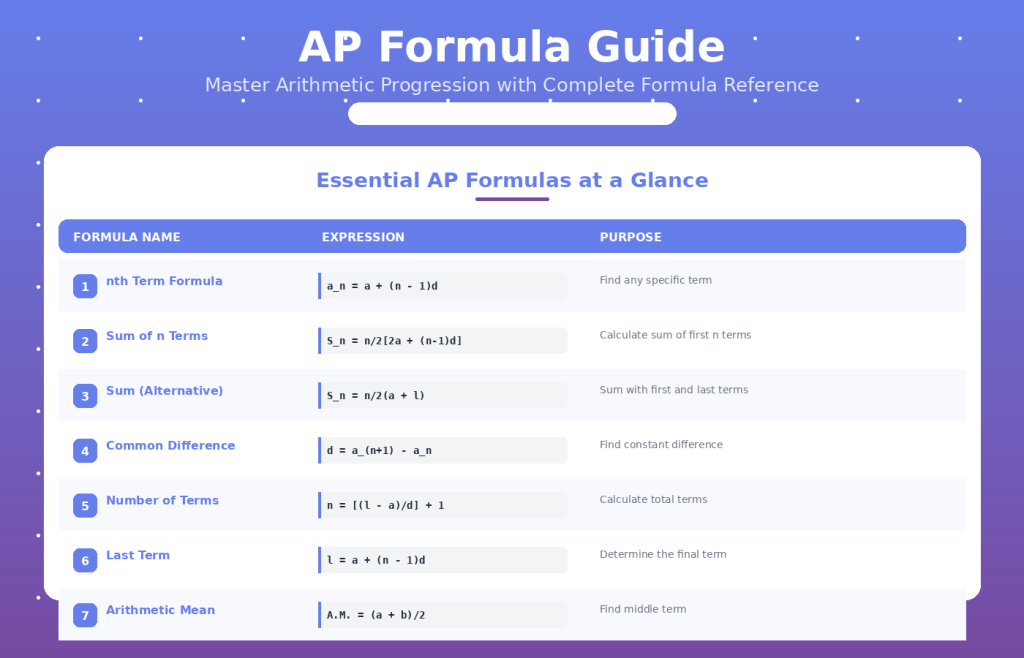
Comprehensive AP Formula Table
| Formula Name | Formula | Where | Purpose |
|---|---|---|---|
| General Term (nth term) | aₙ = a + (n – 1)d | a = first term n = term position d = common difference |
Find any term in the sequence |
| Common Difference | d = aₙ – aₙ₋₁ or d = (aₙ – a)/(n – 1) |
aₙ = nth term aₙ₋₁ = previous term a = first term |
Calculate the common difference |
| Sum of n Terms | Sₙ = n/2[2a + (n – 1)d]
or Sₙ = n/2(a + l) |
a = first term l = last term n = number of terms d = common difference |
Find sum of first n terms |
| Middle Term (odd number of terms) | Middle term = (n + 1)/2 th term | n = total terms (odd) | Find the middle term position |
| Middle Terms (even number of terms) | Two middle terms = n/2 th and (n/2 + 1)th terms | n = total terms (even) | Find both middle terms |
| Last Term | l = a + (n – 1)d | a = first term n = number of terms d = common difference |
Find the last term |
| Number of Terms | n = [(l – a)/d] + 1 | l = last term a = first term d = common difference |
Find how many terms exist |
Important AP Formulas Explained
1. nth Term Formula
Formula: aₙ = a + (n – 1)d
When to use: When you need to find any specific term in the AP sequence.
Example: Find the 10th term of AP: 3, 7, 11, 15…
- a = 3, d = 4, n = 10
- a₁₀ = 3 + (10 – 1)×4 = 3 + 36 = 39
2. Sum of n Terms (Most Important)
Formula 1: Sₙ = n/2[2a + (n – 1)d]
Formula 2: Sₙ = n/2(a + l)
When to use: To find the sum of first n terms or total sum of the sequence.
Example: Find sum of first 20 terms of AP: 5, 8, 11, 14…
- a = 5, d = 3, n = 20
- S₂₀ = 20/2[2(5) + (20-1)×3]
- S₂₀ = 10[10 + 57] = 670
3. Finding Common Difference
Formula: d = a₂ – a₁
When to use: When the common difference is not given directly.
Example: Find d if a₁ = 7 and a₂ = 12
- d = 12 – 7 = 5
AP vs GP: Main Differences
| Aspect | Arithmetic Progression (AP) | Geometric Progression (GP) |
|---|---|---|
| Definition | Constant difference between terms | Constant ratio between terms |
| Pattern | Addition/Subtraction | Multiplication/Division |
| Common | Common difference (d) | Common ratio (r) |
| nth Term | aₙ = a + (n-1)d | aₙ = a × r^(n-1) |
| Sum Formula | Sₙ = n/2[2a + (n-1)d] | Sₙ = a(rⁿ – 1)/(r – 1), r ≠ 1 |
| Example | 2, 5, 8, 11, 14… | 2, 6, 18, 54, 162… |
Special AP Formulas (Advanced)
| Formula Type | Formula | Application |
|---|---|---|
| Sum of first n natural numbers | Sₙ = n(n + 1)/2 | When a = 1, d = 1 |
| Sum of first n odd numbers | Sₙ = n² | When AP is 1, 3, 5, 7… |
| Sum of first n even numbers | Sₙ = n(n + 1) | When AP is 2, 4, 6, 8… |
| Arithmetic Mean | A.M. = (a + b)/2 | Find middle term between a and b |
| Three terms in AP | a – d, a, a + d | When three consecutive terms needed |
Class 10 Important Formulas (CBSE/ICSE)
Core Formulas Students Must Know:
- nth term: aₙ = a + (n – 1)d
- Sum of n terms: Sₙ = n/2[2a + (n – 1)d]
- Alternative sum formula: Sₙ = n/2(first term + last term)
- Common difference: d = a₂ – a₁
Derived Formula:
- Sum of AP when last term is known: Sₙ = n/2(a + l)
Problem-Solving Tips
Step 1: Identify what is given (a, d, n, l, or Sₙ)
Step 2: Identify what needs to be found
Step 3: Select the appropriate formula
Step 4: Substitute values carefully
Step 5: Solve systematically and verify your answer
Common Mistakes to Avoid
- Confusing n with d: n is the position, d is the difference
- Forgetting (n-1): The formula uses (n-1), not n
- Wrong formula selection: Use Sₙ = n/2(a + l) only when last term is known
- Sign errors: Pay attention to negative common differences
- Calculation errors: Always double-check arithmetic operations
Practice Problems
Problem 1: Find the 15th term of AP: 4, 9, 14, 19…
- Solution: a = 4, d = 5, n = 15
- a₁₅ = 4 + (15-1)×5 = 4 + 70 = 74
Problem 2: Find sum of first 25 terms of AP: 3, 8, 13, 18…
- Solution: a = 3, d = 5, n = 25
- S₂₅ = 25/2[2(3) + (25-1)×5] = 12.5[6 + 120] = 1575
Why These Formulas Matter
Arithmetic Progression formulas form the foundation for:
- Algebra: Understanding sequences and series
- Calculus: Basis for understanding summation concepts
- Real-world applications: Loan calculations, salary increments, construction planning
- Competitive exams: Regular questions in SAT, JEE, NEET, CAT
Quick Reference Card
Most Frequently Used Formulas:
- nth term: aₙ = a + (n-1)d
- Sum: Sₙ = n/2[2a + (n-1)d]
- Common difference: d = aₙ – aₙ₋₁
This comprehensive guide covers all essential AP formulas aligned with Class 10, CBSE, ICSE, and competitive exam syllabi. Practice regularly using these formulas to build strong mathematical foundations.
FAQs on AP Formulas
Q. What is the formula of AP with example?
The fundamental AP formula for the nth term is aₙ = a + (n – 1)d, where ‘a’ is the first term, ‘n’ is the term position, and ‘d’ is the common difference.
Example: In the AP sequence 5, 8, 11, 14, 17…
- First term (a) = 5
- Common difference (d) = 3
- To find the 7th term: a₇ = 5 + (7-1)×3 = 5 + 18 = 23
Q. What is the sum of n terms in AP?
The sum of first n terms of an AP is given by two formulas:
Formula 1: Sₙ = n/2[2a + (n – 1)d]
Formula 2: Sₙ = n/2(a + l) [when last term is known]
Example: Find sum of first 10 terms where a = 2, d = 3
- S₁₀ = 10/2[2(2) + (10-1)×3]
- S₁₀ = 5[4 + 27] = 5 × 31 = 155
Q. How do you find the common difference (d) in AP?
Answer: The common difference is found by subtracting any term from its next term:
Formula: d = aₙ₊₁ – aₙ or d = (last term – first term)/(n – 1)
Example: In AP: 7, 12, 17, 22…
- d = 12 – 7 = 5
- Or d = 17 – 12 = 5
Q. What is the difference between AP and GP formula?
| Feature | AP (Arithmetic Progression) | GP (Geometric Progression) |
|---|---|---|
| Pattern | Add/subtract constant (d) | Multiply/divide by constant (r) |
| nth Term | aₙ = a + (n-1)d | aₙ = a × r^(n-1) |
| Sum | Sₙ = n/2[2a + (n-1)d] | Sₙ = a(rⁿ – 1)/(r – 1) |
| Example | 3, 7, 11, 15… (d=4) | 3, 6, 12, 24… (r=2) |
Q. How to find the number of terms (n) in an AP?
When first term, last term, and common difference are known:
Formula: n = [(l – a)/d] + 1
Where:
- l = last term
- a = first term
- d = common difference
Example: Find n in AP: 4, 7, 10, …, 31
- n = [(31 – 4)/3] + 1 = [27/3] + 1 = 9 + 1 = 10 terms
Q. What are the 3 terms in AP formula?
When three consecutive terms are in AP, they can be represented as:
Formula: (a – d), a, (a + d)
This simplifies calculations where the middle term is known.
Example: Three numbers in AP with middle term 15 and d = 4:
- Terms are: (15-4), 15, (15+4) = 11, 15, 19
Q. What is the AP formula for Class 10 CBSE?
Class 10 students must know these essential formulas:
Core Formulas:
- nth term: aₙ = a + (n – 1)d
- Sum of n terms: Sₙ = n/2[2a + (n – 1)d]
- Sum (alternative): Sₙ = n/2(a + l)
- Common difference: d = a₂ – a₁
These formulas are crucial for CBSE Board exams and cover 80% of AP problems.
Q. How do you find the last term of an AP?
The last term (also called nth term) is found using:
Formula: l = a + (n – 1)d
Where l represents the last term.
Example: Find the last term of AP with 15 terms: 6, 10, 14…
- a = 6, d = 4, n = 15
- l = 6 + (15-1)×4 = 6 + 56 = 62
Q. What is the formula for sum of first n natural numbers?
This is a special case of AP where a = 1 and d = 1:
Formula: Sₙ = n(n + 1)/2
Example: Sum of first 50 natural numbers:
- S₅₀ = 50(50 + 1)/2 = 50 × 51/2 = 1275
Related formulas:
- Sum of first n odd numbers: n²
- Sum of first n even numbers: n(n + 1)
Q. How to solve AP word problems step by step?
Follow this systematic approach:
Step 1: Read carefully and identify given information (a, d, n, l, Sₙ)
Step 2: Determine what needs to be found
Step 3: Choose the appropriate formula
Step 4: Substitute values accurately
Step 5: Solve and verify your answer
Example Problem: “The 5th term of an AP is 18 and the 10th term is 33. Find the first term and common difference.”
Solution:
- a₅ = 18 → a + 4d = 18 … (1)
- a₁₀ = 33 → a + 9d = 33 … (2)
- Subtract (1) from (2): 5d = 15 → d = 3
- Substitute in (1): a + 12 = 18 → a = 6