This guide is for Class 10 students who want clarity and confidence before exams.
If you feel confused about what to revise and what to leave, this page is for you.
Parents can also use this guide to check whether their child is covering the entire syllabus properly.
This is a class 10 maths full syllabus revision, not a collection of selective tips or random questions.
Book a Counseling Session
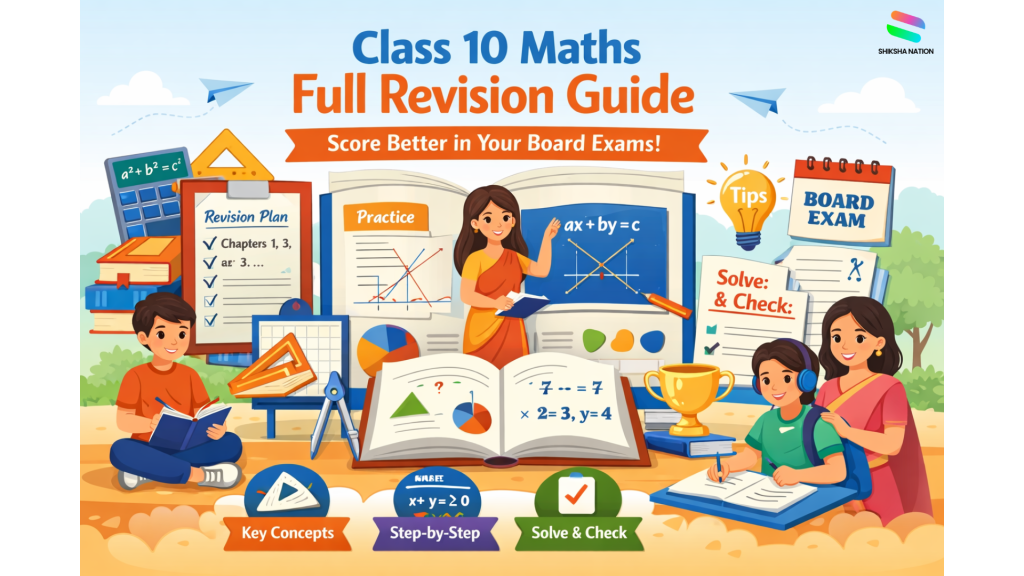
A visual overview of Class 10 Maths full syllabus revision, covering key concepts, practice, and exam-focused preparation for board exams.
When should you use this guide
You can use this guide during pre-boards, after finishing the syllabus, or in the final weeks before the board exam.
It is designed to help you revise faster, stay organised, and avoid last-minute panic.
This works well even if you are short on time and need a class 10 maths full revision plan that makes sense.
What is covered (and what is not)
This guide covers all important chapters, key concepts, and exam-focused revision points.
It tells you what to focus on, where students usually make mistakes, and how to revise smartly.
It does not replace your textbook or coaching classes.
Instead, it helps you revise the right things in the right order, without missing anything important.
How to Use This Class 10 Maths Full Revision Guide
Step-by-step way to revise effectively
This guide is meant to be used after you have completed the syllabus at least once.
Do not read it like a textbook. Use it as a revision checklist to track your preparation.
Start with one chapter at a time.
Revise concepts, solve a few key questions, and then move ahead. This is one of the best ways to revise Class 10 Maths effectively without feeling overloaded.
Parents can help by checking whether the student is revising regularly, not just reading notes.
How to plan your revision
Keep short daily revision slots instead of long study hours.
Spend more time on weak chapters, but do not skip strong ones completely.
This maths board exam revision strategy helps you balance accuracy, speed, and confidence.
Always revise formulas, steps, and presentation style together.
Who Should Follow This Revision Plan
Average students
This plan helps you cover the full syllabus in a clear order and reduce fear of Maths.
High scorers
It helps you avoid silly mistakes and strengthen areas where marks are often lost.
Late starters
If time is less, this guide helps you focus on what matters most without wasting effort.
Class 10 Maths Chapters Covered in This Full Syllabus Revision
Complete syllabus clarity for students and parents
This section clearly shows all Class 10 Maths chapters included in this guide.
Students can revise without fear of missing any topic, and parents can easily track syllabus coverage.
This is a chapter-wise maths revision, planned strictly according to the Class 10 syllabus.
Every chapter listed below is part of the board exam and needs proper revision.
List of Chapters Included
Chapter No.
Chapter Name
1
Real Numbers
2
Polynomials
3
Pair of Linear Equations in Two Variables
4
Quadratic Equations
5
Arithmetic Progressions
6
Coordinate Geometry
7
Triangles
8
Circles
Why this chapter list matters
Following this list helps students revise systematically, not randomly.
It also reassures parents that the full syllabus is covered, with no gaps in preparation.
Chapter-Wise Revision Focus for Class 10 Maths
This section helps you understand what exactly to revise from each chapter.
The focus is on concepts that matter in exams, not extra theory.
Students should use this as a final revision guide, and parents can use it to ensure the right areas are being revised.
Real Numbers – What to Revise
This chapter builds the base for many maths concepts, so clarity is important.
Focus on Euclid’s Division Lemma, Fundamental Theorem of Arithmetic, and HCF–LCM based questions.
Make sure you can clearly show steps and reasoning, not just the final answer.
Board exams often check how well you explain the method.
A common mistake students make is skipping proof-based questions or writing incomplete steps.
These are important topics of Class 10 Maths and can fetch easy marks if written properly.
Parents should check whether the student is writing full solutions, not shortcuts.
Accuracy and presentation matter more than speed in this chapter.
Polynomials – Revision Focus
In this chapter, students should focus on types of polynomials, zeros of a polynomial, and the relationship between zeros and coefficients.
Graphs-based questions should also be revised carefully.
Many students lose marks due to calculation errors or incorrect factorisation.
Practice solving step by step instead of jumping to answers.
Board questions are usually direct, but they test concept clarity.
Make sure you understand why a method works, not just how to apply it.
Parents can help by checking whether the student can explain the solution in words.
Clear thinking and neat work can improve scores in this chapter.
Pair of Linear Equations in Two Variables
This chapter is scoring if the method is clear and steps are correct.
Focus on solving questions using substitution, elimination, and cross-multiplication methods.
Students should also revise graph-based questions and understand what different cases of solutions mean.
Do not memorise steps blindly; know why a method is used.
A common mistake is mixing methods in one answer or skipping steps.
In board exams, step-wise working carries marks even if the final answer is wrong.
Parents can check whether the student is practising neatly written solutions.
Clear steps reduce silly mistakes and improve confidence.
Quadratic Equations
This chapter requires both concept clarity and practice.
Revise all three methods: factorisation, completing the square, and quadratic formula.
Students should know when to use which method.
Board questions often check this decision-making ability.
Avoid calculation errors by writing each step clearly.
Many students lose marks due to sign mistakes or incorrect substitution.
Parents can support by ensuring the student revises formulas daily.
Regular short practice works better than long study hours here.
Arithmetic Progressions
Arithmetic Progressions is a high-scoring chapter when revised properly.
Focus on finding the nth term, sum of n terms, and identifying AP from word problems.
Students should practice word-based questions carefully.
Reading the question slowly helps avoid wrong values.
A common error is using the wrong formula or mixing up terms.
Always write the formula before substituting values.
Parents can help by checking whether the student explains each step clearly.
Correct method presentation is key to full marks in this chapter.
Coordinate Geometry
This chapter mainly checks accuracy and step-wise calculation.
Students should focus on solving questions related to area of triangles using coordinates.
Most board questions are direct, but small calculation mistakes can cost marks.
Write each step clearly and avoid mental calculations.
A common error is placing wrong coordinate values or skipping units.
Always recheck values before moving to the next step.
Parents can help by ensuring the student practices neatly written solutions.
Clear working improves both speed and confidence in exams.
Triangles
Triangles is an important chapter where logic and proof writing matter.
Revise the key ideas behind similar triangles and how results are applied.
Students often lose marks by writing incomplete proofs or missing steps.
In board exams, every step carries value, not just the final conclusion.
Avoid learning proofs by heart without understanding.
Understanding the flow helps in writing correct answers under pressure.
Parents should check whether the student is explaining steps properly, not memorising blindly.
Clear reasoning leads to better scores.
Circles
This chapter tests concept understanding and correct explanation.
Focus on the logic behind tangents and their properties.
Many students make mistakes by skipping diagrams or not labelling them properly.
Always draw a clear diagram before starting the answer.
Do not rush through theory-based questions.
Marks are given for reasoning and correct explanation.
Parents can support by reminding students to draw and label diagrams neatly.
Good presentation can improve marks in this chapter.
Common Mistakes Students Make During Maths Revision
Many students work hard but still lose marks because of small and avoidable errors.
Understanding these common mistakes in Class 10 Maths can help you revise smarter and score better.
Parents often notice that students study for long hours, but revision lacks proper direction.
The points below highlight where most students go wrong during exam preparation.
Mistakes to Avoid During Revision
Ignoring presentation
Students focus only on answers and forget neat steps, diagrams, and clear working.
In board exams, marks are given for method and clarity, not just the final result.
Over-practising easy chapters
Spending too much time on strong chapters feels comfortable but limits progress.
This reduces time for chapters that actually need attention.
Skipping weak topics
Many students avoid difficult chapters due to fear or confusion.
This creates gaps in preparation and increases stress during exams.
Not revising regularly
Revision done only once is not enough.
Short and repeated revision helps improve accuracy and confidence.
Rushing without checking work
Simple calculation or sign errors happen when answers are not reviewed.
Taking a few minutes to recheck can save valuable marks.
Parents can support by encouraging balanced revision and regular self-checks.
Revision Strategy for the Last Few Weeks Before Boards
The last few weeks before exams are about smart planning, not heavy study.
This class 10 maths revision guide helps students revise calmly and stay confident.
Parents should focus on keeping the environment stress-free and regular, not rushed.
Weekly revision structure
Divide your time week by week instead of thinking about the full syllabus at once.
In the first week, revise chapters that need more attention.
In the next weeks, focus on strengthening accuracy and speed.
Keep one light revision day every week to avoid burnout.
Short, planned sessions work better than long hours.
Balance between practice and revision
Do not spend all your time solving questions or only reading notes.
A good balance is revision first, practice next, and quick review at the end.
Practice helps you apply concepts, while revision keeps formulas and steps fresh.
Both are equally important for board exams.
Self-check before moving ahead
After revising a chapter, pause and review your mistakes.
Check whether errors are due to concepts, steps, or calculation.
Parents can help by asking simple questions or checking written answers.
Regular self-check builds confidence and reduces exam fear.
Why Students Trust Shiksha Nation for Complete Revision
Students and parents trust Shiksha Nation because the focus is always on clear learning, not shortcuts.
Teaching is planned in a way that helps students understand concepts and revise them properly before exams.
One important reason is consistent teaching support.
Even during challenging times, Shiksha Nation ensured students stayed connected with studies.
The approach is student-first, where doubts, revision needs, and exam pressure are taken seriously.
Parents feel confident because the system supports regular study habits and disciplined revision.
Shiksha Nation’s commitment to uninterrupted learning and structured teaching has been highlighted earlier as well, showing how a strong academic system was built around –
This consistency helps students revise with trust and confidence before board exams.
Frequently Asked Questions – Class 10 Maths Revision
Q. Is this revision guide enough for board exams?
This guide is designed to support your final revision, not replace your textbook or school teaching.
If you have studied the syllabus properly and use this guide to revise, it is enough for exam readiness. Students should still practice questions from their book and school worksheets.
Parents can check whether the student is revising regularly, not just reading once.
Q. How many times should I revise Class 10 Maths?
Ideally, each chapter should be revised at least two to three times before the exam.
The first revision helps recall concepts, and later revisions improve accuracy and speed. Short and repeated revision works better than long study hours.
Parents can help by ensuring revision is planned, not rushed.
Q. Should I focus more on weak chapters?
Yes, weak chapters need more time, but strong chapters should not be ignored.
Balance is important to avoid losing easy marks. Spend extra time understanding weak areas, then revise strong topics briefly.
Parents can help by encouraging steady effort instead of fear-based studying.
Q. When should I start solving sample papers?
Sample papers should be solved after at least one full revision of the syllabus.
This helps you manage time and understand exam patterns. After solving a paper, always check mistakes and revise those topics again.
This self-review step is very important for improvement.
Q. What should parents focus on during revision time?
Parents should focus on routine, calm study hours, and regular breaks.
Avoid adding pressure during the final weeks. Simple support and encouragement can make revision more effective and stress-free.