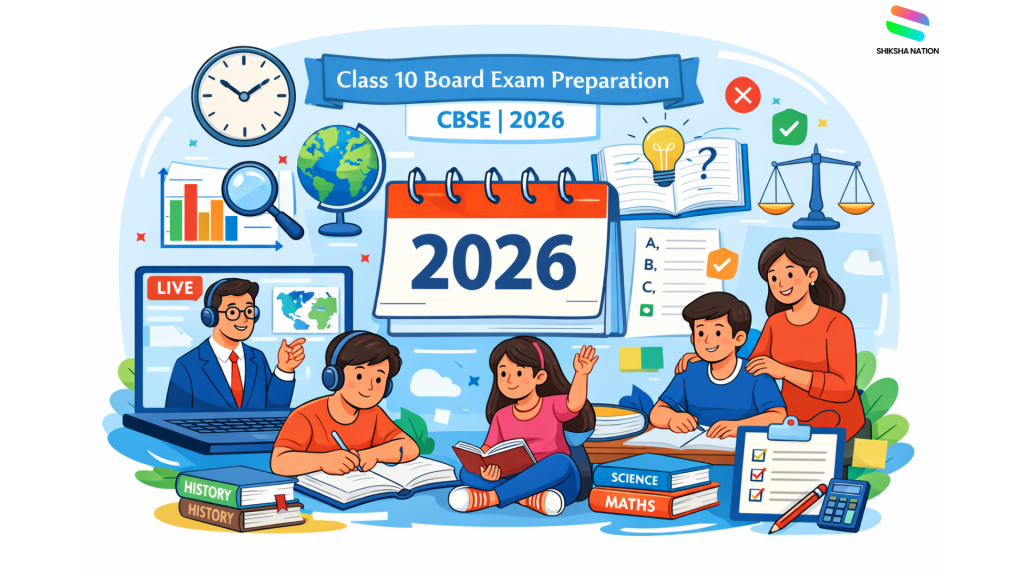
Class 10 final revision live class options are becoming increasingly relevant as Class 10 Boards 2026 approach and students realise that completing the syllabus is only half the work. The real challenge lies in revising all subjects effectively within limited time, without confusion or panic. Many students reach this stage feeling unsure about what to revise, how much to revise, and whether their preparation matches board exam expectations.
This guide is written for Class 10 students preparing for the 2026 board exams, as well as for parents who want a clear, practical understanding of revision support options. It focuses on realistic preparation needs, not shortcuts or exam hype. At this stage of preparation, students usually require structured revision, concept reinforcement, and clarity on important areas across Maths, Science, English, and SST.
A LIVE revision class is one of the formats students consider during final preparation, especially when self-study alone feels unstructured. When designed properly, such sessions aim to consolidate key concepts, highlight common exam mistakes, and align revision with the Class 10 board exam 2026 pattern and NCERT expectations. This article explains how such revision support fits into an overall preparation plan and how students can use it meaningfully.
Book a Counseling Session
A visual overview of structured final revision for Class 10 Boards 2026 across Maths, Science, English and SST
Why Final Revision Matters for Class 10 Boards 2026
Final revision plays a critical role in Class 10 boards 2026 preparation, especially when students have already completed most of the syllabus. At this stage, the issue is usually not a lack of study, but a lack of clarity and confidence. Without proper revision, students often forget formulas, mix up concepts, or struggle to recall answers during exams.
One common challenge in class 10 final revision is syllabus overload. With four major subjects and multiple chapters in each, students find it difficult to decide what to revise first and what can be revised later. This confusion increases stress and reduces the effectiveness of self-study.
Time pressure is another major concern. As exams come closer, students feel there is not enough time to revise everything again. Parents also worry whether their child’s preparation is on the right track or not. In such situations, revision needs to be focused and well planned.
This is why clear class 10 preparation tips 2026 become important. Final revision helps students strengthen weak areas, improve answer writing, and avoid common mistakes. It allows students to enter the exam hall with better control over concepts, rather than relying on last-minute reading.
🚨 FINAL CALL: Class 10 Board Exam 2026 | 120 Hours NON-STOP LIVE Full Syllabus Crash Revision | 09 Feb – 14 Feb 2026 | Don’t Miss This!
What Is a NON-STOP LIVE Revision Class?
A live revision class 10 is a real-time revision session where students revise important topics along with a teacher, instead of watching pre-recorded videos. In a LIVE format, students can follow the flow of revision as it happens, which often keeps them more attentive and focused compared to recorded lectures.
Recorded videos are usually chapter-wise and long. Students have to decide what to watch and what to skip. During final preparation, this can become confusing and time-consuming. A class 10 board revision live session, on the other hand, is planned in advance and focuses only on exam-relevant areas.
The term class 10 non stop revision means that multiple subjects are covered continuously in a single session. Maths, Science, English, and SST are revised one after another, without long breaks. The aim is not to teach from the beginning, but to revise key points, formulas, concepts, and common exam patterns.
For parents, this format offers clarity that revision is structured and time-bound. For students, it reduces decision fatigue and helps them revise more in less time, especially when exams are close.
How This LIVE Class Covers All Subjects Together
This LIVE revision format is designed to help students revise all major subjects in a planned and balanced way. Instead of studying one subject for many hours, students move through subjects in a fixed sequence. This approach helps maintain focus and reduces mental tiredness during final preparation.
Maths – Final Revision Focus
Maths often creates the most pressure during exams because it requires both speed and accuracy. In class 10 final revision maths, the focus is on recalling important formulas and learning how to apply them correctly in exam-type questions.
Students revise key formulas from each chapter so that they do not forget them under exam pressure. Along with this, teachers explain how to approach numericals step by step, including how to read questions carefully and avoid common calculation mistakes.
The revision also helps students understand which types of numericals are frequently asked in board exams. For parents, this gives reassurance that practice is not random. For students, it builds confidence that they can solve questions within the exam time limit without panic.
Science – Physics, Chemistry & Biology
Physics – Concept-Based Revision
In class 10 final revision science, Physics revision focuses on understanding concepts instead of rote learning. Students revise key laws, formulas, and diagrams with clarity. Common exam mistakes like wrong units, incorrect formula use, and incomplete explanations are clearly discussed so students can avoid losing easy marks.
Chemistry – Reactions and Application
During a live class 10 science session, Chemistry revision highlights important reactions, chemical equations, and everyday applications. Students are guided on balancing equations, writing correct steps, and avoiding common errors such as incorrect symbols or skipped conditions in answers.
Biology – Clear Explanations and Diagrams
Biology revision focuses on understanding processes, definitions, and diagrams. Students often lose marks due to unclear explanations or poorly labelled diagrams. Final revision helps them present answers in a simple and structured way, which is important for scoring well in board exams.
English – Writing Skills & Literature
In class 10 final revision english, the main focus is on improving answer structure and presentation. Many students know the content but lose marks because their answers are not well organised. Final revision helps students understand how to start, develop, and conclude answers clearly.
For writing skills, students revise formats for letters, notices, and analytical paragraphs. They learn how to keep language simple, stay within word limits, and present points logically. This reduces mistakes related to format and clarity.
In literature, revision focuses on key themes, character points, and important lines from chapters and poems. Students are guided on writing short, relevant answers instead of long and unclear responses. For parents, this ensures that their child’s language skills are exam-ready. For students, it builds confidence to write answers neatly and clearly during the exam.
SST – History, Civics, Geography & Economics
SST revision is important because it includes both theory-based answers and map work. Along with maths science english sst class 10, students need a balanced revision plan for SST to score well in boards. Final revision focuses on identifying key themes from each chapter instead of memorising every line.
In History and Civics, students revise important events, concepts, and definitions that are commonly asked in exams. Geography revision includes key terms, diagrams, and map-based questions, which many students find challenging. Economics revision helps students understand basic concepts and write clear, point-wise answers.
This approach ensures that students give equal importance to map work and written answers. For parents, it brings confidence that SST preparation is structured. For students, it makes revision manageable and less stressful before the exam.
CBSE Class 10 Boards 2026 – What Students Should Prepare For
The CBSE class 10 board exam 2026 will continue to test students on their understanding of concepts, not just memory. Students should focus on clear learning and regular revision instead of studying new topics at the last moment. Parents should also understand that steady preparation is more effective than sudden pressure close to exams.
The CBSE class 10 syllabus 2026 remains the foundation of board preparation. All questions are framed directly or indirectly from NCERT textbooks. This makes NCERT based class 10 revision extremely important. Students should revise examples, definitions, and in-text questions carefully, as these often guide the type of questions asked in exams.
Awareness of the CBSE class 10 exam pattern 2026 is equally important. Students need to understand the mark distribution, types of questions, and time management required for each subject. This includes objective questions, short answers, and longer descriptive answers.
Board examiners also look for clear presentation, correct steps, and relevant points in answers. Writing neatly, using headings where needed, and sticking to the question asked helps improve scores. When students prepare with these expectations in mind, they feel more confident and organised during the actual exam.
Competency-Based Questions in Class 10 – How to Revise for Them
Competency based questions class 10 are designed to test how well students understand and apply what they have learned. Instead of direct questions, students are asked to analyse situations, interpret data, or connect concepts to real-life examples. This approach checks thinking skills, not just memory.
In competency based questions CBSE class 10, students often face case-based questions, assertion–reason types, or questions linked to graphs, passages, or practical situations. Many students find these questions difficult because they are not used to applying concepts in new ways.
This is where structured LIVE revision becomes helpful. During revision, teachers explain how to read such questions carefully and identify what is being asked. Students learn how to break a question into parts and link it to the correct concept.
For parents, this method shows that preparation is moving beyond rote learning. For students, it builds confidence to handle unfamiliar questions calmly. Regular practice and guided revision help students improve accuracy and avoid confusion in competency-based sections.
Is the 2026 Class 10 Board Exam Expected to Be Difficult?
Many students and parents ask whether will 2026 boards be hard class 10. This concern is natural, especially when exam patterns and question styles continue to focus on understanding rather than memorisation. However, difficulty is not the right way to look at board exams.
The 2026 class 10 board exam is designed to assess whether students have understood concepts clearly and can apply them correctly. It does not aim to surprise students with unexpected questions. If preparation is steady and aligned with the syllabus, the exam remains manageable.
What usually feels “difficult” is lack of revision or unclear concepts. When students revise regularly, practise different types of questions, and understand exam expectations, their confidence improves. Parents can support by encouraging consistency instead of last-minute pressure.
Rather than worrying about exam difficulty, students should focus on proper revision, clear concepts, and calm exam practice. This approach helps reduce stress and allows students to perform to their true potential during the board exam.
How Students Can Use a LIVE Revision Class Effectively (When Exams Are Very Close)
When board exams are just days away, revision needs to be focused and practical. A LIVE revision class can help students quickly organise what they already know, clear last-minute confusion, and revise important areas without wasting time. Parents can use this phase to support calm and consistent study instead of pushing new material.
If You Have About 10 Days Before the Exam
At this stage, students searching how to prepare for class 10 board exam in 1 month usually have less time left than planned. The priority now is not starting new chapters, but strengthening what has already been studied.
Use the LIVE revision class to revise high-weight topics, formulas, definitions, and common question patterns. After the session, go back to NCERT textbooks and review the same topics again. This class 10 revision strategy helps improve recall and reduces exam-time confusion.
Parents should ensure students follow a fixed daily routine with short revision slots and proper rest. Calm, focused revision during these final days helps students enter the exam hall with confidence.
Is a LIVE Revision Class Right for Every Class 10 Student?
A LIVE revision class can be helpful for many students during class 10 board exam preparation 2026, but it may not suit everyone in the same way. Students who feel confused about revision order, forget key points, or struggle with exam pressure often benefit from guided revision and clear explanations.
Students who already have strong self-discipline and a clear study plan may prefer self-study. If a student is comfortable revising from NCERT books, notes, and sample questions on their own, they can continue with that approach and use revision classes only for specific doubts.
For parents, the focus should be on understanding how their child studies best. A LIVE class should support learning, not replace regular study. When students combine structured guidance with self-practice, they are better prepared for exams. Knowing how to prepare for CBSE class 10 board exam 2026 depends more on consistency and clarity than on the number of revision sessions attended.
Tips for Class 10 Boards 2026 Students & Parents
As the Class 10 CBSE board 2026 approaches, the focus should be on calm and meaningful revision rather than stress. Students do not need to study everything again from the start. What matters more is revising important concepts, practising exam-style questions, and maintaining confidence.
For class 10 boards 2026 preparation, parents play an important role by providing emotional support and a stable routine. Encouragement and balance are more helpful than constant pressure during the final days before exams.
A structured revision approach, whether through self-study or guided sessions, helps students stay organised and clear-headed. Students should choose methods that match their learning style and comfort level. With steady revision and the right mindset, students can approach the board exams feeling prepared and confident.
FAQs on Class 10 Final Revision & LIVE Preparation
Q. What is the best way to do final revision for Class 10 boards?
The best final revision approach is to revise important topics from NCERT, practise exam-type questions, and focus on weak areas. Short, regular revision sessions work better than long study hours close to exams.
Q. Is a LIVE revision class useful for Class 10 board preparation?
A LIVE revision class can be useful if it helps students revise key concepts in a structured way. It works best when used along with self-study, not as a replacement for regular revision.
Q. How many days are enough for final revision before Class 10 boards?
The number of days depends on preparation level. Students who have studied regularly can use 10-15 days for focused revision. Those with gaps may need more time and careful planning.
Q. Should students revise all subjects every day before the board exam?
Revising all subjects daily is not necessary. A better approach is to rotate subjects and give extra time to weaker areas while maintaining light revision for strong subjects.
Q. Are NCERT books enough for Class 10 board exam revision?
Yes, NCERT books are the main source for board exams. Students should revise NCERT chapters, examples, and in-text questions carefully before referring to additional practice material.
Q. What are competency-based questions in Class 10 exams?
Competency-based questions test understanding and application of concepts. These include case-based questions, assertion-reason, and questions linked to real situations.
Q. How can students avoid common mistakes during final revision?
Students should avoid learning new topics at the last moment, revise formulas and definitions regularly, and practise writing answers within time limits to reduce errors.
Q. Is self-study enough for Class 10 board preparation?
Self-study is effective if the student has a clear plan and discipline. Some students also benefit from guided revision to organise their study and clear doubts.
Q. How can parents support students during final board exam preparation?
Parents can help by maintaining a calm environment, ensuring a fixed routine, and encouraging regular breaks. Emotional support is as important as academic support at this stage.