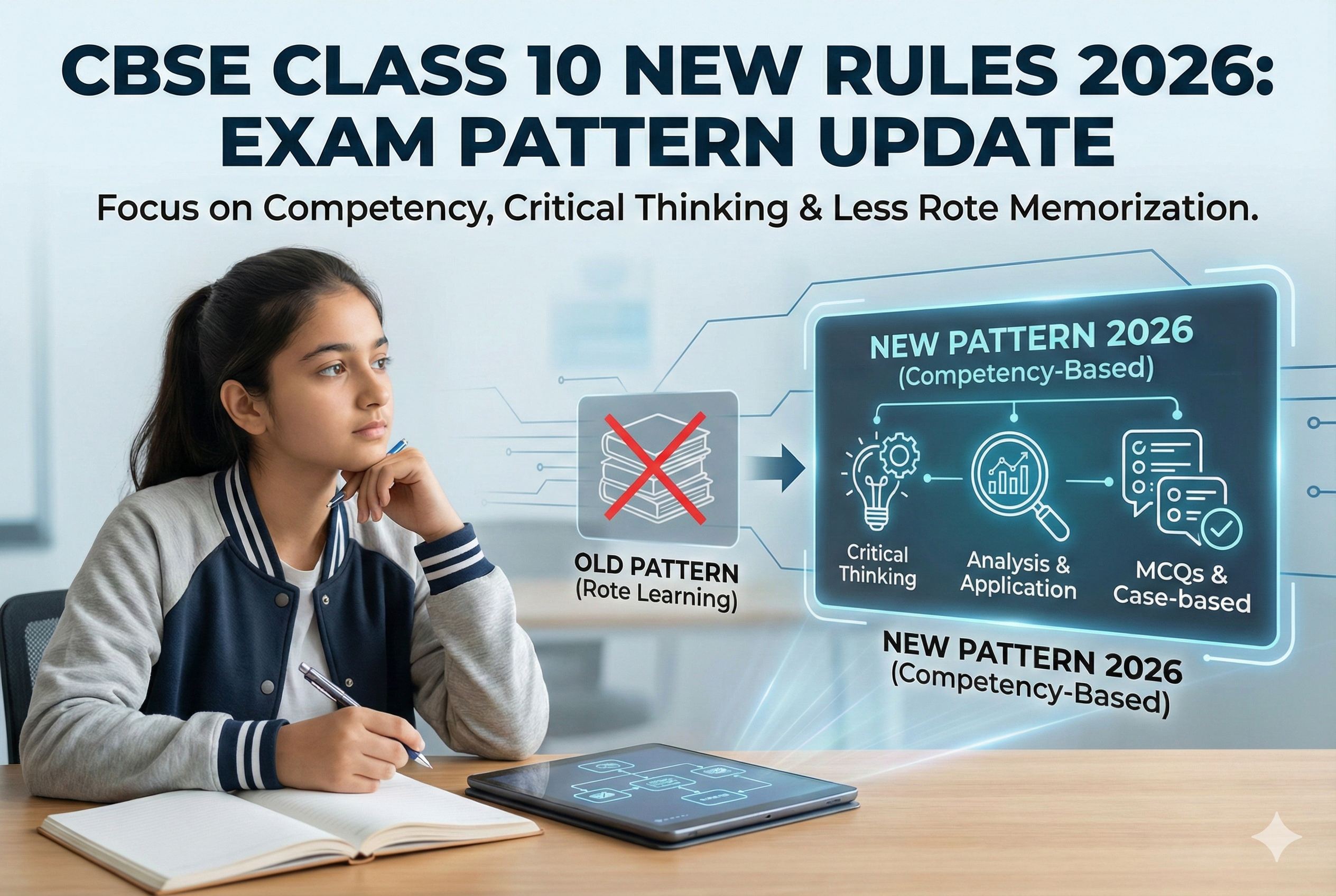
Disclaimer: This article is intended to explain the CBSE Class 10 examination framework and commonly observed question paper structure based on publicly available academic guidelines, sample papers, and educational practices.
CBSE does not publish exam instructions as “new rules” unless communicated through official notifications. Students should always refer to official CBSE circulars, sample papers, and syllabus documents for final and authoritative information related to board examinations.
The CBSE Class 10 examination framework highlights a structured approach to question paper design and answer presentation for subjects like Science and Social Science. Question papers are organised in a way that helps students clearly identify different sections and subject areas, encouraging organised and clear answer writing. Students are advised to read questions carefully and respond according to the instructions provided in the question paper.
This guide from Shiksha Nation explains the exam structure and answer-writing approach to help students understand how to present their responses effectively and prepare with confidence.
Book a Counseling Session
Why CBSE Introduced the New Rules for 2026
The earlier exam pattern had one major issue. Many students mixed answers from different subjects or chapters. This created confusion during evaluation. As a result, students often lost marks even after writing the correct content. To remove these problems, CBSE added clear rules. These rules separate each part of science and social science into well-defined sections. Therefore, checking becomes easier and fairer.
The CBSE Class 10 New Rules 2026 aim to reduce errors, improve clarity, and make the marking process transparent. This benefits both students and teachers.
Class 10 90% Marks Guarantee Program with NCERT syllabus, weekly tests, and personal mentorship.
Overview of the CBSE Class 10 Examination Framework (Academic Session 2025-26)
The Central Board of Secondary Education (CBSE) conducts the Class 10 board examinations based on a defined examination framework that focuses on structured assessment, clarity in question papers, and fair evaluation.
The framework emphasises:
Clear section-wise division in question papers
Subject-specific questions within a paper
Assessment of conceptual understanding and application
Proper presentation and organisation of answers
Consistency in evaluation across CBSE-affiliated schools
These guidelines are designed to help students present their answers clearly and enable examiners to evaluate responses efficiently.
CBSE does not issue exam instructions as “rules” but follows an assessment framework communicated through official documents and sample papers.
Science Question Paper Structure in CBSE Class 10
The Science question paper in CBSE Class 10 is prepared by covering the three core disciplines of Science: Biology, Chemistry, and Physics. Questions are designed to assess understanding, application, and problem-solving skills across these areas.
The question paper is generally organised in a structured manner so that students can clearly identify the subject area being tested.
Biology Component in the Science Paper
Biology-related questions are framed from the prescribed CBSE syllabus and focus on concepts such as life processes, reproduction, heredity, evolution, and environmental awareness.
Students are expected to answer biology questions based on conceptual clarity and accurate scientific explanations.
Chemistry Component in the Science Paper
Chemistry questions assess understanding of chemical reactions, properties of substances, basic organic chemistry, and periodic classification.
Numerical problems, reasoning-based questions, and conceptual explanations may be included as per the examination design.
Physics Component in the Science Paper
Physics questions focus on topics such as light, electricity, magnetic effects, and basic numerical problem-solving.
The objective is to evaluate conceptual understanding along with the ability to apply formulas and principles correctly.
Answer Writing and Presentation Guidelines for Students
CBSE encourages students to:
Read questions carefully before attempting answers
Answer questions in a neat and organised manner
Follow the internal structure of the question paper
Present steps clearly in numerical answers
Label diagrams and sections properly where required
Clear presentation helps examiners understand responses easily and supports accurate evaluation.
CBSE evaluates answers based on correctness, clarity, and adherence to the question requirements. Students are not penalised arbitrarily for answer placement if the response is relevant and clear.
Social Science Question Paper Structure in CBSE Class 10
The Social Science question paper assesses students across four disciplines:
History
Geography
Political Science
Economics
The paper is structured so that questions from each discipline are clearly identifiable.
History Questions
History questions focus on key historical developments, movements, and interpretations based on the prescribed syllabus. Students are assessed on understanding events, causes, and consequences.
Geography Questions
Geography questions test knowledge of resources, physical features, human activities, and environmental aspects. Map-based and analytical questions may be included where applicable.
Political Science Questions
Political Science questions assess understanding of democratic systems, institutions, rights, and governance concepts. Students are expected to explain concepts using appropriate examples.
Economics Questions
Economics questions focus on development, economic activities, money systems, and global economic connections. Conceptual clarity and real-life application are important evaluation criteria.
How the CBSE Examination Framework Helps Students
The structured examination approach helps students by:
Promoting organised answer writing
Encouraging subject-wise clarity
Reducing ambiguity in question interpretation
Supporting fair and standardised evaluation
A clear understanding of the exam framework enables students to plan their preparation more effectively.
Common Mistakes Students Should Avoid in Board Exams
Students should be careful to avoid:
Writing unclear or incomplete answers
Skipping question instructions
Poor presentation and lack of spacing
Missing diagrams or steps where required
Rushing through answers without review
Role of Teachers in Exam Preparation
Teachers support students by:
Explaining the exam structure clearly
Conducting practice tests based on CBSE patterns
Guiding students on presentation skills
Providing feedback on answer writing
Helping students manage exam time effectively
How Students Can Prepare Effectively for CBSE Class 10 Exams
Students can improve performance by:
Understanding the question paper structure
Practising previous years’ and sample papers
Revising subjects systematically
Focusing on clarity and presentation
Staying calm and attentive during exams
Important Note for Students and Parents
The information shared above is based on the CBSE examination framework and publicly available academic guidelines.
For the most accurate and updated details, students should always refer to official CBSE notifications, sample papers, and syllabus documents published by the Board.
Frequently Asked Questions (FAQs)
Q. Has CBSE officially announced “new rules” for Class 10 exams in 2026?
CBSE has not issued a separate notification titled “new rules” for Class 10 exams. The Board follows an examination framework that is communicated through official circulars, curriculum documents, sample papers, and evaluation guidelines released on the CBSE website.
Q. What does section-wise structure mean in CBSE Class 10 question papers?
Section-wise structure refers to the way questions are organised within a question paper. Sections help separate different types of questions or subject areas so that students can clearly understand what is being asked and answer accordingly.
Q. Are Science and Social Science papers divided by subject areas?
Yes. In CBSE Class 10, Science covers Physics, Chemistry, and Biology, while Social Science includes History, Geography, Political Science, and Economics. Questions are designed so that students can identify the subject area being assessed within the paper.
Q. Can marks be affected if answers are not written clearly or properly organised?
CBSE evaluates answers based on correctness, clarity, and relevance to the question. Students are encouraged to follow the question paper structure, write neatly, and present answers clearly to help examiners evaluate responses accurately.
Q. Does CBSE penalise students only for writing answers in the wrong section?
CBSE marking is done according to official evaluation schemes. Students should read questions carefully and respond as instructed, but answers are assessed based on content quality and adherence to the question requirements outlined by the Board.
Q. How should students prepare for section-wise question papers?
Students should practise answering questions by carefully identifying the subject or section, follow sample papers released by CBSE, and focus on clear presentation. Regular practice helps reduce confusion during the actual exam.
Q. Where can students find the most reliable information about CBSE Class 10 exams?
The most reliable and updated information is always available on official CBSE sources, including the CBSE website, sample papers, curriculum documents, and official notifications issued by the Board.
Conclusion
The CBSE Class 10 New Rules 2026 introduce a clear and structured system for science and social science exams. With section-wise answering, students must stay careful and organised. Students are advised to follow question paper instructions carefully and present answers clearly, even if the content is correct. However, with the right preparation and consistent practice, students can adapt easily to the new system.
These rules are designed to make marking fair, transparent, and efficient. As students learn the new pattern, they will also develop better writing habits and stronger exam strategies. Shiksha Nation is committed to helping learners navigate these updates and achieve excellent results.