
When you walk into your Tamil class today, or read a Tamil newspaper, or see government schools providing free mid-day meals, you’re experiencing the vision of a man who believed education and social justice could change everything. C.N. Annadurai wasn’t born into power or wealth. He rose through the strength of his words, the clarity of his ideas, and an unshakeable commitment to equality.
For students preparing for competitive exams, history projects, or simply curious about leaders who shaped modern India, understanding Annadurai’s life offers lessons in courage, communication, and standing up for what’s right even when it’s difficult.
Who Was C.N. Annadurai?
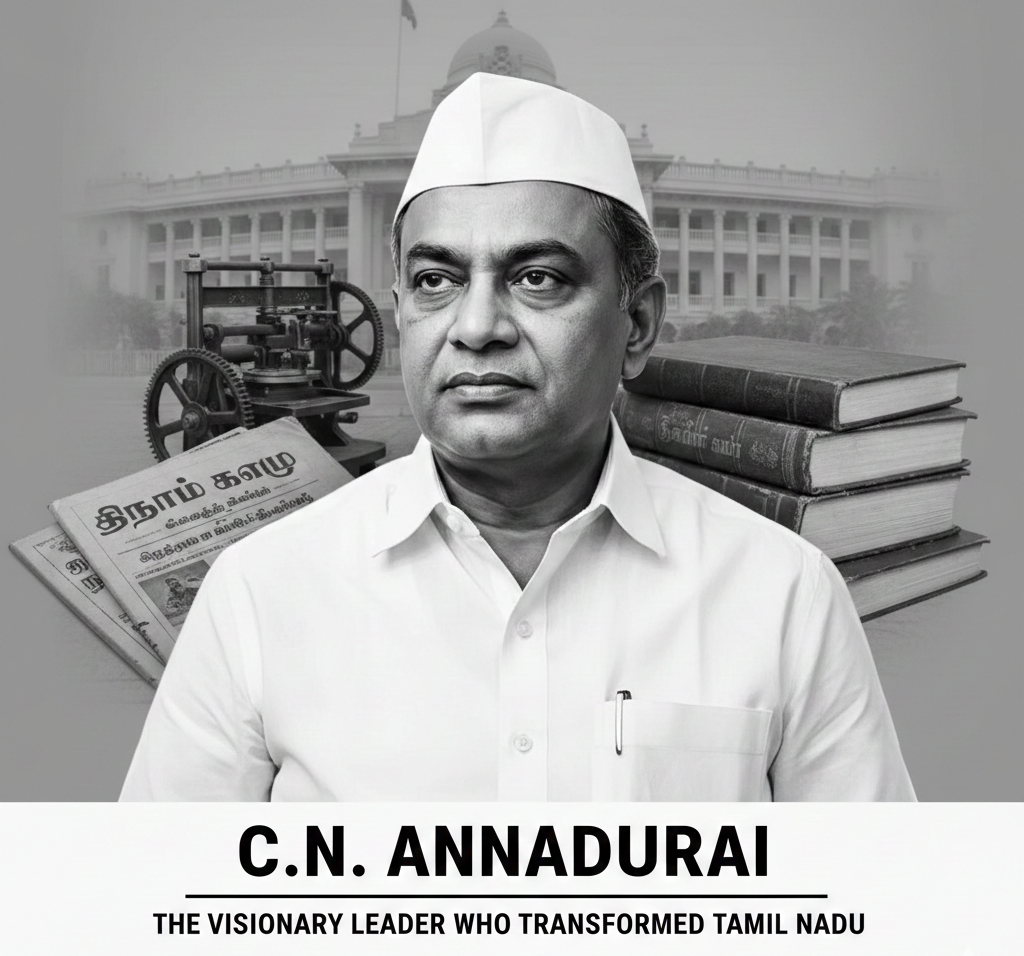
Conjeevaram Natarajan Annadurai was a freedom fighter, writer, orator, and politician who served as the first Dravida Munnetra Kazhagam (DMK) Chief Minister of Tamil Nadu from 1967 until his death in 1969.
Born on September 15, 1909, in Kanchipuram, Tamil Nadu, Annadurai transformed the political landscape of South India through his powerful speeches and progressive policies.
Noteable Points:
- Full Name: Conjeevaram Natarajan Annadurai
- Popular Name: Anna (meaning “Elder Brother”)
- Born: September 15, 1909
- Died: February 3, 1969
- Role: Chief Minister of Tamil Nadu, Writer, Social Reformer
- Party: Dravida Munnetra Kazhagam (DMK) – Founder
Think of him as a teacher who never stopped teaching, even when he became Chief Minister. His classroom just became bigger the entire state of Tamil Nadu.
Early Life and Education
Annadurai’s journey is proof that dedication to learning can open any door.
Educational Journey:
He grew up in a modest family in Kanchipuram, a temple town known for its silk sarees and spiritual heritage. Despite financial challenges, his family valued education deeply.
Academic Milestones:
- Completed schooling in Kanchipuram
- Graduated from Pachaiyappa’s College, Chennai
- Earned an M.A. in Economics from the University of Madras in 1939
- Worked as a school teacher early in his career
As a student, Annadurai was passionate about Tamil literature and debate. He would participate in college discussions, developing the oratory skills that would later captivate millions. Imagine being in his class students would actually look forward to lectures because he made every topic come alive with stories and examples.
His teaching experience shaped his belief that education should be accessible to everyone, regardless of their background. This would later influence his policies as Chief Minister.
Which Caste Was Annadurai?
C.N. Annadurai was born into the Mudaliar community, which is classified under the Other Backward Classes (OBC) in Tamil Nadu’s social structure.
Why This Matters for Students:
Understanding social background helps us appreciate the barriers many leaders overcame. Annadurai experienced firsthand the caste-based discrimination prevalent in early 20th century India.
Rather than accepting inequality, he questioned it. He asked, “Why should birth determine opportunity?” This question drove his entire political philosophy.
His Approach to Caste:
- Opposed caste-based discrimination actively
- Advocated for social equality and dignity for all
- Promoted rationalism and merit-based advancement
- Supported reservation policies for backward communities
For your history projects, remember: Annadurai didn’t let his background limit him. Instead, he used his experience to fight for others facing similar challenges. That’s true leadership.
Connection to Tamil Nadu
C.N. Annadurai is intrinsically linked to Tamil Nadu he dedicated his entire life to its people, language, and culture.
State Connection:
- Born in Kanchipuram, Tamil Nadu
- Educated in Chennai (then Madras)
- Entire political career centered in Tamil Nadu
- Became Tamil Nadu’s Chief Minister in 1967
Why Tamil Nadu Needed Annadurai:
In the 1960s, Tamil Nadu faced several challenges:
- Hindi imposition fears threatening Tamil language
- North-South political tensions
- Caste-based inequalities
- Limited educational opportunities for backward classes
Annadurai emerged as the voice articulating Tamil pride without hatred, regional identity without separatism, and social reform without violence.
His Vision for Tamil Nadu:
- Protecting Tamil language and culture
- Ensuring social justice
- Expanding educational access
- Economic development for all communities
Think of him as the guardian who ensured Tamil Nadu’s unique identity flourished within the Indian union.
Journey into Politics
Annadurai’s political journey shows how ideas, when expressed powerfully, can create movements.
Early Political Involvement:
While still a teacher, Annadurai joined the Justice Party, which fought against Brahmin dominance in South Indian politics. He then became a close associate of E.V. Ramasamy (Periyar) in the Self-Respect Movement.
Milestones:
1930s-1940s:
- Joined the Dravidar Kazhagam (DK) led by Periyar
- Became editor of “Dravida Nadu” magazine
- Wrote plays and stories promoting social reform
1949 – The Big Split: Annadurai split from Periyar’s DK over ideological differences, particularly regarding electoral politics. He founded the Dravida Munnetra Kazhagam (DMK) on September 17, 1949.
This was a bold move. Imagine disagreeing with your mentor and starting your own path. That takes courage and conviction.
1950s-1960s:
- Built DMK into a mass movement
- Used Tamil cinema, literature, and oratory to spread ideas
- Contested elections and grew party strength
1967 – Historic Victory: The DMK won the state elections, and Annadurai became Chief Minister. This was the first time a regional party defeated the Indian National Congress in any major state.
Major Achievements of Annadurai
As Chief Minister from 1967-1969, Annadurai implemented transformative policies despite serving less than two years.
1. Educational Reforms
Mid-Day Meal Scheme: Introduced nutritious meals in government schools to improve attendance and reduce malnutrition. Today, this scheme feeds millions of students across India.
Think about your school lunch. If you’re in a government school receiving free meals, you’re benefiting from Anna’s vision.
Expansion of Education:
- Opened new schools and colleges
- Promoted Tamil medium education
- Increased scholarships for backward communities
2. Language Policy
Two-Language Formula: Opposed the three-language formula that mandated Hindi. Implemented Tamil and English as languages of instruction, protecting Tamil while ensuring global connectivity.
This is why Tamil Nadu students today have strong English skills without compromising their mother tongue.
3. Social Justice Initiatives
Reservation Expansion: Increased reservations for backward classes in education and employment, ensuring opportunity based on need, not birth.
Administrative Reforms:
- Made government more accessible to common people
- Simplified bureaucratic procedures
- Promoted transparency in governance
4. Economic Development
- Industrial growth initiatives
- Agricultural support programs
- Infrastructure development
5. Cultural Promotion
- State support for Tamil literature
- Encouragement of Tamil cinema
- Preservation of Tamil heritage
Achievement Table:
| Area | Major Achievement | Impact |
|---|---|---|
| Education | Mid-Day Meal Scheme | Improved attendance, nutrition |
| Language | Two-Language Formula | Protected Tamil, promoted English |
| Social Justice | Expanded Reservations | Increased backward class representation |
| Governance | Administrative Simplification | Better public service delivery |
| Culture | Tamil Literature Support | Cultural preservation and growth |
Why Was Annadurai Famous?
Annadurai’s fame rested on four pillars: his words, his principles, his accessibility, and his results.
1. Master Orator
Annadurai could hold audiences spellbound for hours. His speeches combined humor, logic, emotional appeal, and literary beauty. He spoke in simple Tamil that everyone understood yet quotable phrases that intellectuals admired.
Imagine a teacher who makes every lecture so interesting that students don’t want the bell to ring. That was Anna as a speaker.
2. Prolific Writer
He wrote:
- Plays addressing social issues
- Short stories highlighting injustice
- Essays on politics and philosophy
- Screenplays for Tamil cinema
His writings reached people who never attended political rallies. Through cinema and literature, his ideas entered every Tamil household.
3. Principled Leadership
Anna stood by his convictions even when unpopular. He opposed Hindi imposition when it could have cost him politically. He split from his mentor Periyar when their paths diverged.
Students often ask, “Should I speak up if I disagree?” Anna’s life answers: yes, when your principles are at stake.
4. People’s Chief Minister
Despite becoming Chief Minister, he remained accessible. People could meet him, share grievances, and receive genuine responses. He didn’t build walls between power and people.
5. Bridge Builder
While protecting Tamil interests, he maintained good relations with the central government. He proved regional pride and national unity aren’t contradictory.
Special Names and Titles
Annadurai earned several affectionate titles reflecting people’s love and respect.
“Anna” (Elder Brother):
This is his most famous title. Followers called him Anna, seeing him not as a distant leader but as a caring elder brother guiding the family.
Think of the best senior in your school who helps juniors, guides them, protects them. That’s why people called him Anna.
“Perarignar” (Great Scholar):
This title honored his intellectual depth, literary contributions, and philosophical insights. He wasn’t just a politician but a thinker who shaped ideas.
Other Titles:
- “Arignar Anna” (Scholar Anna)
- “Kalaignar’s Guru” (Mentor to M. Karunanidhi, who later became Chief Minister)
These names tell us something important: respect in Tamil Nadu politics comes from knowledge, not just power.
Famous Quotes by Annadurai
Anna’s words continue inspiring students and citizens decades later. Here are some of his most powerful quotes explained simply.
1. “Equality is the soul of liberty; there is, in fact, no liberty without it.”
What It Means: True freedom comes only when everyone has equal opportunities. If society divides people by caste, religion, or class, freedom is incomplete.
Classroom Connection: Imagine a class where only some students can access books or participate in activities. That’s not a free classroom. Anna believed society works the same way.
2. “The test of intelligence is not how much you know, but how effectively you apply what you know.”
What It Means: Knowledge becomes valuable only through application. Understanding concepts matters less than using them to solve real problems.
For Students: Don’t just memorize formulas for exams. Understand when and how to apply them. That’s real learning.
3. “The temple of democracy stands on four pillars: justice, liberty, equality, and fraternity.”
What It Means: Democracy requires justice (fairness), liberty (freedom), equality (no discrimination), and fraternity (brotherhood among all).
Project Idea: For your civics project, examine if your school environment reflects these four pillars.
4. “Rationalism should be our guiding light, not blind faith.”
What It Means: Use reason and evidence to make decisions rather than following traditions without questioning them.
5. “A leader should be a servant to the people, not their master.”
What It Means: Leadership means serving others, not dominating them. Power comes with responsibility, not privilege.
Impact on Education and Social Reform
Annadurai’s greatest legacy lives in classrooms and communities transformed by his policies.
Educational Impact:
Before Anna’s Policies:
- Many poor children couldn’t attend school regularly due to hunger
- Limited schools in rural areas
- Tamil medium education undervalued
- Higher education inaccessible for backward communities
After Anna’s Reforms:
- Mid-day meals ensured consistent attendance
- New schools opened in underserved areas
- Tamil medium gained equal status
- Scholarships enabled backward class students to pursue higher education
Real Student Story: A student from a farming family in rural Tamil Nadu could now attend school regularly (free meals), study in Tamil (comfortable medium), and secure a scholarship for college (reservation policies). Without Anna’s reforms, this path would be blocked.
Social Reform Impact:
Breaking Caste Barriers:
- Promoted inter-caste marriages through government recognition
- Opposed untouchability actively
- Ensured backward class representation in government
Women’s Empowerment:
- Supported women’s education
- Encouraged female participation in politics
- Advocated for widow remarriage rights
Rationalist Movement:
- Questioned superstitions scientifically
- Promoted logical thinking
- Separated religion from government policy
Measurement of Impact:
| Indicator | Before (1960s) | Impact Direction |
|---|---|---|
| School Attendance | Lower, especially poor children | Increased significantly |
| Backward Class Representation | Minimal | Substantial growth |
| Tamil Language Status | Threatened | Protected and promoted |
| Women’s Education | Limited | Expanded opportunities |
| Social Mobility | Caste-restricted | Merit-based pathways created |
The Dravidian Movement
To understand Annadurai, you need to grasp the Dravidian Movement he helped shape.
What Is the Dravidian Movement?
A socio-political movement that arose in South India, particularly Tamil Nadu, advocating for:
- Rights and dignity of Dravidian people
- Social justice and caste equality
- Tamil language and culture protection
- Rationalist thinking over blind faith
Are Dravidians Original Indians?
This is a complex historical and anthropological question often misunderstood.
Simple Explanation: The Aryan-Dravidian division theory, once widely accepted, suggested Aryans migrated to India and Dravidians were original inhabitants. Modern genetic and archaeological research presents a more nuanced picture various populations mixed over millennia.
What Students Should Know: Rather than getting caught in “who came first” debates, understand that Indian civilization developed through multiple populations contributing over thousands of years. The Dravidian movement focused more on contemporary social justice than ancient origins.
The Dravidian Movement’s Core Ideas:
Social Equality: Reject caste hierarchy and promote equal opportunity for all.
Tamil Pride: Celebrate Tamil language, literature, and culture without hatred toward others.
Rationalism: Question practices lacking logical basis while respecting genuine cultural values.
Political Autonomy: Ensure regional voices influence national decisions affecting them.
Annadurai’s Unique Contribution:
While maintaining Dravidian ideology, Anna:
- Rejected separatism (unlike early movement advocates)
- Embraced electoral democracy
- Built bridges with other regions
- Focused on practical governance, not just ideology
Legacy and Influence
C.N. Annadurai’s death on February 3, 1969, brought Chennai to a standstill. An estimated 15 million people attended his funeral one of the largest gatherings in human history.
Political Legacy:
DMK Dynasty: The DMK he founded continues as a major political force. His protégé M. Karunanidhi and later leaders carried forward his vision.
Regional Party Success: Anna proved regional parties could govern effectively, inspiring similar movements across India.
Two-Language Policy: His language policy model influenced several states’ educational frameworks.
Educational Legacy:
Mid-Day Meal Scheme: Expanded across India, now feeding over 100 million children daily. What started in Tamil Nadu became a national program.
Tamil Medium Education: Tamil medium institutions flourished, allowing students to excel in their mother tongue.
Scholarship Programs: Paved the way for extensive scholarship systems supporting backward class students.
Cultural Legacy:
Tamil Cinema: Anna’s involvement in cinema (as screenwriter and supporter) helped Tamil films become vehicles for social messages.
Literary Contributions: His plays and writings remain studied in Tamil literature courses.
Respectful Politics: Set a tone of dignified political discourse, even with opponents.
Social Legacy:
Caste Awareness: Increased consciousness about caste discrimination and need for social justice.
Rationalist Movement: Strengthened scientific temper and questioning attitude among Tamils.
Leadership Model: Demonstrated that leaders should be accessible, principled, and service-oriented.
For Today’s Students:
When you eat your mid-day meal at school, remember Anna.
When you study in Tamil and excel, remember Anna.
When you see reservation policies helping deserving students, remember Anna.
His legacy isn’t in statues and street names alone it’s in the opportunities you have today.
FAQs About C.N. Annadurai
Q. Which caste did C.N. Annadurai belong to?
C.N. Annadurai belonged to the Mudaliar community, classified under Other Backward Classes (OBC) in Tamil Nadu. Despite his background, he actively opposed caste-based discrimination and worked throughout his life for social equality and justice for all communities, promoting merit-based advancement.
Q. What were C.N. Annadurai’s major achievements as Chief Minister?
Annadurai’s major achievements include introducing the Mid-Day Meal Scheme in schools, implementing the two-language formula (Tamil and English), expanding reservations for backward classes, simplifying governance procedures, and promoting Tamil language and culture while maintaining good center-state relations despite his short tenure.
Q. Why is C.N. Annadurai called “Anna”?
“Anna” means “elder brother” in Tamil. Followers affectionately gave him this title because he guided, protected, and cared for people like a caring elder brother guides family members. The name reflects the personal connection and respect people felt toward him beyond his political position.
Q. Which state is associated with C.N. Annadurai?
C.N. Annadurai is intrinsically associated with Tamil Nadu. He was born in Kanchipuram, Tamil Nadu, served as its first DMK Chief Minister from 1967-1969, and dedicated his entire political career to Tamil Nadu’s people, protecting Tamil language and culture while ensuring social justice.
Q. What are some famous quotes by C.N. Annadurai?
Famous Annadurai quotes include: “Equality is the soul of liberty,” “The test of intelligence is not how much you know, but how effectively you apply it,” “Rationalism should be our guiding light,” and “A leader should be a servant to the people, not their master.”
Q. Why was C.N. Annadurai famous?
Annadurai was famous for his extraordinary oratory skills, prolific writing (plays, stories, essays), founding the DMK party, becoming Tamil Nadu’s first DMK Chief Minister, protecting Tamil language against Hindi imposition, implementing progressive social reforms, and maintaining principled yet practical leadership that balanced regional pride with national unity.
Q. How did C.N. Annadurai impact education in Tamil Nadu?
Annadurai revolutionized education by introducing the Mid-Day Meal Scheme to improve attendance and nutrition, expanding schools and colleges particularly in rural areas, promoting Tamil medium education, increasing scholarships for backward class students, and making education accessible to communities previously denied educational opportunities.
Q. What is C.N. Annadurai’s connection to the Dravidian Movement?
Annadurai was a key leader of the Dravidian Movement, initially working with Periyar before founding the DMK in 1949. He channeled Dravidian ideology into electoral politics, advocating for Tamil language protection, social justice, rationalism, and caste equality while rejecting separatism and embracing democratic governance.
Conclusion
C.N. Annadurai’s life offers every student a powerful lesson: your background doesn’t determine your destination, but your dedication, principles, and service to others do.
From a teacher’s desk to the Chief Minister’s office, Anna’s journey proves that ideas expressed clearly, values held firmly, and service rendered genuinely can transform entire societies. The mid-day meal you might eat at school, the Tamil books you read, the opportunities available regardless of caste—these aren’t accidents. They’re the fruit of someone’s vision and struggle.
Note for Students:
- Education Opens Doors: Anna’s academic excellence created opportunities despite social barriers
- Communication Matters: His oratory and writing skills multiplied his impact exponentially
- Principles Over Popularity: Standing by your convictions, even when difficult, builds lasting respect
- Service Defines Leadership: Real leaders serve people, not themselves
- Ideas Change Worlds: Thoughtful ideas, clearly expressed and persistently promoted, reshape societies