What is Benzene?
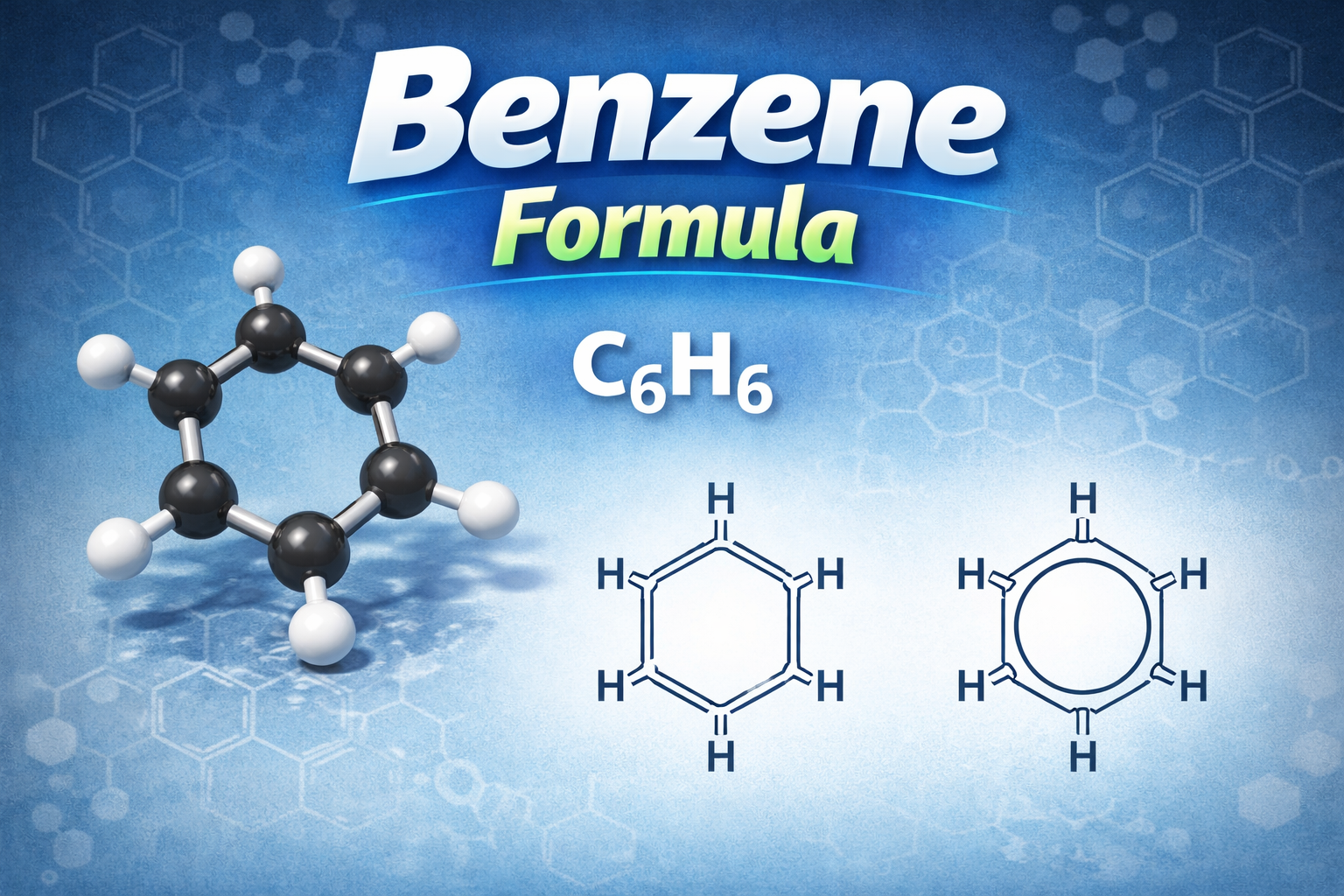
Benzene is an aromatic hydrocarbon and one of the most important compounds in organic chemistry. It consists of six carbon atoms arranged in a hexagonal ring with alternating double bonds.
Key characteristics:
- Colorless liquid at room temperature
- Sweet aromatic odor
- Highly flammable
- Foundation for many industrial chemicals
- Parent compound of aromatic chemistry
Understanding benzene formulas helps you predict its properties, reactions, and behavior in chemical equations—essential knowledge for exams and practical applications.
Complete List of Benzene Formulas
Here’s a comprehensive table covering all benzene formula types you’ll encounter in chemistry courses:
| Formula Type |
Formula |
Explanation |
When to Use |
Example Application |
| Molecular Formula |
C₆H₆ |
Shows total number of each atom type |
General identification, mass calculations |
Calculating molar mass: (6×12) + (6×1) = 78 g/mol |
| Empirical Formula |
CH |
Simplest whole-number ratio of atoms |
Finding molecular formula from percentage composition |
Converting mass percentages to formula |
| Structural Formula |
Hexagon with alternating double bonds |
Shows atom arrangement and bonding |
Understanding structure and reactions |
Predicting substitution patterns |
| Condensed Structural Formula |
C₆H₆ or (CH)₆ |
Shortened version without bonds shown |
Quick notation in equations |
Writing reaction equations |
| Skeletal Formula |
Hexagon only |
Shows carbon skeleton, hydrogens implied |
Organic chemistry notation |
Drawing mechanisms |
| Kekulé Structure |
Hexagon with three alternating C=C bonds |
Historical representation |
Learning resonance concept |
Understanding bond length equality |
| Resonance Structures |
Two alternating forms ↔ |
Shows electron delocalization |
Explaining stability and reactivity |
Justifying aromatic properties |
| Circle Notation |
Hexagon with inscribed circle |
Modern representation of delocalized electrons |
Showing aromaticity |
Advanced organic chemistry |
Molecular Formula of Benzene Explained
Molecular Formula: C₆H₆
The molecular formula shows the exact number of each type of atom in one benzene molecule.
Breaking it down:
- 6 carbon atoms (C₆)
- 6 hydrogen atoms (H₆)
- Total of 12 atoms per molecule
Why this formula matters:
This formula tells you benzene is unsaturated compared to hexane (C₆H₁₄). The “missing” hydrogen atoms indicate the presence of double bonds or ring structures. For benzene, both are true—it contains a ring with alternating double bonds.
Calculating degree of unsaturation:
Degree of unsaturation = (2C + 2 – H) / 2 = (2×6 + 2 – 6) / 2 = 4
This indicates four degrees of unsaturation: three from double bonds and one from the ring structure.
Structural Formula of Benzene
The structural formula shows how atoms connect within the molecule. Benzene has multiple valid structural representations.
Kekulé Structure
German chemist August Kekulé proposed benzene as a hexagonal ring with alternating single and double bonds. This structure shows:
- Six carbon atoms forming a ring
- Each carbon bonded to one hydrogen
- Three C=C double bonds alternating with three C-C single bonds
Important note: Real benzene doesn’t have distinct single and double bonds. All carbon-carbon bonds are identical with a length of 1.40 Å (between typical C-C at 1.54 Å and C=C at 1.34 Å).
Modern Representation
The circle inside the hexagon represents delocalized π electrons shared equally across all six carbons. This better reflects benzene’s actual structure where electrons move freely around the ring.
Main features:
- Planar molecule (all atoms in same plane)
- 120° bond angles (perfect hexagon)
- Equal bond lengths
- High stability due to resonance
Empirical Formula of Benzene
Empirical Formula: CH
The empirical formula shows the simplest whole-number ratio of atoms in a compound.
How to derive it:
Starting from C₆H₆, divide both subscripts by their greatest common factor (6):
- C₆ ÷ 6 = C₁
- H₆ ÷ 6 = H₁
- Result: CH
Difference from molecular formula:
The empirical formula (CH) doesn’t tell you the actual number of atoms—only their ratio. Multiple compounds can share the same empirical formula but have different molecular formulas:
- Benzene: C₆H₆
- Acetylene: C₂H₂
- Both have empirical formula: CH
Exam application:
If given percentage composition (92.3% C, 7.7% H), you can find the empirical formula first, then determine the molecular formula using molar mass.
Condensed and Skeletal Formulas
Condensed Structural Formula
Format: C₆H₆ or sometimes written as (CH)₆
This notation shows the molecular formula but hints at the repeating unit structure. It’s commonly used in chemical equations where drawing full structures isn’t practical.
Skeletal Formula
Format: Simple hexagon
In skeletal notation:
- Each corner represents a carbon atom
- Hydrogen atoms are implied (not drawn)
- Only heteroatoms and functional groups are labeled
- Most common in organic chemistry
Reading skeletal formulas:
When you see a plain hexagon, understand that each vertex has a carbon atom with enough hydrogens to satisfy carbon’s four bonds (one hydrogen per carbon in benzene’s case).
Solved Examples
Example 1: Finding Molar Mass from Molecular Formula
Question: Calculate the molar mass of benzene using its molecular formula.
Solution:
- Molecular formula: C₆H₆
- Carbon mass: 6 × 12.01 g/mol = 72.06 g/mol
- Hydrogen mass: 6 × 1.008 g/mol = 6.048 g/mol
- Total molar mass: 72.06 + 6.048 = 78.11 g/mol
Answer: 78.11 g/mol
Example 2: Determining Molecular Formula from Empirical Formula
Question: A hydrocarbon has empirical formula CH and molar mass of 78 g/mol. Find its molecular formula.
Solution:
Step 1: Find empirical formula mass
Step 2: Calculate the multiplier
- n = Molar mass / Empirical formula mass
- n = 78 / 13 = 6
Step 3: Multiply empirical formula by n
Answer: Molecular formula is C₆H₆ (benzene)
Example 3: Calculating Percentage Composition
Question: Find the percentage composition of carbon and hydrogen in benzene.
Solution:
Molar mass of C₆H₆ = 78.11 g/mol
Percentage of carbon:
- (72.06 / 78.11) × 100 = 92.3%
Percentage of hydrogen:
- (6.048 / 78.11) × 100 = 7.7%
Answer: 92.3% C, 7.7% H
Example 4: Identifying Benzene from Combustion Data
Question: Complete combustion of 0.39 g of a hydrocarbon produces 1.32 g CO₂ and 0.27 g H₂O. Molar mass is 78 g/mol. Identify the compound.
Solution:
Step 1: Find moles of C from CO₂
- Moles CO₂ = 1.32/44 = 0.03 mol
- Moles C = 0.03 mol
Step 2: Find moles of H from H₂O
- Moles H₂O = 0.27/18 = 0.015 mol
- Moles H = 2 × 0.015 = 0.03 mol
Step 3: Find empirical formula
- C:H ratio = 0.03:0.03 = 1:1
- Empirical formula = CH
Step 4: Find molecular formula
- n = 78/13 = 6
- Molecular formula = C₆H₆ (benzene)
Answer: The compound is benzene
Common Mistakes Students Make
Mistake 1: Confusing molecular and empirical formulas
Students often write CH when asked for benzene’s molecular formula. Remember: molecular formula shows actual atom count (C₆H₆), while empirical shows simplest ratio (CH).
Mistake 2: Drawing incorrect structures
Drawing three isolated double bonds creates 1,3,5-cyclohexatriene, not benzene. True benzene has delocalized electrons—show this with resonance arrows or circle notation.
Mistake 3: Assuming different bond lengths
Don’t think benzene has alternating long and short bonds. All six C-C bonds are identical at 1.40 Å due to resonance.
Mistake 4: Wrong hydrogen count
Some students write C₆H₁₂ (cyclohexane) instead of C₆H₆. Remember: benzene has three degrees of unsaturation from π bonds, resulting in fewer hydrogens.
Mistake 5: Forgetting planarity
Benzene is completely flat with 120° angles. Don’t draw it with puckered or tetrahedral carbons.
Memory Tricks and Tips
Trick 1: “Six and Six”
Remember benzene as “six and six”—six carbons, six hydrogens. Equal numbers make it easy to recall.
Trick 2: Half the Hydrogens
Benzene (C₆H₆) has exactly half the hydrogens of hexane (C₆H₁₄). The “missing” hydrogens indicate unsaturation.
Trick 3: “CH Pattern”
The empirical formula CH helps you remember that each carbon has exactly one hydrogen in benzene.
Trick 4: Perfect Hexagon
All angles are 120° (360°/3 for each carbon’s sp² geometry). This makes benzene a perfect regular hexagon.
Tip 5: Draw the Circle
When drawing benzene quickly, use the circle notation to avoid implying distinct single and double bonds.
FAQs about Benzene Formula
Q. What is the molecular formula of benzene?
The molecular formula of benzene is C₆H₆, indicating six carbon atoms and six hydrogen atoms per molecule. This formula represents the actual number of atoms present in one benzene molecule.
Q. What is the difference between benzene’s molecular and empirical formulas?
Benzene’s molecular formula is C₆H₆ (actual atom count), while its empirical formula is CH (simplest ratio). The empirical formula divides both subscripts by their greatest common factor of six.
Q. Why does benzene have the formula C₆H₆ instead of C₆H₁₂?
Benzene contains three carbon-carbon double bonds and a ring structure, creating four degrees of unsaturation. This means it has six fewer hydrogens than the saturated equivalent hexane (C₆H₁₄).
Q. How do you draw the structural formula of benzene?
Draw a regular hexagon with alternating double bonds, or use a hexagon with a circle inside. Each vertex represents a carbon atom bonded to one hydrogen. The circle notation is preferred as it shows electron delocalization.
Q. What is benzene’s condensed structural formula?
Benzene’s condensed structural formula can be written as C₆H₆ or (CH)₆. This notation shows the chemical composition without drawing the full structural bonds and arrangement.
Q. Is benzene’s empirical formula the same as acetylene?
Yes, both benzene (C₆H₆) and acetylene (C₂H₂) have the empirical formula CH. This shows they have the same carbon-to-hydrogen ratio but different actual molecular compositions and structures.
Q. What does the circle in benzene’s structure represent?
The circle inside benzene’s hexagon represents six delocalized π electrons shared equally among all carbon atoms. This shows benzene’s aromatic stability and equal bond lengths rather than alternating single and double bonds.
Q. How many atoms are in one molecule of benzene?
One benzene molecule contains 12 atoms total: six carbon atoms and six hydrogen atoms, as shown in its molecular formula C₆H₆.
Conclusion
Mastering benzene formulas from the basic molecular formula C₆H₆ to complex structural representations—builds a strong foundation for organic chemistry success. Remember that the molecular formula tells you composition, the empirical formula shows ratio, and structural formulas reveal arrangement and bonding.
Whether you’re solving homework problems, preparing for exams, or advancing to complex aromatic chemistry, these fundamental formulas remain essential tools. The molecular formula C₆H₆ isn’t just a collection of symbols—it’s your gateway to understanding aromatic compounds, predicting reactions, and excelling in chemistry.
Practice drawing structures, calculating compositions, and applying these formulas in different contexts. With consistent effort and the clear explanations provided here, benzene formulas will become second nature, helping you tackle any chemistry challenge with confidence.