

Introduction: Babu Jagjivan Ram
Babu Jagjivan Ram was an Indian independence activist, social reformer, and senior national leader who played an important role in building modern India. Born on 5 April 1908 in present-day Bihar, he worked for freedom, equality, and the rights of ordinary people.
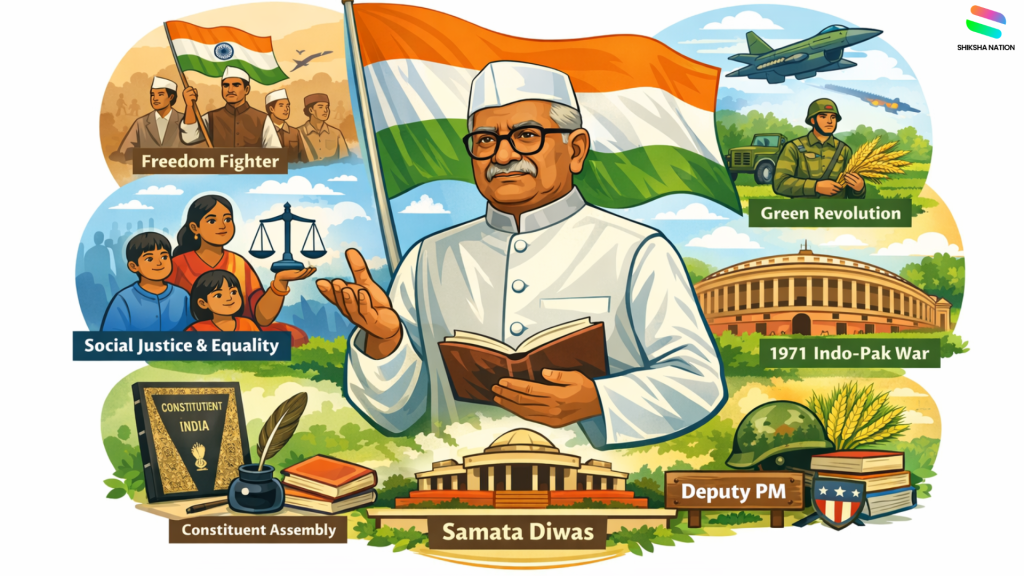
So, who is Babu Jagjivan Ram for students today?
He is studied in school because his life explains how education, courage, and hard work can bring social change. Despite facing discrimination as a child, he continued his studies and later helped shape India’s laws and policies.
After Independence in 1947, he served India as a Union Minister for over 30 years, which is a national record. He also contributed to key areas like labour welfare, agriculture, and national defence.
For students and parents, his story teaches values such as equality, dignity, and leadership, which are part of Indian history and civics textbooks.
Important Facts About Babu Jagjivan Ram (For Exams)
- Full name: Babu Jagjivan Ram
- Born: 5 April 1908, Chandwa village, near Ara, Bihar
- Died: 6 July 1986
- He was an Indian freedom fighter and a senior national leader after Independence.
- He became a member of the Constituent Assembly in 1946 and supported equality in law-making.
- He served as a Union Minister for over 30 years, which is the longest in Indian history.
- He was Defence Minister of India (1970–1974) during the Indo-Pak War of 1971.
- He became Deputy Prime Minister of India in 1977.
- His birth anniversary, 5 April, is observed as Samata Diwas (Equality Day).
Student tip: These points are useful for short answers, MCQs, and quick revision before exams.

Who Was Babu Jagjivan Ram? (Exam-Focused Overview)
He was an Indian independence activist and a senior national leader who worked for India both before and after Independence. He was born on 5 April 1908 in a village near Ara, Bihar, and later became one of the most respected Bihar political leaders in the country.
Babu Jagjivan Ram took part in the freedom movement and supported equality, social justice, and the rights of workers. Because of his clear thinking and honesty, he was chosen for important roles in the government after 1947.
He served India as a Union Minister for many years and handled key departments like Labour, Agriculture, and Defence. His long service helped improve the lives of farmers, workers, and soldiers.
For Class 6-8 students, he is important because his life shows how education and determination can change society. For parents, his journey is a strong example of leadership with values, which is why he is included in school history and civics lessons.
Early Life and Education of Jagjivan Ram
Childhood and Background
Jagjivan Ram was born on 5 April 1908 in Chandwa village near Ara, Bihar. His family background was simple, and life was not easy after the early loss of his father. From a young age, he saw unfair treatment in society, which later shaped his thinking about social justice and equality.
During his school years, he faced discrimination because of his social background. Instead of accepting this quietly, he questioned such practices and stood up for self-respect. These early experiences made him sensitive to the problems faced by marginalized communities and strengthened his belief in Dalit rights in India.
For students, his childhood shows that difficult situations do not decide one’s future. Courage and confidence can help overcome barriers.
Jagjivan Ram Education Journey
Jagjivan Ram was a bright student and passed his school exams with good results. In 1927, he joined Banaras Hindu University (BHU), where he continued to speak against unfair treatment of students. Later, he moved to Calcutta University and completed his B.Sc. degree in 1931.
His education was not just about books. It taught him leadership, discipline, and responsibility. For parents and students, Jagjivan Ram education journey proves that learning can empower individuals to bring positive change in society.
Babu Jagjivan Ram in India’s Freedom Movement
Babu Jagjivan Ram was an Indian independence activist who worked actively during the final decades of British rule. Even before Independence, he believed that freedom must also bring dignity and fair treatment to common people, especially workers and the poor.
Early Political Involvement
In the 1930s, Jagjivan Ram became active in public life in Bihar. He joined national movements that demanded equal rights and better working conditions. During this period, he supported labour groups and spoke against unfair practices faced by workers in factories and farms.
His leadership skills were noticed by senior freedom fighters, and he became a voice for people who were often ignored in decision-making.
Work for Labour and Social Reform
In 1946, just before Independence, he was appointed Labour Minister in the interim government. Here, he helped lay the base for early labour welfare policies such as worker safety, fair wages, and social security.
For students and parents, this phase of his life shows that the freedom movement was not only about ending British rule, but also about building a just and caring society for all Indians.
Role of Babu Jagjivan Ram in the Indian Constitution
The Babu Jagjivan Ram role in Indian Constitution was important because he spoke for equality and fair treatment of all citizens. In 1946, he became a member of the Constituent Assembly of India, the body responsible for drafting the Constitution.
Work in the Constituent Assembly
Inside the Assembly, Jagjivan Ram supported laws that protected the dignity of every individual. He believed that freedom would be incomplete if some groups were left behind. His views helped strengthen ideas related to equal rights and social justice.
He supported provisions that ensured representation for weaker sections in public life. This helped different communities feel included in the new nation.
Focus on Rights and Equality
Jagjivan Ram stressed that the Constitution should guarantee basic rights such as equality before law and equal opportunity in jobs and education. These ideas later became part of India’s democratic system.
For students, this section explains why the Constitution is not just a legal document but a promise of fairness. For parents, his role shows how leaders worked to protect unity and equality when India became independent in 1950.
Major Political Positions Held by Jagjivan Ram
Babu Jagjivan Ram held many important positions in the Government of India after Independence. His roles are often asked in school exams because they show his long and trusted public service.
Jagjivan Ram as Defence Minister of India
Jagjivan Ram Defence Minister tenure began in 1970. During this period, India faced a major challenge on its eastern border. He played a key administrative role during the Indo-Pak War 1971, which led to the creation of Bangladesh.
As Defence Minister, he focused on strengthening the armed forces and improving support systems for soldiers. His calm decision-making during a difficult time made this role historically important.
Jagjivan Ram as Deputy Prime Minister
In 1977, Jagjivan Ram became the Deputy Prime Minister of India. This position showed the high level of trust placed in his leadership and experience.
As Deputy Prime Minister, he supported national stability and coordinated between different ministries. For students, this highlights how senior leaders help in smooth governance.
Longest-Serving Union Cabinet Minister
Jagjivan Ram served as a Union Minister for over 30 years, making him the longest-serving Union Cabinet minister in Indian history. He handled departments like Labour, Agriculture, Defence, and Transport.
For exams, this fact shows his unmatched continuity in public service and his importance in India’s post-Independence government.
Jagjivan Ram’s Contribution to India
Jagjivan Ram’s work helped improve daily life for ordinary people in independent India. His policies focused on fairness, food security, and equal opportunities, which makes his contributions relevant even today.
Contribution to Social Justice and Equality
The Jagjivan Ram contribution to India is strongly linked with social justice and equality. Throughout his public life, he supported laws and programs that aimed to reduce discrimination and give equal chances to all citizens.
He worked for better representation of weaker sections in education and government services. His efforts strengthened Dalit rights in India by promoting dignity, respect, and participation in national life.
For students, this teaches the importance of equal treatment. For parents, it shows how policy decisions can protect social balance.
Role in Agriculture and the Green Revolution
As Union Minister for Agriculture in the late 1960s and mid-1970s, Jagjivan Ram played a key role in improving food production. During difficult years like the 1974 drought, his decisions helped prevent food shortages.
He supported modern farming methods, better seeds, and fair distribution of food. These steps became part of the Green Revolution in India, which helped farmers and ensured stable food supply for families across the country.
Even today, these contributions matter because food security affects every household.
Legacy of Babu Jagjivan Ram
Babu Jagjivan Ram’s legacy is remembered for his lifelong work toward equality, dignity, and national development. After his death on 6 July 1986, the country continued to honour his ideas through institutions, memorials, and public events.
His birth anniversary on 5 April is observed as Samata Diwas, which means Equality Day. This day reminds citizens of the importance of fairness and respect in society. His memorial, Samta Sthal in Delhi, stands as a symbol of unity and justice.
Many schools, colleges, and public institutions are named after him to keep his values alive. His work in social reform, governance, and nation-building made a lasting impact on India.
For students, he is studied because his life explains how strong values and education can change society. For parents, his journey is an example of leadership with responsibility and integrity.
Frequently Asked Questions on Babu Jagjivan Ram
Q. Who was Babu Jagjivan Ram?
Babu Jagjivan Ram was an Indian independence activist and a national leader who worked for India before and after Independence. He was born on 5 April 1908 in Bihar and dedicated his life to equality, public service, and nation-building.
Q. Why is Babu Jagjivan Ram important in Indian history?
He is important because he helped shape India’s policies in areas like labour welfare, agriculture, and defence. His long service in the government made him one of the most experienced leaders of independent India.
Q. What role did Jagjivan Ram play in the Constitution?
Jagjivan Ram was a member of the Constituent Assembly of India in 1946. He supported ideas of equal rights, fair representation, and dignity for all citizens, which became part of India’s democratic system.
Q. Which ministries did Jagjivan Ram handle?
During his career, he handled key ministries such as Labour, Agriculture, Defence, Transport, and Communications. He served as Defence Minister during the 1971 war and later became Deputy Prime Minister.
Q. Why is his birth anniversary celebrated as Samata Diwas?
His birth anniversary on 5 April is observed as Samata Diwas, or Equality Day. It honours his lifelong work for fairness, social harmony, and equal opportunity, values that students still learn in school today.