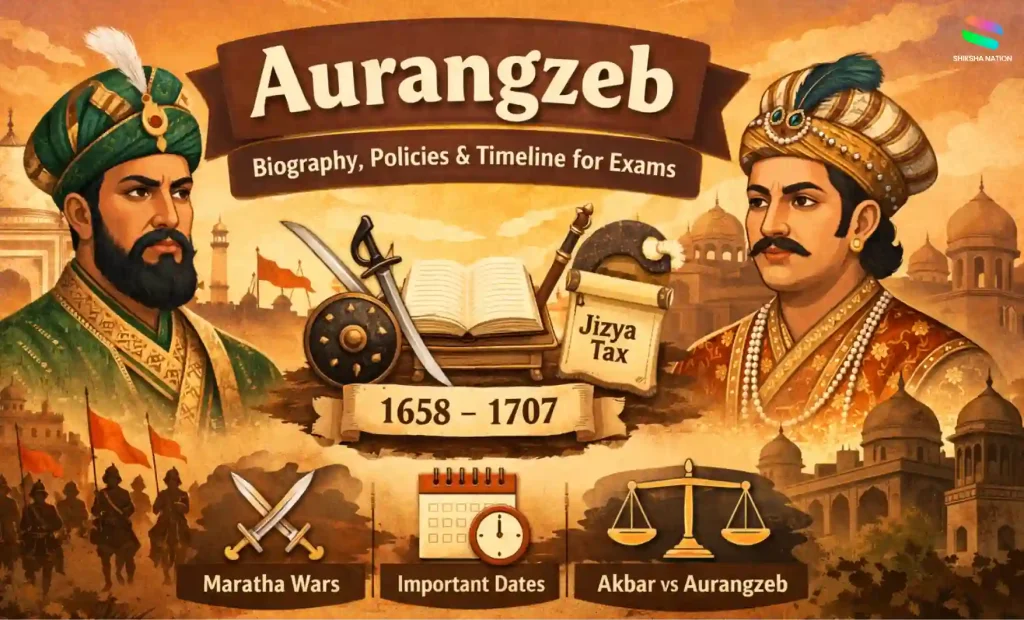
Aurangzeb’s Facts
| Field |
Details |
| Full Name |
Muhi al-Din Muhammad |
| Title |
Alamgir (Conqueror of the World) |
| Born |
3 November 1618 |
| Reign |
1658 – 1707 |
| Father |
Shah Jahan |
| Death |
3 March 1707 |
Aurangzeb (Early Life)
Aurangzeb was the third son of Shahjahan and Mumtaz Mahal. Unlike some other Mughal princes, he was known to be serious and disciplined from a young age.
He was trained in administration and military skills early in his life. This helped Aurangzeb later when he had to fight for the throne. Even before becoming emperor, Aurangzeb had experience as a governor in different regions.
How Aurangzeb Became Emperor
When Shahjahan fell ill in 1657, a war started between his sons for the throne. This is known as the War of Succession.
Aurangzeb’s main rival was his elder brother Dara Shikoh. Dara was supported by Shah Jahan, but Aurangzeb was more strategic and militarily strong.
In 1658, Aurangzeb defeated Dara Shikoh and took control of the empire. After this, Aurangzeb imprisoned his father Shahjahan in Agra Fort.
This event is very important because many exam questions come from this power struggle.
Aurangzeb’s Policies and Administration
Aurangzeb followed a strict and centralized style of administration. Some of his major policies include:
- Reintroduction of Jizya tax on non-Muslims
- Compilation of Fatawa-e-Alamgiri (Islamic law code)
- Expansion of Mughal territory in South India
- Strong control over provincial governors
Aurangzeb focused more on control and discipline rather than flexibility. This worked in some areas, but in others it created resistance.
Aurangzeb’s Religious Policy
Aurangzeb is often discussed because of his religious policies. He followed orthodox Sunni Islam and tried to run the empire based on Islamic principles.
One major decision was bringing back the Jizya tax in 1679, which was earlier removed by Akbar.
Because of such decisions, many groups in the empire felt uncomfortable. This increased tensions over time.
This topic is very important for exams, especially in comparison questions.
Aurangzeb’s Rule (Major Conflicts)
Aurangzeb spent a large part of his rule dealing with conflicts.
Conflict with Marathas
- Main opponent: Shivaji Maharaj and later Sambhaji
- Long wars in the Deccan region
- Drained Mughal resources
Sikh Revolt
- Execution of Guru Tegh Bahadur in 1675
- Resistance continued under Guru Gobind Singh
Rajput Relations
- Earlier Mughals had strong alliances
- Under Aurangzeb, relations became weaker
These conflicts weakened the empire slowly, even though Aurangzeb was winning many battles.
Important Events & Timeline
To understand Aurangzeb’s rule more clearly, it helps to look at the major events in chronological order as they show how his decisions, policies, and conflicts developed over time, making it easier for students to revise and connect important points for exams.
| Year |
Event |
| 1658 |
Aurangzeb became emperor |
| 1675 |
Guru Tegh Bahadur executed |
| 1679 |
Jizya tax reintroduced |
| 1689 |
Sambhaji executed |
| 1707 |
Death of Aurangzeb |
Aurangzeb vs Akbar
To understand Aurangzeb better, it is helpful to compare his rule with Akbar, as both followed very different policies which directly affected the stability and unity of the Mughal Empire.
| Factor |
Akbar |
Aurangzeb |
| Religious Policy |
Tolerant |
Orthodox |
| Jizya Tax |
Removed |
Reintroduced |
| Approach |
Inclusive |
Strict |
| Empire Stability |
Strong |
Declining phase started |
This comparison is very common in exams, so don’t skip it.
Aurangzeb in Controversy
Aurangzeb is considered controversial mainly because of his policies.
- Religious decisions created division
- Some historians criticize his strict rule
- Others say he was a disciplined and capable administrator
So, opinions about Aurangzeb are mixed. That’s why questions sometimes ask for analysis, not just facts.
Aurangzeb’s Death
Aurangzeb died on 3 March 1707 at the age of 88. He died in Ahmednagar.
At the time of his death, the Mughal Empire was very large but also facing many internal problems.
Aurangzeb’s Legacy
Aurangzeb left behind a very complex legacy.
- He expanded the empire to its largest size
- But continuous wars weakened resources
- His policies created long-term instability
After Aurangzeb, the Mughal Empire slowly started declining.
FAQ’s on Aurangzeb
Q. Why is Aurangzeb considered controversial?
Because of his religious policies and strict rule, which created tensions in the empire.
Q. What was the Jizya tax?
It was a tax on non-Muslims, reintroduced by Aurangzeb in 1679.
Q. Who did Aurangzeb defeat to become emperor?
He defeated his brother Dara Shikoh.
Q. How long did Aurangzeb rule?
He ruled for about 49 years (1658-1707).
Q. Was Aurangzeb a successful ruler?
He was successful in expansion but faced many internal challenges.
Q. Why did the Mughal Empire decline after Aurangzeb?
Continuous wars, administrative pressure, and internal revolts weakened the empire.