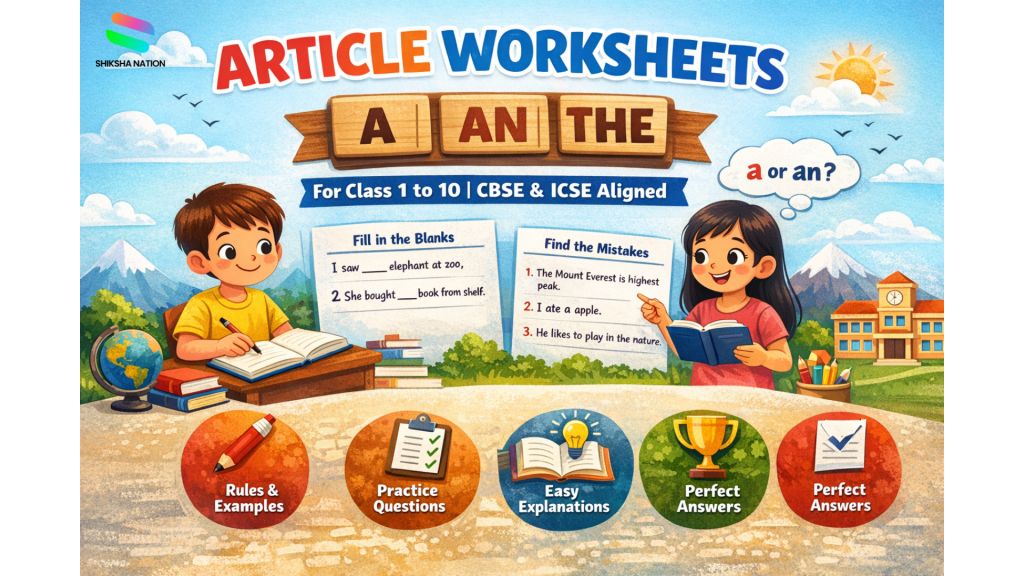
Articles are small words like a, an, and the, but they create big confusion for many students. One small mistake can change the meaning of a sentence or reduce marks in exams.
This article worksheet page is made for school students from Class 1 to Class 10 who want clear practice, not long grammar theory. It is also helpful for parents who want simple, ready-to-use material to support daily study at home.
Here, students will get class-wise practice questions, from easy to exam-level. Each worksheet is followed by answers, so students can check mistakes and improve step by step. Parents can easily track where the child is confused and guide them calmly.
Instead of random PDFs, this articles worksheet is structured, practice-focused, and safe for school exams. Use it for revision, homework support, or quick grammar improvement without pressure.
Book a Counseling Session
What Are Articles in English Grammar? (Quick Recap)
Understanding a, an, and the
Articles are small grammar words placed before a noun. They help us know whether we are talking about something general or something specific. Students often practise them using an a an the worksheet to understand correct usage through examples.
Indefinite article (a or an) is used when we talk about something for the first time or in a general way. The choice depends on the sound of the next word, not the spelling.
Definite article (the) is used when both the speaker and listener know which thing is being talked about. It points to something specific or already mentioned.
Parents should focus on helping children recognise patterns instead of memorising rules. The worksheets ahead will make this clearer through practice and answers.
Class 6-10 90% Marks Guarantee Program with NCERT syllabus, weekly tests, and personal mentorship.
Article Worksheet for Class 1 & 2
This article worksheet for class 1 and article worksheet for class 2 is designed for young learners who are just starting English grammar. At this stage, children learn better with simple words, clear sentences, and familiar objects.
The focus here is only on a and an. Students are guided to choose the correct article based on the sound of the word that comes next. No rules to memorise, only practice through easy examples.
Parents can sit with the child and read the sentence aloud. Hearing the sound helps children decide naturally. This makes learning stress-free and suitable for early classes.
Fill in the Blanks (Easy Level)
I see ___ apple on the table.
She has ___ ball to play with.
He saw ___ elephant at the zoo.
This is ___ cat sleeping on the chair.
I want ___ ice cream.
There is ___ dog in the park.
She eats ___ orange daily.
He bought ___ pencil from the shop.
We saw ___ ant near the window.
It is ___ book for my class.
Answers with Explanation
an – apple starts with a vowel sound.
a – ball starts with a consonant sound.
an – elephant begins with a vowel sound.
a – cat has a consonant sound.
an – ice cream starts with a vowel sound.
a – dog starts with a consonant sound.
an – orange has a vowel sound.
a – pencil begins with a consonant sound.
an – ant starts with a vowel sound.
a – book begins with a consonant sound.
Article Worksheet for Class 3 & 4
This article worksheet for class 3 and article worksheet for class 4 is made for students who already know a and an and are now learning how to use the correctly. At this level, confusion usually starts when students are unsure whether a noun is general or specific.
This articles worksheet helps children practise using a, an, and the through short and familiar sentences. The questions are simple, but they slowly train the mind to notice meaning and sound together.
Parents can help by asking the child why they chose an article. This builds thinking skills and reduces careless mistakes in exams.
Fill in the Blanks with Articles (Set 1)
I saw ___ bird on ___ tree.
She has ___ umbrella in her bag.
We went to ___ park near our house.
He ate ___ apple given by ___ teacher.
There is ___ cat sitting on ___ wall.
My father bought ___ watch yesterday.
She opened ___ window in ___ room.
I saw ___ elephant at ___ zoo.
He wants ___ book from ___ shelf.
___ sun rises in the east.
Fill in the Blanks with Articles (Set 2)
I have ___ orange and ___ banana.
She found ___ old coin on ___ road.
We visited ___ museum last Sunday.
He saw ___ owl sitting on ___ tree.
Please close ___ door of ___ classroom.
My brother bought ___ new bag.
She read ___ story before sleeping.
We saw ___ aeroplane in ___ sky.
He took ___ umbrella because of rain.
___ moon looks bright tonight.
Answers with Simple Explanation
Use a before consonant sounds, an before vowel sounds, and the when we talk about something special or already known. Encourage children to read the sentence aloud to avoid vowel sound confusion.
Article Worksheet for Class 5
This article worksheet for class 5 is designed for students who already know the basics but still make mistakes in exams. At this stage, questions become more sentence-based, and students must understand meaning, not just sounds.
The worksheet below works like both a definite article worksheet and an indefinite article worksheet. Students practise choosing a, an, or the based on whether the noun is general, specific, or already known in the sentence.
Parents can encourage the child to read each sentence slowly and think about what is being talked about. This habit improves accuracy and reduces careless errors.
Fill in the Blanks with Correct Articles
She wants to buy ___ dress for the party.
I saw ___ boy standing near the gate.
He returned ___ book that I lent him.
There is ___ honest man in our village.
We went to ___ market after school.
My uncle bought ___ umbrella yesterday.
The teacher called ___ student who was late.
She lives in ___ small house near the river.
I found ___ keys on the table.
___ sun was very hot in the afternoon.
Answers with One-Line Explanation
Use a/an when the noun is general or mentioned for the first time. Use the when the noun is specific, already mentioned, or clearly known to the reader.
Common Mistakes Students Make in Class 5
Using the everywhere, even when the noun is general
Choosing a or an by spelling instead of sound
Ignoring context and rushing through sentences
Parents should focus on explanation, not speed. Regular practice will slowly fix these mistakes.
Article Worksheet for Class 6
This article worksheet for class 6 is meant for students who are now expected to understand context clearly. At this level, questions are no longer very direct, and students must decide whether to use a, an, the, or no article.
The focus here is on the zero article concept, where no article is used before certain nouns. This includes names of subjects, languages, meals, and some places. Many students lose marks because they add an article where it is not needed.
Parents can help by asking the child to explain why an article is used or skipped. This habit improves exam accuracy and confidence.
Fill in the Blanks (Exam-Style Practice)
She is good at ___ mathematics.
We eat ___ dinner at eight o’clock.
He wants to become ___ engineer.
___ honesty is the best policy.
They visited ___ Taj Mahal during holidays.
I usually go to ___ school by bus.
She bought ___ umbrella from the shop.
___ English is taught in our school.
He is ___ honest boy.
We stayed at ___ hotel near the station.
Answers with One-Line Explanation
Use no article before subjects, meals, and abstract nouns used in a general sense. Use a/an for first-time mention and the for specific or well-known places. Practising an a an the no article worksheet helps students avoid overusing articles in exams.
Article Worksheet for Class 7 & 8
This article worksheet for class 7 and article worksheet for class 8 is designed for middle-school students where grammar questions become more meaning-based. At this stage, students must clearly understand when to use an article and when to avoid it.
The exercises below focus on abstract nouns, geographical names, and the difference between general and specific reference. Parents can support learning by asking the child to explain the reason behind each choice. This improves thinking and reduces guesswork in exams.
Set 1: Fill in the Blanks (Articles Practice)
___ honesty is always valued in life.
We visited ___ Himalayas during summer vacation.
She wants to become ___ doctor in future.
___ Ganga flows through many states of India.
He spoke ___ truth without fear.
They live near ___ Arabian Sea.
___ courage shown by the soldier was praised.
She bought ___ dress for the annual function.
___ Mount Everest is the highest peak in the world.
I read ___ book you gave me yesterday.
Set 2: Fill in the Blanks (Articles Practice)
___ kindness should be shown to everyone.
We stayed near ___ river during the trip.
He joined ___ school that is close to his house.
___ honesty of the boy impressed the teacher.
They crossed ___ Indian Ocean by ship.
She told me ___ story about her childhood.
___ bravery of the firefighters saved many lives.
I saw ___ aeroplane flying very low.
___ Sahara Desert is very hot during the day.
She lost ___ pen she was using in class.
Answers with Simple Explanation
Use no article with abstract nouns when they are used in a general sense. Use the with well-known geographical names and when talking about something specific. Practising such articles exercise with answers helps students avoid confusion and improves accuracy in school exams.
Article Worksheet for Class 9 & 10
This article worksheet for class 9 and article worksheet for class 10 is created strictly at board-exam level. Here, articles are tested inside long, connected paragraphs, where students must understand context, reference, and flow.
At this stage, mistakes happen not because students don’t know rules, but because they miss specific reference, repeated nouns, and unique objects that require the. Parents often notice marks cut in grammar despite good writing. This section fixes that gap.
Students should always read the full paragraph first. Articles like the become clear only when the noun is already known, unique, or discussed earlier.
Paragraph-Based Article Practice Questions (Board Pattern)
Read the paragraph carefully and fill in the blanks with a, an, the, or no article.
Last winter, our school organised ___ educational trip to ___ historical city.
___ city is famous for ___ old monuments and ___ rich culture.
We first visited ___ fort which is located on ___ hill near ___ river.
___ fort was built during ___ Mughal period and still attracts ___ tourists.
At ___ main gate, ___ guide welcomed us and shared ___ history of ___ fort.
He explained how ___ king ruled ___ region with ___ wisdom and courage.
___ bravery of ___ soldiers protected ___ fort for many years.
From ___ top of ___ fort, we could see ___ entire city clearly.
___ view of ___ sunset from ___ fort was unforgettable.
After ___ visit, we sat under ___ large tree near ___ entrance.
We had ___ lunch while discussing ___ facts we had learned.
___ experience helped us understand ___ importance of history.
___ history teaches us lessons about ___ past and ___ present.
I believe ___ such trips should be part of ___ school education.
___ students learn better when ___ learning is practical.
This trip became ___ one of ___ best memories of my school life.
___ teachers also felt ___ students were more attentive after ___ trip.
___ whole journey was planned in ___ organised manner.
Student & Parent Guidance for Board Exams
These article practice questions reflect how articles appear in CBSE and ICSE board papers, especially where the is tested repeatedly for reference and clarity. Parents should ask students whythe is used instead of a. This habit reduces confusion and improves grammar scores in Class 9 and 10 exams.
Article Worksheet for Class 9 & 10
This article worksheet for class 9 and article worksheet for class 10 is designed at board-exam level. At this stage, students are expected to apply article rules inside long sentences and short paragraphs, not isolated lines.
The questions below are framed to match school exams, where meaning, context, and flow matter. Parents can help by asking the student to read the full paragraph first, then fill the blanks. This habit improves accuracy and confidence in exams.
Article Practice Questions – Class 9 (Paragraph-based)
Fill in the blanks with a, an, the, or no article.
Rohan wanted to become ___ engineer since childhood.
He studied in ___ school near his house.
___ honesty is valued more than marks.
One day, he met ___ teacher who changed his thinking.
The teacher explained ___ importance of discipline.
Rohan realised that ___ success needs patience.
He started waking up early in ___ morning.
He read ___ newspaper daily.
___ hard work slowly showed results.
He joined ___ coaching centre nearby.
___ guidance he received helped him improve.
He learnt ___ lesson from his mistakes.
___ confidence in his ability increased.
He cleared ___ exam with good marks.
His parents felt ___ pride after the result.
Article Practice Questions – Class 10 (Paragraph-based)
Fill in the blanks with correct articles.
India is ___ country with rich history.
___ freedom we enjoy today came after struggle.
___ British ruled India for many years.
Mahatma Gandhi was ___ leader of masses.
He believed in ___ truth and non-violence.
___ simple life he lived inspired millions.
He led ___ movement without violence.
___ courage of common people was remarkable.
Students should learn ___ value of freedom.
___ education plays important role in society.
Today, India is ___ independent nation.
___ youth have responsibility towards country.
___ discipline helps build strong character.
Every citizen must follow ___ law of land.
___ future of nation depends on students.
These article practice questions help students handle real exam patterns calmly. Regular paragraph-level practice reduces silly mistakes and improves board exam performance.
Article Worksheet Answers (Class-wise)
This article worksheet with answers section helps students check their work and understand why an option is correct. Parents can use this part to guide the child calmly instead of only marking answers as right or wrong.
Class 1 & 2 – Answer Logic
a is used before words with consonant sounds, and an is used before vowel sounds. Saying the word aloud makes the choice easy for young learners.
Class 3 & 4 – Answer Logic
Use a/an when the noun is general or mentioned first. Use the when the noun is already known, unique, or clearly pointed out in the sentence.
Class 5 – Answer Logic
Choose indefinite articles when talking about something in a general way. Use the definite article when the noun is specific, repeated, or clear from context.
Class 6 – Answer Logic
Use no article before subjects, languages, meals, and abstract ideas used generally. Use a/an/the only when the meaning becomes specific.
Class 7 & 8 – Answer Logic
Abstract nouns take no article when used generally, but the is used when they are defined by a phrase. Geographical names often use the when they refer to groups or regions.
Class 9 & 10 – Answer Logic
Articles depend on meaning within the paragraph. a/an introduce something new, the points to something specific or already known, and no article is used for general ideas.
This approach makes articles worksheet with answers useful for learning, not just checking.
How Parents Can Use These Article Worksheets at Home
Simple Daily Practice Plan for Better Grammar
Parents do not need long study hours to help their child improve grammar. Just 10–15 minutes daily is enough if the practice is calm and regular. Choose a small set of questions and sit with the child while they attempt them.
Ask the child to read the sentence aloud and explain why they chose a particular word. This builds thinking and reduces blind guessing. Avoid correcting immediately; let the child realise the mistake with guidance.
When checking answers, focus on understanding, not marks. If the answer is wrong, explain the reason in simple words and give one more similar example. Do not compare with others.
Regular short practice, gentle correction, and patient listening help children gain confidence and accuracy over time.
How Parents Can Use These Article Worksheets at Home
A Calm and Effective Home Practice Approach
Parents do not need to turn grammar practice into long study sessions. Just 10–15 minutes daily is enough when done regularly. Pick a few questions and let the child attempt them without pressure.
Ask the child to explain their choice in simple words. This helps you understand their thinking and clears confusion better than memorising rules. Listening patiently builds confidence.
While correcting, avoid focusing on marks or how many answers are right. Instead, explain why an answer works and give one similar example. Keep the tone supportive, not strict.
Short daily practice, gentle correction, and clear explanation help children improve grammar naturally and feel more confident in school exams.
Article Worksheet – FAQs
Q. Is article worksheet enough for exams?
An article worksheet is enough for practice and revision if the student understands the answers. It helps reduce common mistakes and improves accuracy. For best results, it should be used along with regular school lessons.
Q. When should children start learning articles?
Children can start learning a and an from early classes. The use of the and deeper understanding comes gradually as reading and sentence sense improve.
Q. When should “no article” be taught?
The concept of “no article” is best introduced from Class 6 onwards. At this level, students can understand context, subjects, meals, and abstract ideas better.
Q. How many questions should a student practise daily?
Practising 8–10 questions daily is enough. Regular short practice works better than long sessions done once in a while.
Q. Is this suitable for both CBSE and ICSE students?
Yes, the practice style and sentence structure are aligned with CBSE and ICSE grammar expectations. The focus is on understanding, not board-specific tricks.
Q. Should parents correct answers immediately?
No. Parents should first ask the child to explain their choice. Gentle guidance helps learning more than quick correction.
Q. What if my child keeps repeating the same mistake?
This usually means the concept is unclear. Slow down practice, explain with one fresh example, and avoid rushing to the next level.
Q. Can these worksheets help in board exams?
Yes. Regular practice builds confidence and reduces silly errors, which is very helpful in Class 9 and 10 board exams.