

Introduction to Applications of Newton’s Laws
Newton’s Laws of Motion describe the fundamental relationship between force and motion. While the laws themselves are stated in simple theoretical form, their real value lies in how they are used to analyse and predict motion in physical systems. In practical situations, objects rarely move in isolation, and multiple forces often act simultaneously.
To understand motion in such cases, it is not sufficient to memorise the laws. One must learn how to apply them to situations involving contact forces, resistance, constraints, and interactions between bodies. This process of translating physical situations into force equations forms the basis of problem solving in mechanics.
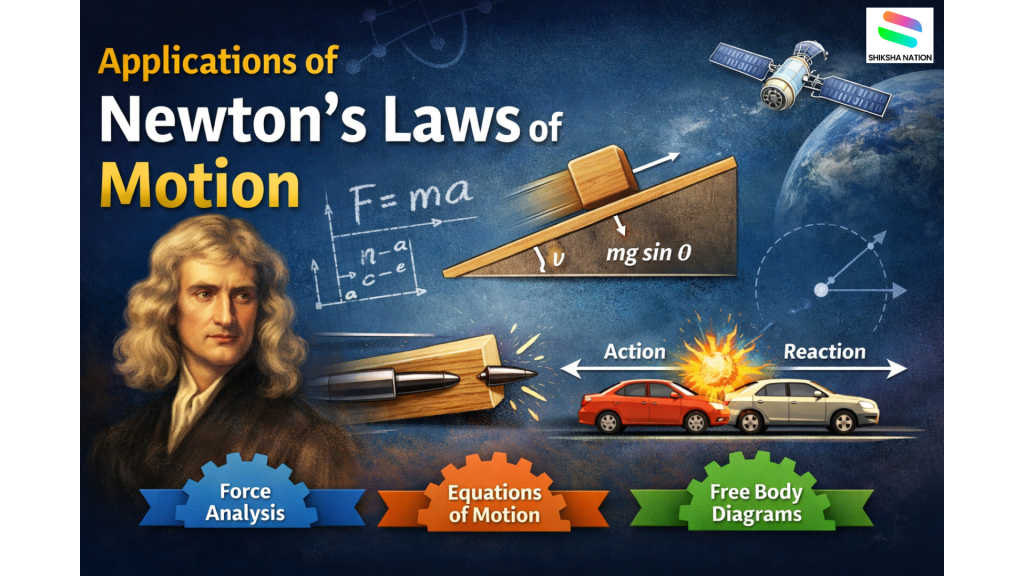
The study of Applications of Newton’s Laws of Motion helps students connect abstract principles with observable phenomena. It explains how forces influence motion on surfaces, through media, and within interconnected systems. Through systematic application, the laws become tools for reasoning rather than mere statements.
A clear understanding of these applications is essential for analysing real-world motion and for building a strong foundation for advanced topics in mechanics.
Revisiting Newton’s Laws of Motion (Concept Foundation)
First Law and the Concept of Inertia
Newton’s First Law states that a body continues in its state of rest or uniform motion in a straight line unless acted upon by an external force. This law introduces the concept of inertia, which is the natural tendency of a body to resist any change in its state of motion. Inertia is directly related to mass; a body with greater mass offers greater resistance to change.
The First Law helps identify situations where forces are balanced. When the net external force on a body is zero, its velocity remains constant. This principle forms the basis for analysing equilibrium and uniform motion before considering more complex force interactions.
Second Law and the Force – Acceleration Relation
Newton’s Second Law establishes a quantitative relationship between force, mass, and acceleration. It states that the rate of change of momentum of a body is directly proportional to the applied force and occurs in the direction of that force. For motion with constant mass, this leads to the familiar relation between force and acceleration.
This law is central to solving motion problems because it allows the calculation of acceleration once all forces acting on a body are known. It provides a systematic method to link physical causes (forces) with observable effects (changes in motion).
Third Law and Action – Reaction Pairs
Newton’s Third Law states that for every action, there is an equal and opposite reaction. These forces always occur in pairs and act on different bodies. Although equal in magnitude, they do not cancel each other because they act on separate objects.
Understanding the Third Law is essential for analysing interactions between bodies, such as contact forces and tension. Correct identification of action–reaction pairs prevents common conceptual errors when applying Newton’s Laws to real physical systems.
Identifying Forces Acting on a System
Correct application of Newton’s Laws begins with identifying all the forces acting on a body. A force is any interaction that can change the state of motion or shape of an object. In real physical situations, multiple forces often act simultaneously, and overlooking even one force can lead to incorrect conclusions about motion.
A systematic identification of forces allows the construction of accurate equations of motion. Each force must be considered with its direction, point of application, and physical origin. This step forms the foundation for analysing acceleration, equilibrium, and interaction between bodies.
Types of Forces in Mechanical Systems
Gravitational force acts on every object near the Earth due to its mass. It is always directed vertically downward toward the centre of the Earth and is proportional to the mass of the body. This force is commonly represented as the weight of the object.
The normal reaction is a contact force exerted by a surface on a body resting or moving on it. It acts perpendicular to the surface and adjusts its magnitude according to other forces acting on the body. The normal reaction is not always equal to the weight, especially when additional forces or acceleration are present.
Tension is the force transmitted through a string, rope, or cable when it is taut. It acts along the length of the connector and pulls equally on the bodies at both ends. In ideal conditions, tension is considered uniform throughout a light, inextensible string.
Friction is a resistive force that opposes relative motion or the tendency of motion between two surfaces in contact. It acts parallel to the surface and depends on the nature of the surfaces and the normal reaction. In idealised cases where a body slides without friction, motion is analysed assuming no energy loss due to surface resistance.
Applied and resistive forces include external pushes or pulls and forces offered by mediums such as air or liquids. These forces may vary with speed or position and often oppose motion, reducing acceleration.
Net Force and Its Physical Meaning
The net force on a body is the vector sum of all forces acting on it. Newton’s Second Law applies to this resultant force, not to individual forces acting alone. If the net force is zero, the body remains at rest or continues moving with constant velocity.
When the net force is non-zero, it determines both the magnitude and direction of acceleration. Accurate calculation of net force requires careful resolution of forces along appropriate directions. This understanding links force identification directly to the prediction of motion.
Free Body Diagrams and Their Role in Applications
A clear understanding of forces acting on a body is essential before applying Newton’s Laws. Free Body Diagrams provide a systematic method to represent these forces in a simplified and organised manner. They serve as an important link between physical situations and mathematical equations of motion.
By isolating a body from its surroundings, a Free Body Diagram allows each force to be examined independently. This visual representation helps prevent omissions and ensures that Newton’s Laws are applied correctly to the chosen system.
What Is a Free Body Diagram
A Free Body Diagram is a simplified sketch of a single body, showing all the external forces acting on it. The body is represented by a point or a simple shape, and each force is drawn as an arrow indicating its direction and nature.
Only forces exerted by objects outside the system are included in the diagram. Internal forces within the body are not shown, as they do not affect the overall motion of the system being analysed.
Steps to Draw a Correct Free Body Diagram
The first step is to clearly identify the system or body under consideration. Once the system is chosen, it must be imagined as completely separated from its surroundings. All external forces acting on the body are then listed.
Each force is drawn with a clear direction and labelled according to its type, such as gravitational force, normal reaction, or tension. The diagram should be neat and uncluttered, allowing easy resolution of forces along chosen axes when applying Newton’s Laws.
Common Errors in Force Representation
A common mistake is including forces that do not act on the selected body, such as reaction forces acting on other objects. Another frequent error is missing forces like friction or tension, especially in complex systems.
Incorrect direction of forces, particularly friction and normal reaction, can also lead to wrong conclusions. Careful attention to the physical situation and consistent use of Free Body Diagrams help avoid these errors and improve accuracy in problem solving.
Applications Involving Motion on Horizontal and Inclined Surfaces
Many practical applications of Newton’s Laws involve bodies moving in contact with surfaces. In such cases, the nature of the surface plays a crucial role in determining the forces acting on the body and, consequently, its motion. Idealised situations are often considered first to develop clear understanding before introducing additional complexities.
Motion on a Smooth Horizontal Surface
A smooth horizontal surface is one on which friction is negligible or absent. When a body moves on such a surface, the only vertical forces acting on it are the gravitational force and the normal reaction, which balance each other. As a result, vertical acceleration is zero.
If an external force is applied horizontally, it becomes the net force acting on the body. According to Newton’s Second Law, this net force produces acceleration in the direction of the applied force. The motion is then analysed by directly relating force, mass, and acceleration.
In the absence of any applied force, a body on a smooth horizontal surface continues to move with uniform velocity or remains at rest. This behaviour illustrates the First Law of Motion and highlights the role of unbalanced forces in changing the state of motion.
Motion on a Smooth Inclined Plane
An inclined plane is a flat surface tilted at an angle to the horizontal. When a body is placed on a smooth inclined plane, its weight can be resolved into two components: one perpendicular to the plane and the other parallel to it. The perpendicular component is balanced by the normal reaction.
The component of weight acting parallel to the plane causes acceleration down the incline. This principle is commonly illustrated through situations where a block is moving down a smooth inclined plane under the influence of gravity alone. The acceleration depends on the angle of inclination and the gravitational field.
In standard applications, such as when a small block slides down on a smooth inclined plane, Newton’s Second Law is applied along the direction of motion to determine acceleration. These cases help students understand how force resolution simplifies complex-looking systems. Similar reasoning applies whenever a block slides down a smooth inclined plane, making this a fundamental model for analysing motion on sloping surfaces.
Motion Under a Constant Retarding Force
In many physical situations, a moving body experiences a force that opposes its motion. Such a force reduces the speed of the body with time and is therefore called a retarding force. Unlike ideal motion, these cases involve interaction with a medium or surface that resists motion.
When the retarding force remains constant in magnitude and direction, the resulting acceleration is also constant but opposite to the direction of motion. This allows the use of Newton’s Laws together with the equations of uniformly accelerated motion to analyse the system.
Meaning of Retarding Force
A retarding force is any force that acts opposite to the direction of motion of a body. Common examples include friction between surfaces and resistive forces offered by solid or dense media. The presence of such a force causes the body to slow down and may eventually bring it to rest.
In solid media, resistance arises due to deformation and internal friction. For instance, when a fast-moving object penetrates a material, the medium exerts a force opposite to the motion throughout the contact. If the properties of the medium are uniform, this resisting force can be treated as constant over a short distance.
Retarding forces play an important role in determining stopping distance and time of motion. Understanding their effect is essential for analysing real systems where energy is continuously dissipated due to resistance.
Application of Newton’s Second Law with Kinematics
According to Newton’s Second Law, the net force acting on a body is equal to the product of its mass and acceleration. When a constant retarding force acts on a body, the acceleration is constant and directed opposite to the velocity. This makes it possible to apply the standard kinematic equations.
Such situations are commonly studied using motion along a straight line. The direction of motion is chosen as the reference direction, and the retarding acceleration is taken as negative. This approach helps in relating velocity, distance travelled, and acceleration in a systematic manner.
A typical example involves motion through a resisting medium, such as when a bullet from a gun is fired on a rectangular wooden block. As the bullet penetrates the block, the wood exerts a constant opposing force, reducing the bullet’s speed uniformly. In similar problems, the initial velocity may be specified, as in cases where a bullet from a gun is fired on a rectangular wooden block with velocity u, and changes in speed over a given distance are analysed.
By combining Newton’s Second Law with the equations of motion, one can determine quantities such as penetration depth or stopping distance. These applications illustrate how force analysis and kinematics together provide a complete description of motion under resistance.
Systems Involving Sudden Change of Motion
In some physical situations, the motion of a system changes abruptly due to internal interactions. These changes occur over a very short time interval and are characterised by large forces acting within the system. Newton’s Laws remain applicable in such cases when combined with appropriate conservation principles.
During sudden events, external forces usually have negligible effect because the time involved is extremely small. As a result, the overall motion of the system is governed primarily by internal forces, making conservation laws especially useful for analysis.
Explosion and Separation of Bodies
An explosion refers to a process in which a body breaks into two or more parts due to internal forces. Before the explosion, the system may be at rest or in motion, but the separation occurs rapidly. Since the forces responsible for the explosion are internal, they obey Newton’s Third Law.
In cases where a shell of mass m is at rest initially, the net external force acting during the explosion can be considered negligible. According to Newton’s Laws, internal forces cannot change the total momentum of the system. Therefore, the total momentum before and after the explosion remains the same.
When a body of mass m at rest explodes, the fragments move in different directions such that their momenta balance each other. Although each fragment gains kinetic energy due to the explosion, the vector sum of their momenta remains zero. This illustrates how Newton’s Laws and the principle of conservation of momentum together explain sudden changes in motion.
Understanding such systems helps students distinguish between internal and external forces. It also reinforces the correct application of Newton’s Third Law and momentum conservation in analysing rapid physical processes.
Understood. The issue is not conceptual, it is structural and visual—the section is too dense for clean copying and reading.
Below is a cleanly restructured, copy-safe rewrite of the same section, with:
- Short, consistent paragraphs
- Clear visual separation
- No content change in intent
- Academic tone preserved
Solved Numerical Examples
Solved numerical problems help in understanding how Newton’s Laws of Motion are applied to real physical situations. They show how force analysis, assumptions about motion, and mathematical relations work together. The following example explains motion under a constant retarding force using a standard Class 11 approach.
Numerical 1 – Bullet Penetrating a Wooden Block
Problem Statement
A bullet of mass 0.01 kg is fired horizontally into a uniform wooden block with an initial speed of 250 m per second. Due to a constant resisting force offered by the block, the speed of the bullet reduces to 150 m per second after travelling a distance of 0.12 m inside the block.
The bullet continues to penetrate the block in the same direction and finally comes to rest inside it. Find the total distance travelled by the bullet inside the block.
Understanding the Physical Situation
When a bullet enters a solid medium such as wood, the medium exerts a force opposite to the direction of motion. This force arises due to deformation and internal resistance of the material. If the block is uniform, the resisting force can be treated as constant.
A constant resisting force produces a constant retardation. Therefore, the motion of the bullet inside the block can be analysed using Newton’s Second Law together with the equations of uniformly accelerated motion. This is a standard bullet hitting a wooden block problem.
Given Data
Mass of bullet,
m = 0.01 kg
Initial velocity of the bullet,
u = 250 m per second
Velocity after travelling 0.12 m,
v1 = 150 m per second
Distance travelled in the first stage,
s1 = 0.12 m
Final velocity when the bullet comes to rest,
v = 0
Let the magnitude of uniform retardation be a.
Let the total distance travelled inside the block be S.
Step 1: Calculation of Retardation
For motion with constant acceleration, the relation between velocity, acceleration, and distance is:
v squared = u squared + 2 a s
Applying this equation to the first stage of motion:
150 squared = 250 squared + 2 a (0.12)
22500 = 62500 + 0.24 a
0.24 a = -40000
a = -166666.7 m per second squared
The negative sign shows that acceleration is opposite to the direction of motion, confirming that the force acting on the bullet is a retarding force.
Step 2: Distance Travelled Before Coming to Rest
In the second stage, the bullet slows down from 150 m per second to rest under the same uniform retardation.
Using the same equation of motion:
0 = 150 squared + 2 (-166666.7) s2
2 (166666.7) s2 = 22500
s2 = 0.0675 m
This is the additional distance travelled by the bullet before it comes to rest.
Step 3: Total Distance Travelled Inside the Block
The total distance travelled by the bullet inside the block is the sum of the distances covered in both stages.
S = s1 + s2
S = 0.12 + 0.0675
S = 0.1875 m
Answer
The bullet travels a total distance of 0.1875 m inside the wooden block before coming to rest.
Concept Note
In problems where a bullet penetrates a solid object, momentum conservation is not applicable because the block exerts a significant external force on the bullet. Instead, Newton’s Second Law must be applied along with equations of motion.
This approach is valid whenever a bullet of mass 0.01 kg is fired horizontally into a resisting medium and experiences a constant opposing force.
Numerical 2 – Block Sliding on a Smooth Inclined Plane
Problem Statement
A block of mass 5 kg is placed on a smooth inclined plane that makes an angle of 30 degrees with the horizontal. The block is released from rest and allowed to slide down the plane under the action of gravity alone.
Find the acceleration of the block as it moves down the inclined plane.
Understanding the Physical Situation
Since the inclined plane is smooth, friction is absent and does not oppose the motion. The only forces acting on the block are its weight and the normal reaction exerted by the plane.
The weight of the block acts vertically downward and can be resolved into two components. One component acts perpendicular to the plane and the other acts parallel to the plane. Only the component parallel to the plane is responsible for the motion.
Step 1: Resolving Forces Along the Inclined Plane
Weight of the block acts vertically downward and is equal to mass multiplied by gravitational acceleration.
The component of weight acting along the inclined plane is equal to mass multiplied by gravitational acceleration multiplied by sine of the angle of inclination.
The component perpendicular to the plane is balanced by the normal reaction and does not affect the motion.
Step 2: Applying Newton’s Second Law
According to Newton’s Second Law, force equals mass multiplied by acceleration.
Along the inclined plane, the net force acting on the block is the component of its weight acting down the plane.
Therefore,
mass multiplied by acceleration = mass multiplied by gravitational acceleration multiplied by sine of the angle
Dividing both sides by mass,
acceleration = gravitational acceleration multiplied by sine of the angle
Step 3: Substituting Values
Gravitational acceleration, g = 9.8 m per second squared
Angle of inclination = 30 degrees
Sine of 30 degrees = 0.5
acceleration = 9.8 multiplied by 0.5
acceleration = 4.9 m per second squared
Final Answer
The acceleration of the block as it slides down the inclined plane is 4.9 m per second squared.
Concept Note
This example represents a standard case where a block is moving down a smooth inclined plane. By resolving forces along the plane and applying Newton’s Second Law, the acceleration can be determined directly.
Such problems demonstrate how force components simplify motion analysis when friction is absent and help build a clear understanding of motion on inclined surfaces.
Common Misconceptions in Applications of Newton’s Laws
Misconceptions often arise when Newton’s Laws are applied mechanically without proper force analysis. These errors usually occur due to incomplete understanding of how forces act on different bodies and how motion responds to those forces. Recognising and correcting such misconceptions is essential for accurate problem solving.
One common error is confusing action–reaction pairs. According to Newton’s Third Law, action and reaction forces act on different bodies, not on the same body. Treating them as forces that cancel each other on a single object leads to incorrect conclusions about motion.
Another frequent mistake is ignoring the direction of friction. Friction always opposes relative motion or the tendency of motion between surfaces. Assuming its direction without analysing the actual motion of the system can result in wrong force equations and incorrect acceleration values.
Students also often assume zero acceleration without analysing forces. Constant velocity does not automatically imply absence of forces; it indicates that the net force is zero. Each force must be identified and balanced before concluding that acceleration is zero.
A further misconception involves mixing momentum conservation with force laws incorrectly. Momentum conservation applies only when the net external force is negligible. Applying it to situations where significant external forces act, such as motion under resistance, leads to conceptual and numerical errors.
Clear force identification, correct use of Free Body Diagrams, and proper selection of physical laws help avoid these misconceptions and strengthen understanding of Newton’s Laws.
Summary and Key Takeaways
Newton’s Laws of Motion serve as analytical tools for understanding and predicting the motion of physical systems. Their true significance lies not in memorising statements, but in applying them logically to situations involving interacting forces and constrained motion.
Accurate identification of all forces acting on a body is the foundation of correct analysis. Each force must be considered with its direction and physical origin before forming equations of motion. Missing or misinterpreting a force often leads to incorrect results.
Free Body Diagrams play a crucial role in this process by providing a clear visual representation of forces acting on a system. They help organise thinking, prevent common errors, and ensure that Newton’s Laws are applied to the correct body.
A systematic approach, moving from force identification to equation formation and finally to motion analysis, allows complex problems to be solved in a clear and consistent manner. Mastery of this logical progression strengthens understanding of mechanics and supports further study in physics.
Newton’s Laws of Motion (FAQs)
Q. Why are Newton’s Laws not enough on their own to solve motion problems?
Newton’s Laws state the relationship between force and motion, but real problems involve multiple forces acting together. Applying the laws requires identifying all forces and forming equations based on the net force.
Q. When should Newton’s Second Law be applied directly?
Newton’s Second Law should be applied when the acceleration of a body is required and all forces acting on it can be identified. It is especially useful in systems involving unbalanced forces.
Q. Why are free body diagrams important in applications of Newton’s Laws?
Free body diagrams help represent all external forces acting on a body clearly. They prevent omission of forces and ensure correct application of Newton’s Laws to the chosen system.
Q. Why is momentum conservation not used in all motion problems?
Momentum conservation is valid only when the net external force on a system is negligible. In situations where external forces act continuously, such as motion under resistance, Newton’s Laws must be used instead.
Q. How does friction affect the application of Newton’s Laws?
Friction introduces a force that opposes motion or the tendency of motion. Its presence changes the net force acting on a body and must be included when applying Newton’s Second Law.
Q. Why does a body accelerate on a smooth inclined plane even without an external push?
On an inclined plane, a component of the body’s weight acts along the surface. This unbalanced force causes acceleration, even in the absence of friction or applied force.
Q. Do action and reaction forces cancel each other in motion problems?
No. Action and reaction forces act on different bodies. Since they do not act on the same object, they cannot cancel each other’s effect on motion.
Q. Can Newton’s Laws be applied to systems involving sudden changes, such as explosions?
Yes. Newton’s Laws apply to all motions, including sudden events. In such cases, they are often used together with conservation principles to analyse the system correctly.