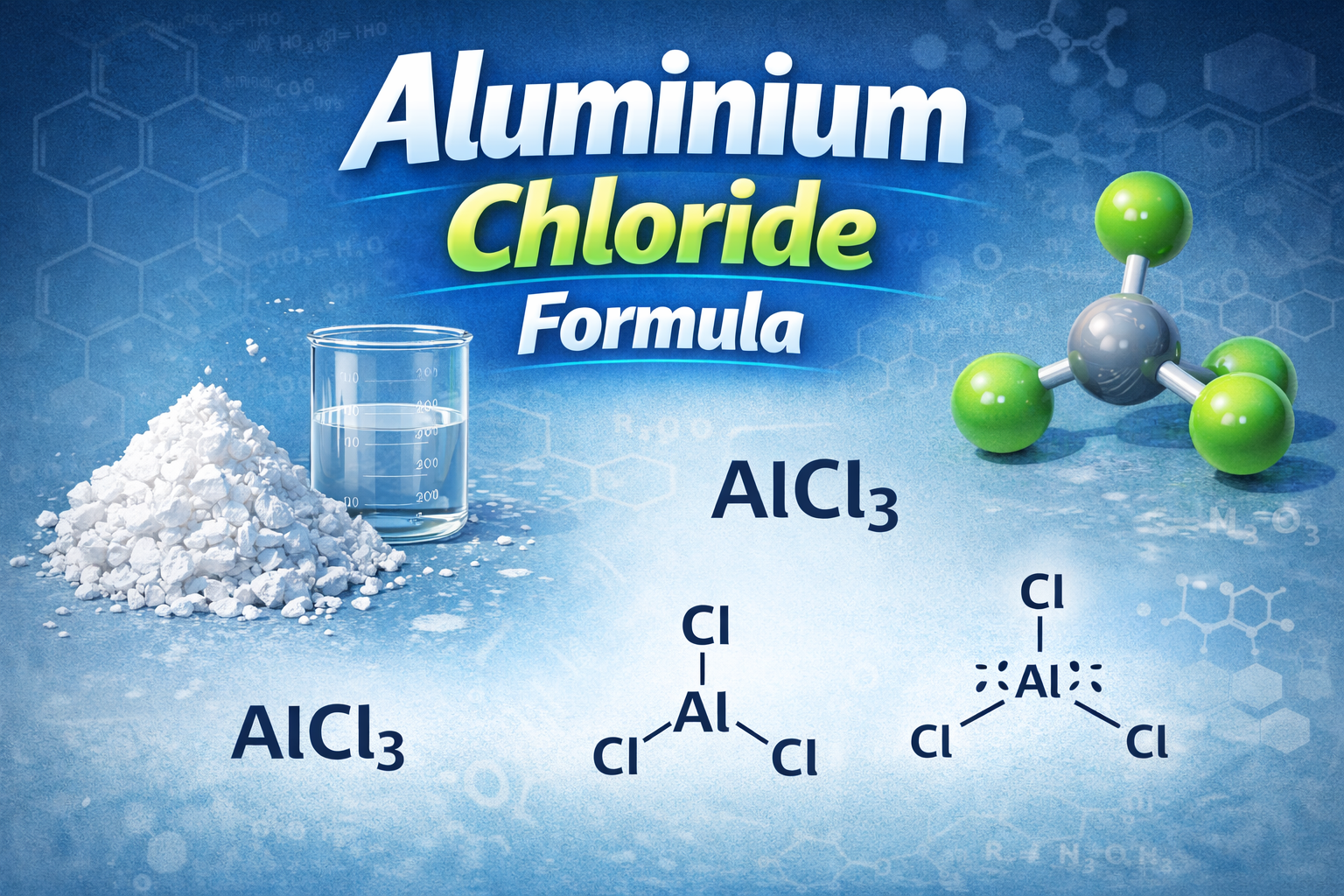
What is Aluminium Chloride?
Aluminium chloride is an inorganic compound formed when aluminium (Al) reacts with chlorine (Cl). It appears as a white or pale yellow crystalline solid in its anhydrous form and is widely used in industrial processes.
Why it matters: This compound is a perfect example of ionic bonding between a metal and a non-metal. Understanding its formula helps you grasp valency concepts, chemical equations, and stoichiometry.
Properties:
- Chemical nature: Ionic compound (primarily)
- Color: White to pale yellow
- State: Solid at room temperature
- Behavior: Hygroscopic (absorbs moisture)
Complete Formula List
Below is a comprehensive table covering all formula variations and representations of aluminium chloride:
| Formula Type |
Formula |
Explanation |
Variables/Components |
Example Use Case |
| Molecular Formula |
AlCl₃ |
Basic chemical composition showing one aluminium atom bonded to three chlorine atoms |
Al = Aluminium, Cl = Chlorine |
Writing chemical equations |
| Empirical Formula |
AlCl₃ |
Simplest whole-number ratio of atoms (same as molecular formula in this case) |
Al : Cl = 1 : 3 |
Determining composition from experimental data |
| Structural Formula |
Cl—Al—Cl with one Cl above |
Shows actual bonding arrangement between atoms |
Single bonds between Al and each Cl |
Understanding molecular geometry |
| Lewis Structure |
Al with 3 Cl atoms, each Cl has 3 lone pairs |
Electron dot representation showing valence electrons |
Dots represent valence electrons |
Studying electron distribution |
| Ionic Formula |
Al³⁺ + 3Cl⁻ |
Shows ionic nature with charges on ions |
Al³⁺ = aluminium ion, Cl⁻ = chloride ion |
Understanding ionic bonding |
| Anhydrous Form |
AlCl₃ |
Formula without water molecules |
Pure aluminium chloride |
Laboratory synthesis |
| Hydrated Form |
AlCl₃·6H₂O |
Formula with water of crystallization |
AlCl₃ = anhydrous part, 6H₂O = water molecules |
Commercial form |
| Dimeric Form |
Al₂Cl₆ |
Molecular structure at moderate temperatures |
Two AlCl₃ units joined by chlorine bridges |
Vapor phase structure |
| IUPAC Name Formula |
AlCl₃ |
Formula corresponding to aluminium trichloride |
Tri = three chlorine atoms |
Systematic nomenclature |
| Hill Notation |
AlCl₃ |
Alphabetically arranged formula (Al before Cl) |
Used in databases |
Chemical indexing |
How to Derive the Formula
Understanding how to derive the aluminium chloride formula strengthens your conceptual foundation.
Step-by-Step Derivation:
Step 1: Identify the valency
- Aluminium (Al) has a valency of +3
- Chlorine (Cl) has a valency of -1
Step 2: Apply the criss-cross method
- Write symbols: Al Cl
- Write valencies: Al³⁺ Cl⁻
- Criss-cross the valencies: Al₁Cl₃
Step 3: Simplify if needed
- Since the subscript 1 is understood, we write: AlCl₃
Why this works: The total positive charge (+3) must equal the total negative charge (3 × -1 = -3) to form a neutral compound.
Different Forms of Aluminium Chloride
Aluminium chloride exists in multiple forms depending on conditions:
Anhydrous Aluminium Chloride
- Formula: AlCl₃
- Appearance: White or pale yellow solid
- Use: Water-free reactions, Friedel-Crafts catalyst
Hexahydrate Form
- Formula: AlCl₃·6H₂O
- Appearance: Colorless to white crystals
- Use: Available commercially, more stable in air
Dimeric Form
- Formula: Al₂Cl₆
- Conditions: Vapor phase or molten state
- Structure: Two aluminium atoms bridged by chlorine atoms
- Why it forms: Aluminium achieves more stable electron configuration
Aqueous Solution
- Representation: Al³⁺(aq) + 3Cl⁻(aq)
- Behavior: Dissociates into ions in water
- pH: Acidic due to hydrolysis
Solved Examples
Example 1: Writing the Basic Formula
Question: Write down the formula of aluminium chloride.
Solution:
- Aluminium symbol: Al
- Chlorine symbol: Cl
- Aluminium valency: +3
- Chlorine valency: -1
- Using criss-cross method: AlCl₃
Answer: AlCl₃
Example 2: Calculating Molar Mass
Question: Calculate the molecular mass of aluminium chloride.
Solution:
- Atomic mass of Al = 27 u
- Atomic mass of Cl = 35.5 u
- Formula: AlCl₃
- Molecular mass = 27 + (3 × 35.5)
- Molecular mass = 27 + 106.5 = 133.5 u
Answer: 133.5 u
Example 3: Finding Mass Percentage
Question: Find the percentage of chlorine in aluminium chloride.
Solution:
- Molecular mass of AlCl₃ = 133.5 u
- Mass of chlorine in formula = 3 × 35.5 = 106.5 u
- Percentage = (106.5/133.5) × 100
- Percentage = 79.78%
Answer: Approximately 79.78% chlorine
Example 4: Balancing Equation
Question: Balance the equation: Al + Cl₂ → AlCl₃
Solution:
- Unbalanced: Al + Cl₂ → AlCl₃
- Balance Cl atoms: Al + Cl₂ → AlCl₃ (3 Cl needed, Cl₂ gives 2)
- Use 3Cl₂ to get 6 Cl atoms
- Need 2AlCl₃ to use all 6 Cl atoms
- Need 2Al to make 2AlCl₃
- Balanced: 2Al + 3Cl₂ → 2AlCl₃
Answer: 2Al + 3Cl₂ → 2AlCl₃
Example 5: Stoichiometry Problem
Question: How many grams of chlorine are needed to react completely with 5.4 g of aluminium?
Solution:
- Equation: 2Al + 3Cl₂ → 2AlCl₃
- Moles of Al = 5.4/27 = 0.2 mol
- From equation: 2 mol Al needs 3 mol Cl₂
- So 0.2 mol Al needs (3/2) × 0.2 = 0.3 mol Cl₂
- Mass of Cl₂ = 0.3 × 71 = 21.3 g
Answer: 21.3 g of chlorine
Common Mistakes Students Make
Mistake 1: Writing AlCl instead of AlCl₃
- Why it’s wrong: Doesn’t balance charges correctly
- How to avoid: Always check valencies and balance charges
Mistake 2: Confusing with Aluminum (American spelling)
- Clarification: Both spellings refer to the same element
- Tip: Use consistent spelling throughout your answer
Mistake 3: Forgetting subscript 3
- Why it matters: Changes the compound entirely
- Fix: Remember aluminium needs three chlorine atoms
Mistake 4: Writing Al₃Cl
- Why it’s wrong: Criss-cross method applied incorrectly
- Correct approach: Valency numbers become subscripts for opposite atoms
Mistake 5: Ignoring the hydrated form
- Context matters: Exam questions may specify anhydrous or hydrated
- Solution: Read questions carefully
Memory Tricks & Tips
Trick 1: “Al needs 3 Pals” Remember that Aluminium (Al) needs 3 chlorine “pals” to be stable.
Trick 2: Valency Rhyme “Aluminium plus three, chlorine one you see, criss-cross carefully, AlCl₃ will be!”
Trick 3: Visual Method Draw Al with +3 above and Cl with -1, then swap numbers as subscripts.
Trick 4: Common Name The common name “aluminium trichloride” tells you there are three (tri) chlorine atoms.
Trick 5: Formula Pattern Metal with +3 charge + Non-metal with -1 charge = MCl₃ pattern (like FeCl₃, CrCl₃).
Real-Life Applications
Industrial Catalysis: AlCl₃ is used as a catalyst in Friedel-Crafts reactions for manufacturing detergents, perfumes, and pharmaceuticals.
Water Treatment: Acts as a coagulant in water purification processes to remove impurities.
Manufacturing: Used in producing aluminium metal and in the petroleum refining industry.
Antiperspirants: Aluminium chloride hexahydrate is used in some antiperspirant formulations.
Organic Synthesis: Essential reagent in organic chemistry laboratories for various reactions.
FAQs about Aluminium Chloride formula
Q. What is the chemical formula of aluminium chloride?
The chemical formula of aluminium chloride is AlCl₃, consisting of one aluminium atom bonded to three chlorine atoms. This formula represents the anhydrous form and is derived from aluminium’s +3 valency and chlorine’s -1 valency.
Q. How do you write the formula of aluminium chloride using the criss-cross method?
Write Al with valency +3 and Cl with valency -1. Criss-cross these numbers to get Al₁Cl₃, which simplifies to AlCl₃. This method ensures electrical neutrality by balancing positive and negative charges in the compound.
Q. What is the difference between AlCl₃ and Al₂Cl₆?
AlCl₃ is the empirical formula, while Al₂Cl₆ is the dimeric molecular formula that exists in vapor phase. At high temperatures, two AlCl₃ units combine through chlorine bridges to form the more stable dimer Al₂Cl₆.
Q. Is aluminium chloride ionic or covalent?
Aluminium chloride shows both ionic and covalent character. In solid state, it’s primarily ionic (Al³⁺ and Cl⁻), but in vapor phase and organic solvents, it exhibits significant covalent bonding characteristics.
Q. What is the formula of hydrated aluminium chloride?
The formula of hydrated aluminium chloride is AlCl₃·6H₂O, also called aluminium chloride hexahydrate. This form contains six water molecules associated with each AlCl₃ unit and is the common commercial form.
Q. Why does aluminium chloride have the formula AlCl₃ and not AlCl?
Aluminium has a valency of +3, requiring three chlorine atoms (each with valency -1) to balance the charge. AlCl would leave unbalanced charges (+3 and -1), making it unstable and unable to exist.
Q. How do you calculate the molecular mass of aluminium chloride?
Add the atomic mass of aluminium (27 u) to three times the atomic mass of chlorine (35.5 u): 27 + (3 × 35.5) = 133.5 u. This gives the molecular mass of AlCl₃.
Q. Can the formula of aluminium chloride be written as Cl₃Al?
While chemically equivalent, the standard convention is to write the metal first, followed by the non-metal, giving AlCl₃. Using Cl₃Al would be unconventional and might be marked incorrect in exams following IUPAC nomenclature.
Conclusion
The aluminium chloride formula AlCl₃ is more than just a combination of symbols and numbers. It represents fundamental principles of chemical bonding, valency, and compound formation that form the backbone of chemistry education.
From understanding the basic molecular formula to recognizing its hydrated and dimeric forms, you now have a complete toolkit for tackling any question related to aluminium chloride. The criss-cross method, valency rules, and solved examples equip you to confidently approach homework problems and exam questions.