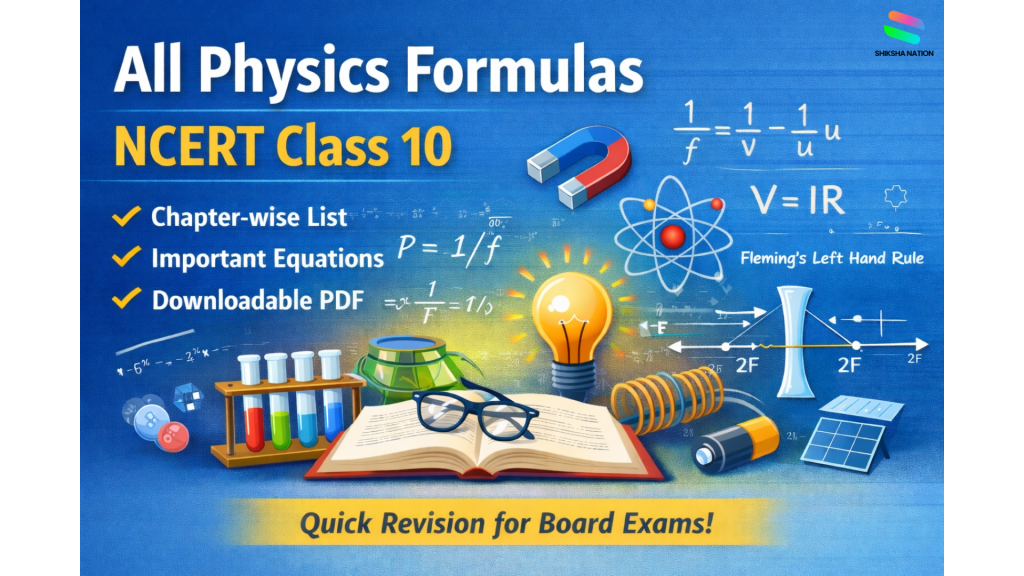
Physics is one of the most important parts of the CBSE Class 10 Science syllabus. Understanding the CBSE class 10 science physics formulas helps students solve numerical problems quickly and correctly in board exams. These formulas are based on key chapters like Light, Human Eye, Electricity, Magnetism, Work and Energy, and Motion. When students learn all formulas of physics class 10, they also understand the concepts behind force, velocity, power, resistance, and refraction more clearly.
In many study materials, you will find a complete list of all formulas of class 10 physics arranged chapter-wise for easy revision. A well-prepared formula sheet of all physics formula of class 10 is very helpful during last-minute exam preparation. Students often search for all formulas of physics class 10 CBSE in PDF format so that they can revise anytime. Along with physics, topics like Chemistry Formula class 10 are also important, but physics formulas require more practice and conceptual clarity.
This introduction provides a structured overview of important equations, derivations, SI units, symbols, and numerical applications. If students revise regularly and practice sample questions, they can improve accuracy and score better marks. Sometimes students ignore small units or signs, which can effect the final answer, so careful learning is very necessary.
Book a Counseling Session
Chapter-wise NCERT Class 10 Physics formulas for quick board exam revision
How to Use Physics Formulas for Class 10 Board Exams
Physics formulas help only when students know when and why to use them. In Class 10 board exams, questions are designed to test understanding along with correct application, not just memory. Students should first read the question carefully and identify what is given and what is asked before selecting any formula.
Parents often notice that students rush into calculations. A better habit is to write the formula first, then substitute values step by step. This reduces silly mistakes and also helps examiners see the student’s approach clearly.
Using correct SI units is equally important. Many marks are lost because students forget to convert units like centimetres to metres or grams to kilograms. Before applying any formula, students should always check units and convert them properly.
Another common mistake is using the right formula in the wrong situation. For example, applying a formula without checking conditions like uniform motion or straight-line motion can lead to incorrect answers. Regular practice helps avoid this.
When students practice class 10 board physics formulas with real numerical questions, confidence improves. Parents can support this by encouraging daily revision and error checking after practice.
NCERT Class 10 Physics Formula Sheet (PDF for Quick Revision)
Many students look for all formulas of physics class 10 in one place for quick revision before exams. To support this need, we have created a chapter-wise NCERT Class 10 Physics formula sheet that students can use offline.
This PDF covers physics formulas class 10 NCERT, organised chapter-wise with correct symbols and SI units. It is useful during unit tests, pre-boards, and last-minute board exam revision when time is limited.
Students should use this formula sheet after studying NCERT chapters and solving textbook numericals. It helps improve speed and accuracy, but concept clarity should always come from NCERT.
This chapter is very important for board exams because most questions are numerical-based. Students are expected to remember formulas clearly and apply proper sign conventions. Parents can help by ensuring regular practice of these questions.
For reflection by spherical mirrors, the mirror formula is used to find image distance or focal length:
1/f = 1/v + 1/u
Here, f is focal length, v is image distance, and u is object distance. Students must always follow the correct sign convention while using this formula.
The magnification formula helps to understand the size of the image formed:
m = hᵢ / h₀ = −v / u
A common mistake is forgetting the negative sign, which indicates image nature. Writing the formula before substitution reduces errors.
In refraction, students use relations based on refractive index. The basic formula is:
n = speed of light in air / speed of light in medium
For glass slab or lenses, this relation explains bending of light.
These light reflection refraction formulas class 10 should be revised regularly. Understanding when to use mirror or refraction formulas helps students score well in board exams.
Chapter 2 – The Human Eye and the Colourful World
This chapter has fewer numericals but students should not ignore the formulas. Board questions often test basic understanding along with correct use of relations. Parents can support revision by checking whether students remember meanings, not just values.
The most important formula here is the power of a lens, which tells how strongly a lens bends light:
P = 1 / f
Here, f is the focal length in metres. Students must be careful with units, as using centimetres leads to wrong answers.
In this chapter, students also learn simple relations related to vision defects and their correction. These are mostly conceptual, but formulas help in understanding how lenses are used to correct eyesight.
Students should focus on clarity rather than memorising many equations. Regular reading of NCERT diagrams and quick formula revision is enough to score well in this chapter.
Chapter 3 – Electricity
Electricity is one of the most scoring chapters in Class 10 Physics. Many board exam questions come directly from numericals, so students must be very clear with formulas. Parents often see students making mistakes due to confusion between symbols, so slow and careful practice is important.
The base of this chapter is Ohm’s Law, which shows the relation between voltage, current, and resistance:
V = I × R
Before using this formula, students should always check whether the circuit conditions follow Ohm’s law.
Another class 10 physics important formula is for electric power, which tells how fast electrical energy is used:
P = V × I
Using Ohm’s law, power can also be written as P = I²R or P = V² / R. Students should practise when to use each form.
Resistance depends on the length, area, and material of the conductor. The relation is written as:
R = ρL / A
Here, ρ is resistivity, which depends on the material only.
These electricity formulas class 10 should be revised daily before exams. Parents can help by asking students to explain why a formula is used, not just write the final answer.
Chapter 4 – Magnetic Effects of Electric Current
This chapter connects electricity with magnetism and is important for both numericals and theory questions. Students often find it confusing at first, so regular revision of formulas is necessary. Parents can help by encouraging slow reading of questions and diagrams.
One key relation is the magnetic force on a current-carrying conductor, which depends on current, magnetic field, and length of the conductor. The direction of force is not guessed but found using Fleming’s Left Hand Rule, which students must remember clearly.
For electromagnetic induction, students learn how changing magnetic fields produce current. The direction of induced current is explained using Fleming’s Right Hand Rule. These rules are not formulas but are equally important for solving board questions.
Another useful relation is related to electric motors and generators, where magnetic force causes motion. Students should focus on understanding the situation before applying any relation.
These magnetism formulas class 10 require both memory and logic. Parents can support practice by asking students to explain the rules in words, not only draw diagrams.
Chapter 5 – Sources of Energy
This chapter has very few numericals, but students should still remember the basic formula used in exams. Questions usually test understanding of how energy is converted from one form to another. Parents can help by discussing real-life examples like bulbs, fans, or vehicles.
The main formula here is efficiency, which shows how useful a machine or device is:
Efficiency = (useful output energy / input energy) × 100
Students should remember that no device is 100% efficient because some energy is always lost as heat or sound. In answers, writing this clearly helps in theory questions.
Understanding energy conversion is more important than memorising formulas in this chapter. Regular reading of NCERT examples is enough to score well.
Chapter 6 – Refraction Through Lenses (Numerical Focus)
This part of optics is very important for board exams because most questions are numerical-based. Students often lose marks due to sign mistakes, not because they don’t know the formula. Parents can help by reminding students to slow down and check steps.
The main formula used is the lens formula:
1/f = 1/v + 1/u
Here, f is focal length, v is image distance, and u is object distance. Students must strictly follow the sign convention given in NCERT.
Another key relation is magnification, which tells the size of the image formed:
m = hᵢ / h₀ = v / u
Understanding whether the image is real or virtual helps in choosing correct signs.
Questions also test the power of a lens, especially when lenses are used for vision correction. Practising NCERT examples and previous-year board questions builds confidence and accuracy in this chapter.
SI Units and Symbols Used in Class 10 Physics
Many students know the correct formula but still lose marks because of wrong units or symbols. In Class 10 board exams, examiners give importance to proper units along with final answers. Parents often notice this mistake during test checking.
Students should always write values in SI units before applying any formula. For example, length should be in metres, mass in kilograms, and time in seconds. If values are given in centimetres or grams, they must be converted first.
Using correct symbols is equally important. Writing v for velocity, I for current, and R for resistance shows clarity in answers. Wrong or mixed symbols can confuse the examiner and reduce marks.
Regular practice helps students remember units naturally. Parents can support learning by asking students to read answers aloud and check whether units and symbols are written correctly.
Common Mistakes Students Make While Using Physics Formulas
One common mistake students make is using a formula without understanding the question. Many times, the formula is correct but the situation does not match. Reading the question twice helps avoid this error. Parents often see this happen during rushed practice.
Another frequent problem is ignoring sign conventions, especially in light and electricity numericals. A small sign error can change the final answer completely. Writing signs clearly at each step reduces confusion.
Students also lose marks by forgetting unit conversion. Using centimetres instead of metres or hours instead of seconds leads to wrong results. Checking units before substitution should become a habit.
Some students memorise formulas but skip writing steps in exams. Even if the final answer is wrong, steps can still fetch marks. Parents can guide students to show full working regularly.
Avoiding these mistakes requires practice and calm thinking. Regular revision and self-checking improve accuracy and exam confidence.
Are These Formulas Enough for Class 10 Physics Boards?
Yes, all formulas of class 10 physics are enough to solve most numerical questions asked in board exams. If students remember formulas clearly and apply them step by step, scoring well in numericals becomes easier. Parents often notice better marks when formula revision is regular.
However, formulas alone are not enough for theory questions. Students must understand basic concepts, definitions, and diagrams given in NCERT. Many questions test reasoning, not calculation.
The best approach is to study concepts first, then use formulas for practice and revision. NCERT examples and exercises should always be completed before relying on formula sheets.
Parents can support preparation by checking whether students can explain the meaning of a formula in simple words. This balance between understanding and application helps students perform confidently in board exams.
Frequently Asked Questions – Class 10 Physics Formulas
Q. Are NCERT formulas enough for CBSE Class 10 board exams?
Yes, NCERT formulas are fully sufficient for CBSE Class 10 board exams. All numerical questions are framed using NCERT concepts and formulas only. Students who practise NCERT examples and exercises regularly do not need extra formula books.
Parents often worry about extra reference material, but focusing on NCERT builds a strong base. Revision of formulas from NCERT chapters is enough to score well.
Q. Should students memorise physics formulas or understand them?
Formulas should be understood first and memorised later. When students know what a formula means, they can apply it correctly in different questions. Blind memorisation increases mistakes during exams.
Parents can help by asking students to explain a formula in simple words. If a student can explain it, they are less likely to forget it in the exam hall.
Q. Do ICSE students follow the same physics formulas as CBSE students?
Most physics formulas are the same for CBSE and ICSE because they are based on standard physics laws. However, ICSE students may have a few additional topics or deeper explanations.
ICSE students should always follow their textbook first, but they can still use NCERT-based formulas for revision of core chapters.
Q. How often should Class 10 students revise physics formulas?
Physics formulas should be revised daily in short sessions. Even 15-20 minutes of formula revision helps improve memory and speed. Waiting until the last week increases stress and confusion.
Parents can support this habit by setting a fixed revision time every day instead of long study hours.
Q. Why do students lose marks even after remembering formulas?
Students usually lose marks due to unit conversion errors, sign mistakes, or wrong formula selection. Knowing a formula is not enough; applying it correctly matters more.
Writing steps clearly and checking units before the final answer reduces such mistakes.
Q. Is a formula sheet enough for last-minute board exam revision?
A formula sheet is helpful for quick revision, especially before exams. However, it should be used only after completing NCERT exercises and understanding concepts.
Parents should ensure students don’t depend only on formula sheets. Balanced preparation leads to better confidence and marks.