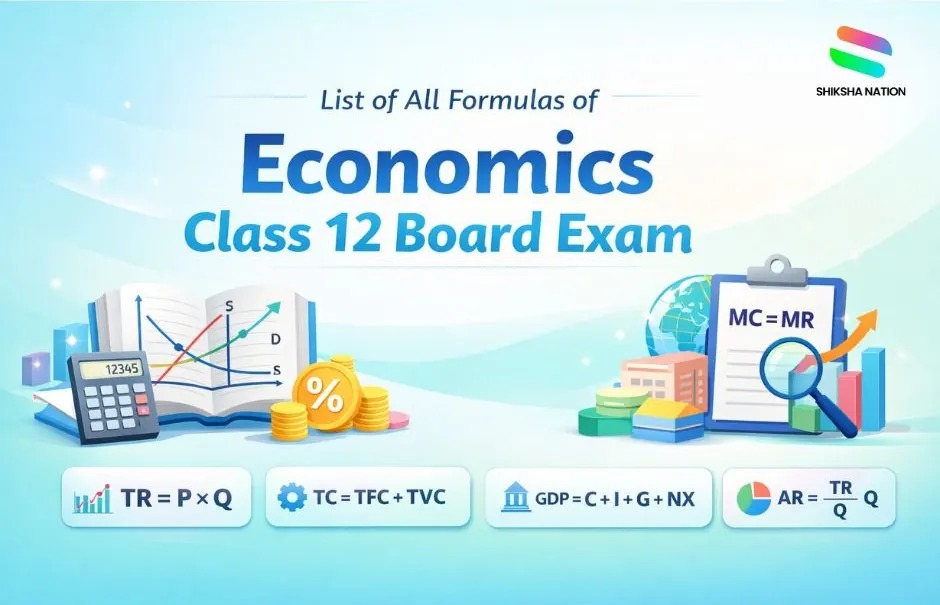
Class 12 Economics Formulas Overview
Class 12 Economics is divided into two main parts. Each part includes different concepts and formulas that students must understand.
| Economics Part |
Topics Covered |
Use of Formulas |
| Microeconomics |
Demand, Elasticity, Revenue |
Calculating demand responsiveness and firm revenue |
| Macroeconomics |
National Income, Multiplier, Money and Banking |
Measuring economic performance and income |
Students preparing for board exams should learn these important economics formulas for quick revision, as they often appear in numerical questions.
Class 12 Microeconomics Formulas
Microeconomics studies the behavior of individual consumers and firms in the market. In this section, formulas are mainly used in elasticity of demand and revenue concepts. Understanding these formulas helps students analyze how price changes affect demand and how firms calculate their earnings.
Elasticity of Demand Formulas
Elasticity of demand measures how much the quantity demanded changes when price changes. It is an important concept in microeconomics.
| Concept |
Formula |
| Price Elasticity of Demand |
% Change in Quantity Demanded / % Change in Price |
| Percentage Method |
(ΔQ / Q) ÷ (ΔP / P) |
| Midpoint Method |
(ΔQ / Average Q) ÷ (ΔP / Average P) |
| Total Expenditure Method |
Change in Total Spending due to price change |
Explanation
- Price Elasticity of Demand (PED) tells how sensitive demand is to price changes.
- If elasticity is greater than 1, demand is elastic.
- If elasticity is less than 1, demand is inelastic.
- If elasticity is equal to 1, demand is unitary elastic.
These formulas are very important for CBSE Class 12 Economics board exams, as numerical questions are frequently asked from elasticity.
Example 1: Price of a product increases from ₹10 to ₹12 and quantity demanded falls from 20 units to 16 units. Find elasticity of demand.
Solution
ΔQ = 16 − 20 = −4
ΔP = 12 − 10 = 2
Elasticity of Demand
Ed = (ΔQ / Q) ÷ (ΔP / P)
Ed = (−4 / 20) ÷ (2 / 10)
Ed = −0.2 ÷ 0.2
Ed = −1
Demand is unitary elastic.
Example 2: Price rises from ₹20 to ₹25 and quantity demanded falls from 100 to 80 units.
ΔQ = −20
ΔP = 5
Ed = (−20/100) ÷ (5/20)
Ed = −0.2 ÷ 0.25
Ed = −0.8
Demand is inelastic.
Example 3: Price falls from ₹50 to ₹40 and demand rises from 30 to 45 units.
ΔQ = 15
ΔP = −10
Ed = (15/30) ÷ (−10/50)
Ed = 0.5 ÷ −0.2
Ed = −2.5
Demand is elastic.
Example 4: Price changes from ₹15 to ₹18 and demand falls from 60 to 50 units.
ΔQ = −10
ΔP = 3
Ed = (−10/60) ÷ (3/15)
Ed = −0.167 ÷ 0.2
Ed ≈ −0.83
Demand is inelastic.
Example 5: Price decreases from ₹30 to ₹20 and demand increases from 40 to 60 units.
ΔQ = 20
ΔP = −10
Ed = (20/40) ÷ (−10/30)
Ed = 0.5 ÷ −0.33
Ed ≈ −1.5
Demand is elastic.
Revenue Formulas in Microeconomics
Revenue refers to the income earned by a firm by selling goods or services. There are three main types of revenue used in economics calculations.
| Concept |
Formula |
| Total Revenue (TR) |
TR = Price × Quantity |
| Average Revenue (AR) |
AR = TR / Q |
| Marginal Revenue (MR) |
MR = Change in TR / Change in Quantity |
Explanation
- Total Revenue (TR) is the total money a firm receives from selling its product.
- Average Revenue (AR) shows revenue earned per unit of output.
- Marginal Revenue (MR) tells how much additional revenue is earned by selling one extra unit.
These formulas are often used when studying market structures and firm behavior in microeconomics.
Example 1: A firm sells 20 units at ₹10 each.
TR = Price × Quantity
TR = 10 × 20 = ₹200
Example 2: Total Revenue is ₹500 and quantity sold is 25 units. Find Average Revenue.
AR = TR ÷ Q
AR = 500 ÷ 25
AR = ₹20
Example 3: TR increases from ₹400 to ₹500 when quantity increases from 20 to 25 units.
MR = ΔTR ÷ ΔQ
ΔTR = 100
ΔQ = 5
MR = 100 ÷ 5
MR = ₹20
Example 4: Price per unit = ₹50
Quantity sold = 12 units
TR = 50 × 12 = ₹600
AR = TR ÷ Q = 600 ÷ 12 = ₹50
Example 5: TR increases from ₹900 to ₹960 when output increases from 30 to 32 units.
MR = ΔTR ÷ ΔQ
ΔTR = 60
ΔQ = 2
MR = 60 ÷ 2 = ₹30
Class 12 Macroeconomics Formulas
Macroeconomics studies the economy as a whole. It includes topics such as national income, money supply, multiplier effect, and fiscal policy. Many numerical questions in board exams come from national income accounting formulas and consumption functions, so students must understand them properly.
National Income Accounting Formulas
National income measures the total income generated by an economy in a given period.
| Concept |
Formula |
| Gross Domestic Product (GDP) |
GDP = C + I + G + (X – M) |
| Gross National Product (GNP) |
GNP = GDP + Net Factor Income from Abroad |
| Net National Product (NNP) |
NNP = GNP – Depreciation |
| National Income (NI) |
NI = NNP at Factor Cost |
| Personal Income (PI) |
PI = National Income – Corporate Taxes – Undistributed Profits + Transfer Payments |
| Disposable Income (DI) |
DI = Personal Income – Personal Taxes |
Explanation
- GDP measures the total value of goods and services produced within a country.
- GNP includes income earned by residents from abroad.
- NNP adjusts GNP by subtracting depreciation.
- Disposable Income shows how much income households have for spending and saving.
These national income formulas class 12 are very important for solving numerical questions in macroeconomics.
Example 1: Consumption = 500
Investment = 200
Government Spending = 300
Exports = 100
Imports = 50
GDP = C + I + G + (X − M)
GDP = 500 + 200 + 300 + (100 − 50)
GDP = 1050
Example 2: GDP = 1500
Net Factor Income from Abroad = 100
GNP = GDP + NFIA
GNP = 1500 + 100
GNP = 1600
Example 3: GNP = 2000
Depreciation = 200
NNP = GNP − Depreciation
NNP = 2000 − 200
NNP = 1800
Example 4: National Income = 1500
Corporate Tax = 200
Undistributed Profit = 100
Transfer Payments = 150
Personal Income
= NI − Corporate Tax − Undistributed Profit + Transfer Payments
= 1500 − 200 − 100 + 150
= 1350
Example 5: Consumption = 800
Investment = 300
Government Expenditure = 400
Exports = 150
Imports = 100
GDP
= 800 + 300 + 400 + (150 − 100)
= 1550
Consumption and Saving Formulas
Consumption and saving functions explain how income is divided between spending and saving.
| Concept |
Formula |
| Consumption Function |
C = a + bY |
| Average Propensity to Consume (APC) |
APC = C / Y |
| Marginal Propensity to Consume (MPC) |
MPC = ΔC / ΔY |
| Average Propensity to Save (APS) |
APS = S / Y |
| Marginal Propensity to Save (MPS) |
MPS = ΔS / ΔY |
Explanation
- Consumption Function shows the relationship between consumption and income.
- MPC tells how much consumption increases when income increases.
- MPS measures how much of additional income is saved.
These propensity formulas are essential for understanding economic behavior and are frequently used in numerical problems.
Example 1: Income = 1000
Consumption = 800
APC = C ÷ Y
APC = 800 ÷ 1000
APC = 0.8
Example 2: Income rises from 1000 to 1200
Consumption rises from 800 to 900
ΔC = 100
ΔY = 200
MPC = 100 ÷ 200
MPC = 0.5
Example 3: Saving = 200
Income = 1000
APS = S ÷ Y
APS = 200 ÷ 1000
APS = 0.2
Example 4: Saving increases from 200 to 300 when income rises from 1000 to 1200.
ΔS = 100
ΔY = 200
MPS = 100 ÷ 200
MPS = 0.5
Example 5: Consumption function
C = 50 + 0.8Y
If Y = 1000
C = 50 + 0.8(1000)
C = 50 + 800
C = 850
Multiplier Formulas in Economics
The multiplier shows how a change in investment affects total income in the economy.
| Concept |
Formula |
| Investment Multiplier |
K = 1 / (1 – MPC) |
| Alternative Multiplier Formula |
K = 1 / MPS |
Explanation
The multiplier effect means that a small increase in investment can lead to a larger increase in national income.
For example, if MPC is high, the multiplier will also be large, which increases economic growth.
The multiplier formula in economics is a very important concept in Class 12 macroeconomics.
Example 1: MPC = 0.8
K = 1 ÷ (1 − MPC)
K = 1 ÷ (1 − 0.8)
K = 1 ÷ 0.2
K = 5
Example 2: MPS = 0.25
K = 1 ÷ MPS
K = 1 ÷ 0.25
K = 4
Example 3: MPC = 0.6
K = 1 ÷ (1 − 0.6)
K = 1 ÷ 0.4
K = 2.5
Example 4: MPS = 0.2
K = 1 ÷ 0.2
K = 5
Example 5: MPC = 0.75
K = 1 ÷ (1 − 0.75)
K = 1 ÷ 0.25
K = 4
Money and Banking Formulas
Money and banking concepts explain how banks create credit and increase money supply in the economy.
| Concept |
Formula |
| Money Multiplier |
1 / CRR |
| Credit Creation |
Initial Deposit × Money Multiplier |
Explanation
- Money Multiplier shows how much money supply increases due to bank deposits.
- CRR (Cash Reserve Ratio) is the percentage of deposits banks must keep with the central bank.
These formulas help students understand the banking system and money creation process.
Example 1: MPC = 0.8
K = 1 ÷ (1 − MPC)
K = 1 ÷ (1 − 0.8)
K = 1 ÷ 0.2
K = 5
Example 2: MPS = 0.25
K = 1 ÷ MPS
K = 1 ÷ 0.25
K = 4
Example 3: MPC = 0.6
K = 1 ÷ (1 − 0.6)
K = 1 ÷ 0.4
K = 2.5
Example 4: MPS = 0.2
K = 1 ÷ 0.2
K = 5
Example 5: MPC = 0.75
K = 1 ÷ (1 − 0.75)
K = 1 ÷ 0.25
K = 4
6. Money and Banking – Solved Examples
Example 1: CRR = 20%
Money Multiplier
= 1 ÷ CRR
= 1 ÷ 0.20
= 5
Example 2: Initial Deposit = ₹1000
Money Multiplier = 5
Credit Creation
= 1000 × 5
= ₹5000
Example 3: CRR = 10%
Money Multiplier
= 1 ÷ 0.10
= 10
Example 4: Deposit = ₹2000
Multiplier = 4
Total Credit
= 2000 × 4
= ₹8000
Example 5: CRR = 25%
Money Multiplier
= 1 ÷ 0.25
= 4
Fiscal Policy Formulas in Economics
Fiscal policy refers to the government’s use of taxation and spending to influence the economy.
| Concept |
Formula |
| Budget Deficit |
Total Expenditure – Total Revenue |
| Fiscal Deficit |
Total Expenditure – Total Receipts (excluding borrowings) |
| Revenue Deficit |
Revenue Expenditure – Revenue Receipts |
| Primary Deficit |
Fiscal Deficit – Interest Payments |
Explanation
- Fiscal Deficit indicates the total borrowing requirement of the government.
- Revenue Deficit shows excess of revenue expenditure over revenue income.
- These indicators help measure the financial health of a country’s economy.
Example 1: Total Expenditure = 1500
Total Revenue = 1200
Budget Deficit
= 1500 − 1200
= 300
Example 2: Total Expenditure = 2000
Total Receipts = 1500
Fiscal Deficit
= 2000 − 1500
= 500
Example 3: Revenue Expenditure = 800
Revenue Receipts = 600
Revenue Deficit
= 800 − 600
= 200
Example 4: Total Expenditure = 2500
Total Revenue = 2100
Budget Deficit
= 2500 − 2100
= 400
Example 5: Revenue Expenditure = 1000
Revenue Receipts = 900
Revenue Deficit
= 1000 − 900
= 100
All Class 12 Economics Formulas
Below is a quick revision table that summarizes the most important economics formulas for board exam preparation.
| Topic |
Formula |
| Price Elasticity of Demand |
%ΔQ / %ΔP |
| Total Revenue |
TR = P × Q |
| Average Revenue |
AR = TR / Q |
| Marginal Revenue |
MR = ΔTR / ΔQ |
| GDP |
C + I + G + (X – M) |
| GNP |
GDP + NFIA |
| NNP |
GNP – Depreciation |
| APC |
C / Y |
| MPC |
ΔC / ΔY |
| APS |
S / Y |
| MPS |
ΔS / ΔY |
| Investment Multiplier |
1 / (1 – MPC) |
| Money Multiplier |
1 / CRR |
Students can use this table for quick revision before exams or class tests.
Important Tips to Remember Economics Formulas
Many students forget formulas during exams. Here are some simple tips that can help.
1. Make Short Notes: Write all formulas in a small notebook and revise them regularly.
2. Practice Numerical Questions: Practicing questions helps you understand how formulas are applied.
3. Use Flashcards: Flashcards are useful for quick revision before exams.
4. Revise Before Exams: Spend at least 15–20 minutes revising formulas daily.
5. Understand the Concept: Do not only memorize formulas. Try to understand the concept behind them.
Common Mistakes Students Make While Using Economics Formulas
Students sometimes lose marks because of small mistakes while solving numerical questions.
Some common mistakes include:
- Confusing GDP and GNP formulas
- Incorrect calculation of MPC and MPS
- Forgetting to subtract depreciation
- Using wrong values in elasticity formulas
- Ignoring units while calculating revenue
Avoiding these mistakes can help students score better in the CBSE Class 12 Economics board exam.
Why Learning Economics Formulas is Important for Board Exams
Economics formulas play a major role in solving numerical problems. Students who remember formulas clearly can solve questions faster and more accurately.
Learning formulas also helps in:
- Improving conceptual understanding
- Saving time during exams
- Solving numerical questions easily
- Scoring higher marks in economics
Therefore, students should revise the important economics formulas class 12 regularly to perform well in exams.
Conclusion
The formulas of Economics Class 12 are essential for solving numerical questions in both microeconomics and macroeconomics. Topics like elasticity of demand, revenue, national income accounting, consumption functions, multiplier, and fiscal policy rely heavily on formulas.
By understanding and practicing these formulas regularly, students can improve their problem-solving skills and perform better in exams. Using quick revision tables, notes, and regular practice can make learning these formulas easier.
Students preparing for the CBSE Class 12 Economics board exam should revise these formulas frequently so that they can confidently solve numerical questions during the exam.
All Formulas of Economics Class 12 FAQs
1. What are the important formulas in Class 12 Economics?
Some important formulas in Class 12 Economics include GDP = C + I + G + (X − M), Total Revenue = Price × Quantity, MPC = ΔC ÷ ΔY, and Money Multiplier = 1 ÷ CRR. These formulas are mainly used in microeconomics and macroeconomics numerical questions.
2. From which chapters do most economics formulas come in Class 12?
Most formulas come from chapters like Elasticity of Demand, Revenue, National Income Accounting, Consumption and Saving, Multiplier, and Money & Banking. These topics often include numerical problems in exams.
3. How can students remember economics formulas easily?
Students can remember formulas by making short notes, practicing numerical questions, revising regularly, and understanding the concept behind each formula instead of only memorizing them.
4. Are economics formulas important for CBSE Class 12 board exams?
Yes, economics formulas are very important for the CBSE Class 12 board exam because many questions require calculations related to national income, revenue, elasticity, and multiplier.
5. Where can I find a complete list of Class 12 Economics formulas?
Students can find a complete list of Class 12 Economics formulas in textbooks, revision notes, and educational websites. Keeping a formula revision sheet can help students revise quickly before exams.