
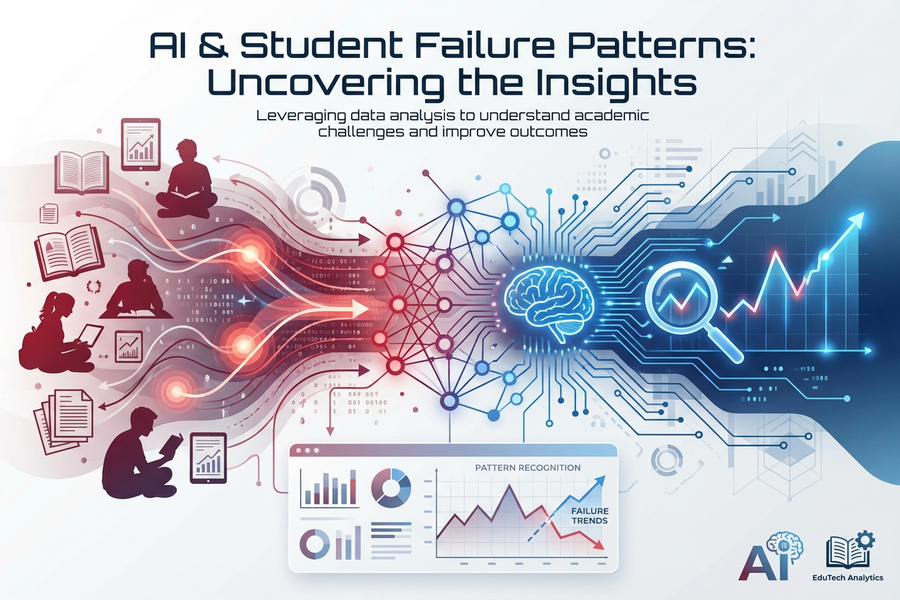

Student Failure Patterns: AI Reveals the Truth
Failure in school has never been random. Yet most students, teachers, and parents treat it like a mystery. A student may study daily but still perform poorly. Another may appear smart but forget concepts during exams. Parents blame focus. Teachers blame discipline. Students blame stress or luck. However, new research shows that failure is not unpredictable. There are secret student failure patterns, and artificial intelligence is exposing them with shocking accuracy.
In 2025, educators and AI researchers worked together to analyse thousands of student learning logs, test responses, and behaviour data. They asked a simple question: Why do students really fail?
AI identified hidden patterns that humans usually miss. These patterns appear weeks before exams, and they determine whether a student succeeds or struggles. Understanding these patterns can change how children learn forever.
1. The Early Decline Pattern Begins Weeks Before Exams
The first major insight AI revealed is that failure begins early. Students do not fail on exam day. They fail 4–6 weeks before without noticing it. When a student begins to misunderstand even 10–15% of a chapter, the decline starts. They lose clarity. They stop answering in class. They avoid difficult topics. Their confidence drops quietly.
Because this decline is silent, teachers and parents miss it. But AI catches it. It tracks every incorrect attempt, every hesitation, and every slow response. It recognises the early dip that marks the beginning of student failure patterns. With this knowledge, AI can alert students early and help them recover before it becomes too late.
2. The Overconfidence Pattern: Students Revise Only What They Know
AI found a surprising behaviour in many students. They revise the same easy chapters again and again. These are topics they already know. Students avoid difficult chapters because they fear failure. This creates a false sense of confidence. While students feel they are ready, their weak areas remain untouched.
AI discovered that 60% of student study time goes to topics they already understand. This is one of the strongest student failure patterns. The student feels safe, but they are actually unprepared. AI breaks this illusion. It ranks strong and weak areas. It forces students to revise what they forget, not what they enjoy revising. This shift improves performance more than long study hours.
3. The Forgetting Pattern: Students Lose 40% of Knowledge in One Day
One of the most powerful findings came from analysing memory. AI proved that students forget up to 40% of what they study within 24 hours. This happens due to stress, distractions, and poor revision habits. This forgetting pattern is the reason students perform well during preparation but freeze during exams.
AI fights this problem using spaced repetition. It prompts students to revise a topic at the right time—just when the brain begins to forget it. This method increases retention by more than 80%. This discovery shows why AI-based learning improves scores even with shorter study hours. It directly tackles one of the biggest student failure patterns: poor memory retention.
Research from Harvard confirms that students forget information quickly without spaced repetition techniques.
4. The Stress and Collapse Pattern: High Stress Predicts Sudden Failure
AI uncovered a deep emotional pattern connected to failure. Students who stay stressed for more than 10 days experience a sudden drop in performance. Their memory weakens. Their speed reduces. Their decision-making gets worse. They lose motivation and stop studying with clarity.
Traditional teaching methods rarely track stress scientifically. But AI can. It analyses hesitation time, typing speed, revision gaps, and consistency. It can detect when stress begins affecting performance. With this information, AI helps students slow down, take breaks, and follow a calm learning plan. This prevents sudden collapses that appear during exams. The emotional side of student failure patterns is now measurable, predictable, and fixable.
5. The Distraction Pattern: Screen Time Predicts Failure More Than Marks
The biggest shock came from digital behaviour analysis. AI discovered that screen time predicts failure more accurately than previous marks. Students who spend long hours on mobile phones, social media, or gaming lose mental energy and focus. They struggle with revision and fall behind without realising it.
The distraction pattern starts small. A student takes a short break. Then another. Soon the break becomes an hour of scrolling. The learning flow breaks completely. AI monitors these gaps. It tracks attention span, study duration, and break patterns. It gives reminders and focus exercises to rebuild consistency. Among all student failure patterns, distraction is the most modern and the most dangerous.
6. The Feedback Gap Pattern: Students Don’t Know What They Are Doing Wrong
Most students receive feedback only during tests. This creates a long delay between mistake and correction. AI revealed that this feedback gap is one of the strongest student failure patterns. Without timely correction, students repeat the same mistakes for weeks.
AI solves this instantly. Every answer gets analysed. Every error gets explained. Students understand the exact reason behind a mistake. This builds strong self-awareness. It also improves accuracy faster than any traditional method. With AI-powered feedback loops, students grow steadily and avoid repeated failure.
7. The Consistency Pattern: Missing 3 Days Lowers Performance Rapidly
Another surprising discovery is how fast consistency breaks. AI found that missing just three days of studying causes a measurable drop in memory, speed, and focus. This leads to panic before exams. Students feel overwhelmed and rush through topics without retention.
AI prevents this by keeping students consistent. Even on busy days, it gives micro-lessons that maintain flow. This stops the consistency drop from triggering other student failure patterns.
8. The Weak Foundation Pattern: Students Build Learning on Gaps
AI also analysed multi-year learning data. It showed that failures often begin from old, unfixed gaps. A student may struggle in Class 10 Algebra because their Class 8 basics were unclear. This is a hidden pattern. Students fail the current chapter not because it is hard, but because the previous ones were never mastered.
AI connects these dots. It maps every learning dependency and identifies the missing foundation. Then it fills these gaps through personalised lessons. This fixes one of the deepest student failure patterns more effectively than any one-size-fits-all classroom.
Conclusion: Failure Is Predictable, Preventable, and Fixable
The truth is simple. Students do not fail by accident. They fail in patterns.
These patterns include early decline, overconfidence, forgetting, stress, distraction, weak foundations, and missing feedback. AI reveals these patterns clearly. More importantly, AI helps students break them.
AI does not make students magically intelligent. It makes them aware. Awareness is what turns repeated failure into consistent success. When students understand their own learning patterns, they study smarter, remember more, and perform better.
In 2025 and beyond, the students who use AI tools will no longer be trapped by hidden student failure patterns. They will recognise them early, overcome them easily, and move towards a confident future.
Also Read : 7 Red Flags That Show Your Child Needs Academic Support