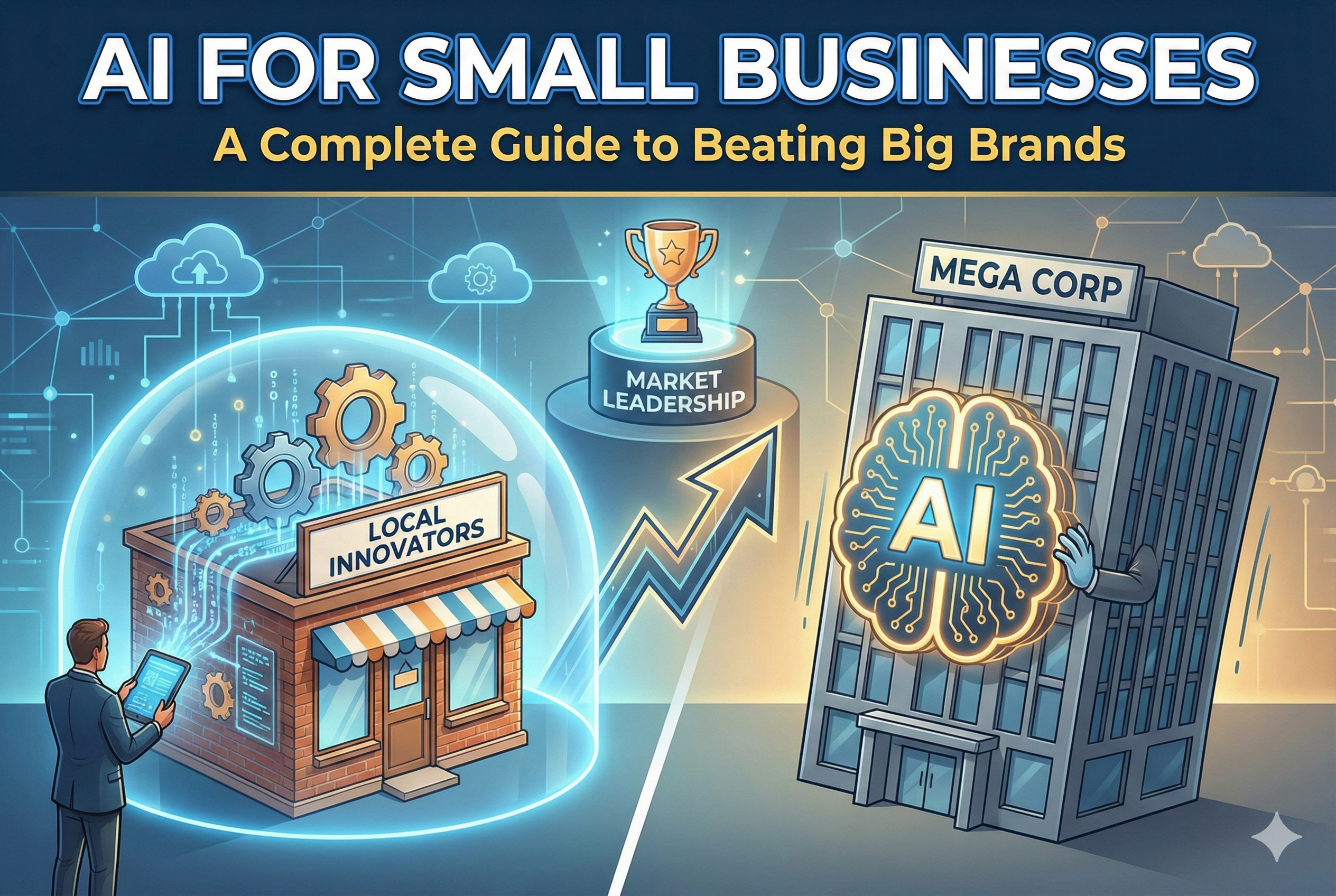

AI for Small Businesses: A Practical Guide to Smarter and Faster Growth
Artificial intelligence has moved from being a complex technology used only by large corporations to an essential tool that even the smallest company can use. Today, AI for small businesses is not only affordable but also incredibly easy to implement. It can save time, reduce costs, improve customer experience and help small brands compete with much bigger competitors. What was once considered a luxury for major organisations is now a powerful resource that every small business can use to grow.
Small business owners usually deal with many tasks at once. They handle marketing, sales, operations, finance, customer service and planning—all at the same time. This workload often slows down growth. AI steps in as a digital assistant that can take care of repetitive tasks, analyse data, improve decision-making and provide support around the clock. When used correctly, it gives small businesses the speed and efficiency they need to stay competitive.

Most importantly, artificial intelligence levels the playing field. Big brands may have huge teams and budgets, but small companies can use AI to match their performance at a fraction of the cost. This shift creates enormous opportunities for ambitious small businesses.
To understand how AI supports growth, it is important to look at the most practical areas where it genuinely helps. These include marketing, customer service, automation, operations, product development and decision-making. When these areas become more efficient, the entire business becomes stronger and more competitive.
The Impact of AI on Modern Marketing
Marketing is one of the biggest challenges for smaller companies, mainly because they cannot always invest in large teams or expensive agencies. This is where AI becomes a game-changer. With the right tools, small businesses can create content, manage campaigns and reach new customers faster than ever before.
One of the most helpful uses of AI for small businesses is content creation. Tools powered by artificial intelligence can generate blog posts, social media captions, email newsletters and product descriptions in minutes. This reduces workload and ensures consistent posting. Content consistency increases brand visibility, improves trust and supports long-term growth.
AI also supports search engine optimisation. Instead of spending hours researching keywords, analysing competitors or rewriting content, AI tools help identify the most effective topics and provide suggestions for improving website ranking. This allows small companies to compete with larger websites and reach customers who are actively searching for their products or services.
Social media is another area where AI plays a major role. Planning posts, designing graphics, scheduling content and checking performance can take a lot of time. AI tools simplify this by generating images, analysing engagement and suggesting the best posting times. With this support, small businesses stay active on social platforms without spending hours on manual tasks.
In short, AI makes marketing smarter, quicker and more affordable. It gives small businesses the ability to reach wider audiences without needing large budgets.
Transforming Customer Experience with AI
Customer experience is one of the most powerful advantages a small business can have. While big brands deal with large volumes of customers, small companies often offer more personal attention. AI enhances this strength by adding speed, accuracy and availability.
One of the most effective tools is the AI-powered chatbot. A chatbot can answer questions instantly, guide customers through the buying process and provide support even when the business is closed. Customers value quick responses, and this improves satisfaction and trust. It also reduces the pressure on small teams and eliminates the need to respond manually to every query.
AI also assists in analysing customer behaviour. An AI-driven CRM system can track purchases, preferences, past conversations and interests. This information helps businesses personalise their communication. When customers feel understood and valued, they remain loyal. Loyal customers come back more often, spend more and recommend the business to others.
Personalisation used to be possible only for large companies with advanced systems, but now AI for small businesses makes it accessible to everyone. This gives small brands the chance to build strong and meaningful relationships with customers.
Automation and Efficiency: Saving Time and Reducing Stress
Running a small business often means time is limited. Owners and teams handle multiple responsibilities, and this can quickly become overwhelming. AI brings automation that reduces manual work and frees up time for more important tasks.
Many routine activities, such as sending emails, updating records, scheduling meetings, processing invoices, managing inventory and organising files, can be automated with AI. Automation ensures tasks are completed on time, without mistakes and with minimal effort.
Finance management is another area where AI helps. Tools can track expenses, prepare reports, predict cash flow, send reminders and organise documents. This reduces financial stress and helps business owners understand their numbers clearly. When finances are under control, decisions become easier and more accurate.
Productivity also increases when operations become more organised. AI can remind teams about deadlines, manage tasks, create workflow systems and provide insights about performance. This allows small teams to work with the speed and clarity of a much larger organisation.
AI does not replace people. Instead, it supports them, allowing them to focus on creative, strategic and high-value work rather than repetitive tasks.
Using AI Insights to Improve Products and Business Decisions
Customer feedback and market trends play a major role in business growth. However, analysing this information manually takes time. AI tools can scan reviews, messages, social posts and surveys to identify what customers appreciate and what needs improvement. This information helps businesses refine their products, fix issues and introduce new features.
This ability to understand customers deeply is extremely valuable. Many small businesses operate with assumptions rather than data. AI changes this by providing real-time insights, helping business owners make informed decisions instead of guessing.
AI also helps in forecasting. It can predict demand, spot patterns, estimate sales and highlight risks. With this level of clarity, small companies can plan better, avoid mistakes and take advantage of opportunities at the right time.
Innovation also becomes easier. AI tools can generate ideas, test concepts, create prototypes and explore new product possibilities. This speeds up the creative process and encourages small businesses to offer unique solutions.
Growth, Scaling and Competing with Big Brands
Scaling a small business usually requires more staff, larger spaces and bigger budgets. AI reduces these requirements by increasing efficiency without increasing costs.
Marketing campaigns can be automated. Sales processes can be streamlined. Customer service can run around the clock. Operations become faster and more accurate. This allows small businesses to serve more customers without needing to hire additional people.
When AI handles repetitive activities, teams can focus on expansion, partnerships, branding and customer relationships. As a result, growth becomes smoother and more controlled.
The biggest advantage is that AI allows small businesses to compete with much larger brands. Even without the same budget or manpower, small companies can offer excellent service, strong marketing, quick communication and high-quality products. This makes them more attractive to customers who prefer personalised and efficient experiences.
Conclusion
AI for small businesses is not just a technological upgrade. It is a major opportunity that transforms the way small companies operate. It brings efficiency, supports growth, improves marketing, enhances customer experience and strengthens decision-making. Most importantly, it allows small businesses to compete confidently with large brands.
By adopting AI early, small businesses build a strong foundation for long-term success. They save time, reduce stress, work smarter and deliver better value to customers. This combination leads to steady and sustainable growth.
Tools like SEMrush help small businesses with keyword research and competitor insights.
Also Read: AI Automation: Which Jobs Are Safe and Which Are at Risk?