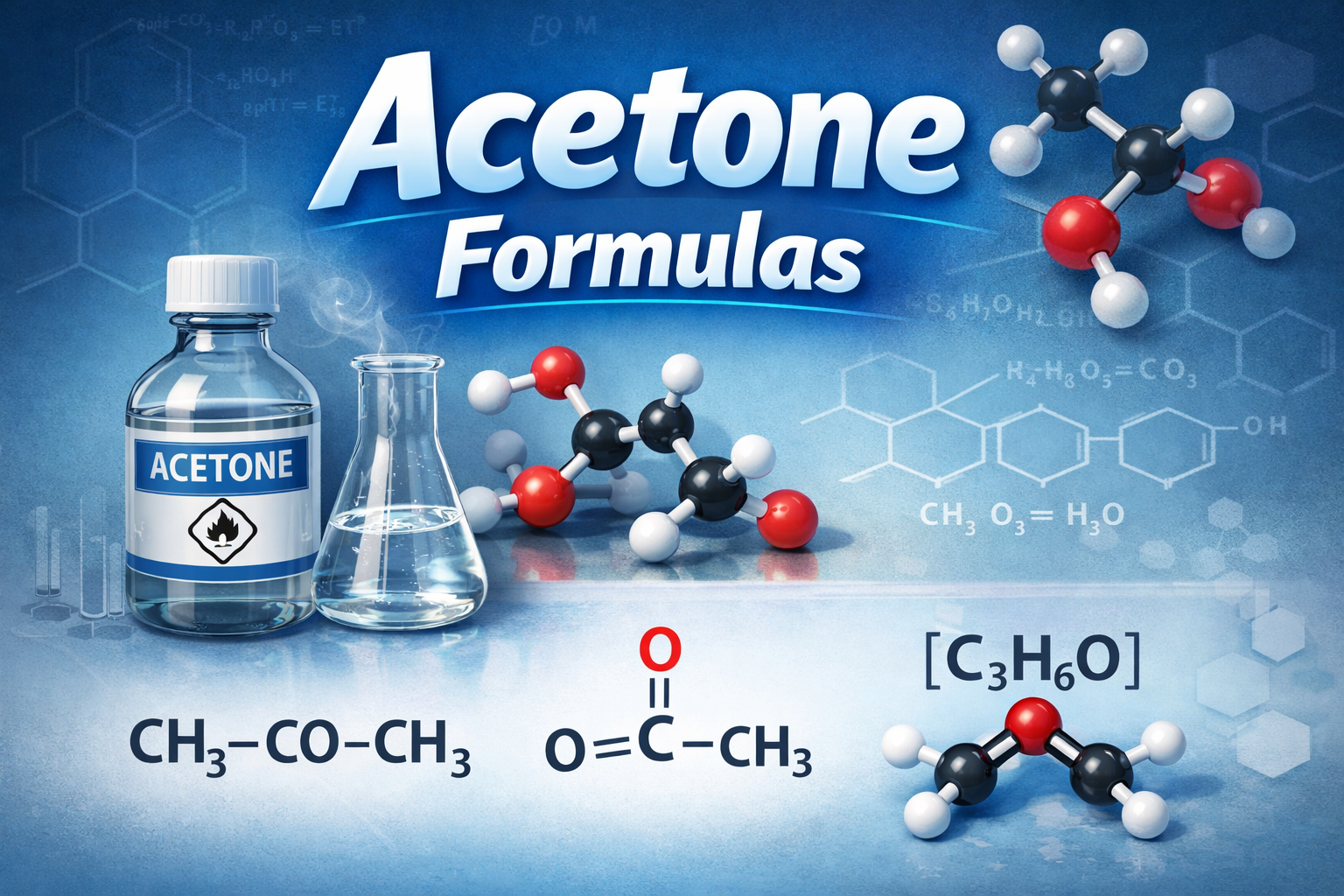
Detailed Structural Representations
1. Lewis Structure (Electron Dot Structure)
 H O H
 | ‖ |
 H - C - C - C - H
 | |
 H H
Explanation: Shows all valence electrons including bonding pairs and lone pairs on the oxygen atom.
2. Line-Angle (Skeletal) Formula
 O
 ‖
 C
 / \
Explanation: Carbon atoms are represented at the ends and angles of lines; hydrogen atoms on carbons are not shown (implied).
3. 3D Structural Formula
- Trigonal planar geometry around the carbonyl carbon
- Tetrahedral geometry around methyl carbons
- Bond angle around C=O: approximately 120°
Important Chemical Properties Related to Formula
| Property |
Details |
| IUPAC Name |
Propan-2-one (or 2-Propanone) |
| Common Name |
Acetone, Dimethyl ketone |
| Molecular Weight |
58.08 g/mol |
| Functional Group |
Ketone (C=O) |
| Hybridization |
sp² (carbonyl carbon), sp³ (methyl carbons) |
| Molecular Geometry |
Trigonal planar at C=O center |
| Polarity |
Polar molecule due to C=O bond |
Understanding Each Formula Type
1. Chemical/Molecular Formula: C₃H₆O
This is the most basic representation showing:
- 3 Carbon atoms (C₃)
- 6 Hydrogen atoms (H₆)
- 1 Oxygen atom (O)
Student Tip: This formula tells you the composition but not the structure or arrangement of atoms.
2. Condensed Structural Formula: CH₃COCH₃
This formula reveals:
- Two methyl groups (CH₃) on either side
- One carbonyl group (C=O) in the center
- The characteristic ketone functional group
Student Tip: The “CO” in the middle represents the C=O double bond, which is the defining feature of ketones.
3. Structural Formula: CH₃-CO-CH₃
Shows:
- The connectivity between atoms
- Single bonds (−) between C and H, C and C
- Double bond (=) between C and O (implied in CO)
Student Tip: This helps visualize how atoms are bonded together in the molecule.
4. Empirical Formula: C₃H₆O
Represents:
- The simplest whole-number ratio of elements
- In acetone’s case, it’s identical to the molecular formula because the ratio cannot be simplified further
Student Tip: For some compounds, empirical and molecular formulas differ (e.g., glucose: CH₂O vs C₆H₁₂O₆).
Acetone Formula Calculations for Students
Calculating Molecular Mass:
- Carbon: 3 × 12.01 = 36.03 g/mol
- Hydrogen: 6 × 1.008 = 6.048 g/mol
- Oxygen: 1 × 16.00 = 16.00 g/mol
- Total = 58.08 g/mol
Percentage Composition:
- Carbon: (36.03/58.08) × 100 = 62.04%
- Hydrogen: (6.048/58.08) × 100 = 10.41%
- Oxygen: (16.00/58.08) × 100 = 27.55%
Notes for Exam Preparation
- Memorize: C₃H₆O and CH₃COCH₃ are the most commonly asked representations
- Understand: Acetone is a ketone with the carbonyl group between two carbons (not at the end)
- Distinguish: Acetone differs from propanal (an aldehyde) which has the formula CH₃CH₂CHO
- Apply: Use the correct formula representation based on what the question asks for
Practical Applications (Context for Learning)
Understanding acetone formulas is important because acetone is used in:
- Nail polish remover
- Laboratory solvent
- Industrial cleaning agent
- Chemical synthesis intermediate
- Paint thinner
Quick Reference
| What You Need |
Use This Formula |
| Composition only |
C₃H₆O |
| Show functional group |
CH₃COCH₃ |
| Draw structure |
Lewis structure or skeletal formula |
| Calculate molar mass |
C₃H₆O (58.08 g/mol) |
| Identify compound class |
CH₃COCH₃ (shows ketone) |
FAQs about Acetone Chemical Formula
Q. What is the chemical formula of acetone?
The chemical formula of acetone is C₃H₆O. This indicates that one molecule of acetone contains 3 carbon atoms, 6 hydrogen atoms, and 1 oxygen atom. The condensed structural formula is CH₃COCH₃, which better shows the arrangement of atoms with the carbonyl group (C=O) positioned between two methyl groups (CH₃).
Q. What is the molecular formula of acetone?
The molecular formula of acetone is C₃H₆O or CH₃COCH₃. Both representations are correct, but CH₃COCH₃ is more informative as it shows the presence of the ketone functional group. The molecular weight of acetone is 58.08 g/mol, making it a relatively small organic molecule commonly used as a solvent.
Q. What is the structural formula of acetone?
The structural formula of acetone is CH₃-CO-CH₃ or CH₃COCH₃. This representation shows that acetone has a central carbonyl group (C=O) bonded to two methyl groups. The complete Lewis structure displays:
- Two methyl groups (CH₃) on either side
- One carbonyl carbon with a double bond to oxygen
- Oxygen atom with two lone pairs of electrons
The carbonyl carbon has trigonal planar geometry with bond angles of approximately 120°.
Q. What is the empirical formula of acetone?
The empirical formula of acetone is C₃H₆O, which is the same as its molecular formula. The empirical formula represents the simplest whole-number ratio of atoms in a compound. In acetone’s case, the ratio 3:6:1 for C:H:O cannot be simplified further while maintaining whole numbers, so the empirical and molecular formulas are identical.
Q. What is the difference between acetone and propanone?
There is no difference acetone and propanone are two names for the same chemical compound with the formula C₃H₆O.
- Acetone is the common or trivial name
- Propanone (or 2-propanone) is the IUPAC systematic name
- Propan-2-one is the preferred IUPAC nomenclature
All three names refer to the same ketone molecule: CH₃COCH₃. In academic and scientific contexts, “propanone” is often used, while “acetone” is more common in everyday laboratory use and commercial products.
Q. How do you draw the Lewis structure of acetone?
To draw the Lewis structure of acetone, follow these steps:
Step 1: Count total valence electrons
- Carbon: 3 × 4 = 12 electrons
- Hydrogen: 6 × 1 = 6 electrons
- Oxygen: 1 × 6 = 6 electrons
- Total = 24 valence electrons
Step 2: Arrange atoms with carbon chain
 H O H
 | ‖ |
 H - C - C - C - H
 | |
 H H
Step 3: Form bonds
- C=O double bond (4 electrons)
- Six C-H single bonds (12 electrons)
- Two C-C single bonds (4 electrons)
- Two lone pairs on oxygen (4 electrons)
- Total = 24 electrons used
Q. What is the molecular weight/molar mass of acetone?
The molecular weight (molar mass) of acetone is 58.08 g/mol.
Calculation:
- Carbon (C): 3 × 12.01 = 36.03 g/mol
- Hydrogen (H): 6 × 1.008 = 6.048 g/mol
- Oxygen (O): 1 × 16.00 = 16.00 g/mol
- Total = 58.08 g/mol
This means that one mole of acetone (6.022 × 10²³ molecules) weighs 58.08 grams. This value is essential for stoichiometric calculations in chemistry.
Q. Is acetone a ketone or aldehyde?
Acetone is a ketone, not an aldehyde.
Differences:
- Ketones have the carbonyl group (C=O) bonded to two carbon atoms
- Aldehydes have the carbonyl group bonded to one carbon and one hydrogen
Acetone structure: CH₃-CO-CH₃ (carbonyl in the middle = ketone)
If it were an aldehyde: CH₃-CH₂-CHO (propanal – carbonyl at the end)
The general formula for ketones is R-CO-R’, where R and R’ are carbon-containing groups. In acetone, both R groups are methyl groups (CH₃), making it the simplest ketone, also called dimethyl ketone.
Q. What is the condensed formula of acetone?
The condensed formula of acetone is CH₃COCH₃ or (CH₃)₂CO.
Explanation:
- CH₃COCH₃ shows the linear arrangement with the carbonyl (CO) in the center
- (CH₃)₂CO emphasizes that two methyl groups are attached to the carbonyl carbon
Both representations are correct and commonly used in chemistry. The condensed formula is preferred over the full structural formula when writing chemical equations or when space is limited, as it provides structural information without drawing out every bond.
Q. What are the uses of acetone in everyday life?
Acetone (C₃H₆O) has numerous practical applications:
Personal Care:
- Nail polish remover (primary ingredient)
- Cosmetic cleaner
Household:
- Paint thinner and remover
- Adhesive remover (super glue, stickers)
- Cleaning agent for glass and surfaces
Industrial/Laboratory:
- Solvent in chemical reactions
- Cleaning laboratory glassware
- Manufacturing plastics and fibers
- Pharmaceutical production
- Extraction processes
Other Uses:
- 3D printing (smoothing ABS plastic)
- Electronic component cleaning
- Degreaser in automotive applications
Safety Note: Acetone is flammable and should be used in well-ventilated areas. It evaporates quickly and can cause skin dryness with prolonged exposure.
Conclusion
Acetone’s various formula representations each serve specific purposes in chemistry education. The molecular formula C₃H₆O provides composition data, while the condensed structural formula CH₃COCH₃ reveals the molecule’s ketone nature. Mastering these different representations will strengthen your understanding of organic chemistry and prepare you for more advanced topics.