

Converting centimeters to inches is a fundamental skill in mathematics, science, and everyday life. Whether you’re working on a school project, preparing for exams, or simply need to understand measurements in different units, mastering this conversion is essential. This comprehensive guide will walk you through the conversion of 40 cm to inches and related measurements, providing you with formulas, examples, and practical applications.
Understanding the Metric and Imperial Systems
Before diving into conversions, it’s important to understand the two measurement systems:
- Metric System (SI): Uses centimeters (cm), meters (m), and kilometers (km)
- Imperial System: Uses inches (in), feet (ft), and miles (mi)
The United States primarily uses the Imperial system, while most other countries use the Metric system. This makes conversion skills valuable for international communication, travel, and academic work.
The Fundamental Conversion Formula
The relationship between centimeters and inches is based on a fixed conversion factor:
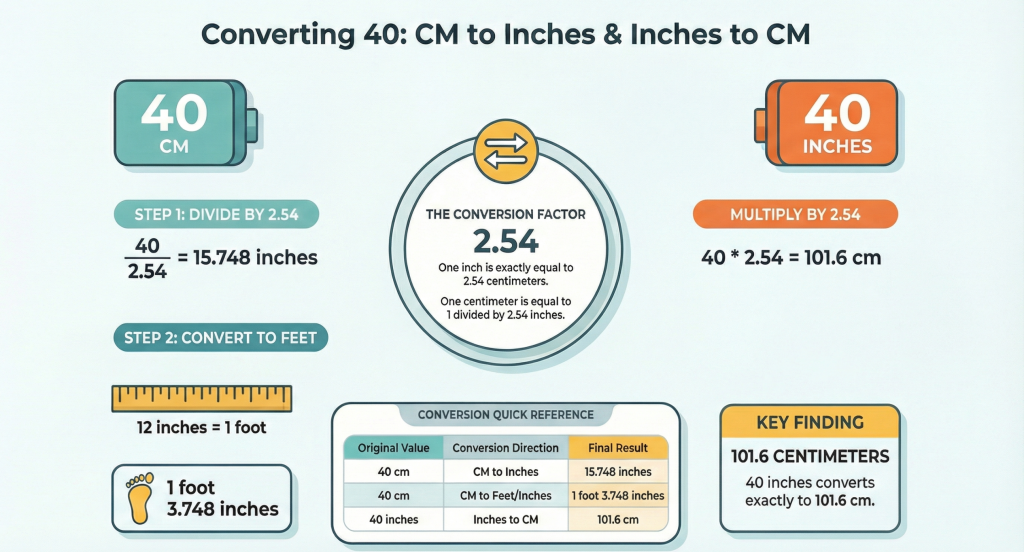
1 inch = 2.54 centimeters
Therefore, the formula to convert centimeters to inches is:
Inches = Centimeters ÷ 2.54
This formula is universally accepted and forms the basis of all cm-to-inch conversions.
Step-by-Step Conversion Process
Let’s break down the conversion of 40 cm to inches:
- Identify the value in centimeters: 40 cm
- Apply the conversion formula: 40 ÷ 2.54
- Calculate the result: 40 ÷ 2.54 = 15.748 inches
- Round appropriately: 15.75 inches (rounded to two decimal places)
Therefore, 40 cm = 15.748 inches (or approximately 15.75 inches)
Comprehensive Conversion Table
Below is a detailed table showing various conversions related to 40 cm, including common variations and dimensional conversions:
| Measurement (cm) | Formula Applied | Result (inches) | Rounded Value |
|---|---|---|---|
| 40 cm | 40 ÷ 2.54 | 15.748 inches | 15.75 inches |
| 40.5 cm | 40.5 ÷ 2.54 | 15.945 inches | 15.95 inches |
| 40.6 cm | 40.6 ÷ 2.54 | 15.984 inches | 15.98 inches |
| 40.64 cm | 40.64 ÷ 2.54 | 16.000 inches | 16.00 inches |
| 40.1 cm | 40.1 ÷ 2.54 | 15.787 inches | 15.79 inches |
| 40.2 cm | 40.2 ÷ 2.54 | 15.827 inches | 15.83 inches |
| 40.3 cm | 40.3 ÷ 2.54 | 15.866 inches | 15.87 inches |
| 40.4 cm | 40.4 ÷ 2.54 | 15.906 inches | 15.91 inches |
| 40.7 cm | 40.7 ÷ 2.54 | 16.024 inches | 16.02 inches |
| 40.8 cm | 40.8 ÷ 2.54 | 16.063 inches | 16.06 inches |
| 40.9 cm | 40.9 ÷ 2.54 | 16.102 inches | 16.10 inches |
Dimensional Conversions (Length × Width)
For rectangular measurements, convert each dimension separately:
| Dimensions (cm) | Conversion Process | Result (inches) |
|---|---|---|
| 40 × 40 cm | (40 ÷ 2.54) × (40 ÷ 2.54) | 15.75 × 15.75 inches |
| 60 × 40 cm | (60 ÷ 2.54) × (40 ÷ 2.54) | 23.62 × 15.75 inches |
| 40 × 30 cm | (40 ÷ 2.54) × (30 ÷ 2.54) | 15.75 × 11.81 inches |
| 50 × 40 cm | (50 ÷ 2.54) × (40 ÷ 2.54) | 19.69 × 15.75 inches |
| 40 × 20 cm | (40 ÷ 2.54) × (20 ÷ 2.54) | 15.75 × 7.87 inches |
| 80 × 40 cm | (80 ÷ 2.54) × (40 ÷ 2.54) | 31.50 × 15.75 inches |
Detailed Explanation of Key Conversions
40 cm to Inches
- Calculation: 40 ÷ 2.54 = 15.748 inches
- Practical Application: A standard school ruler is often 30 cm (about 12 inches), so 40 cm is slightly longer than a foot ruler.
40.5 cm to Inches
- Calculation: 40.5 ÷ 2.54 = 15.945 inches
- Use Case: Precision measurements in technical drawings or engineering projects.
40.6 cm to Inches
- Calculation: 40.6 ÷ 2.54 = 15.984 inches
- Note: This is very close to 16 inches, useful when exact measurements matter.
40.64 cm to Inches
- Calculation: 40.64 ÷ 2.54 = 16.000 inches
- Significance: This is exactly 16 inches, making it a perfect conversion point.
- Why it matters: 40.64 cm is the precise metric equivalent of 16 inches, often used in manufacturing standards.
60 × 40 cm to Inches
- Calculation:
- Length: 60 ÷ 2.54 = 23.622 inches
- Width: 40 ÷ 2.54 = 15.748 inches
- Common Use: Standard poster or picture frame sizes.
Reverse Conversion: Inches to Centimeters
Understanding reverse conversion helps verify your work:
Formula: Centimeters = Inches × 2.54
Example: To convert 15.75 inches back to centimeters:
- 15.75 × 2.54 = 40.005 cm ≈ 40 cm
This confirms our original conversion is accurate.
Practical Applications for Students
In Mathematics
- Geometry problems involving unit conversions
- Scale factor calculations
- Proportion and ratio exercises
In Science
- Laboratory measurements
- Physics experiments with displacement
- Chemistry equipment specifications
In Real Life
- Shopping for furniture or electronics
- Understanding product dimensions
- International travel and communication
- Art and design projects
Common Mistakes to Avoid
- Using the wrong conversion factor: Always use 2.54, not 2.5 or 2.6
- Multiplying instead of dividing: Remember to divide cm by 2.54, not multiply
- Incorrect rounding: Be consistent with decimal places based on precision needs
- Forgetting units: Always include units in your final answer
- Not checking your work: Use reverse conversion to verify
Tips for Quick Mental Approximation
For quick estimates without a calculator:
- Divide by 2.5 instead of 2.54 for a close approximation
- Example: 40 ÷ 2.5 = 16 inches (actual: 15.75 inches)
- This method gives you a result that’s slightly high but useful for quick checks
Memory Aids and Tricks
To remember the conversion factor:
- “2.54 Forever” – This rhyme helps you remember the exact number
- Think of it as: 1 inch is about 2.5 cm plus a little bit
- Visual aid: A standard business card is about 5.5 cm × 8.5 cm or roughly 2 × 3.5 inches
Practice Problems for Students
Problem 1: Convert 40.2 cm to inches
- Solution: 40.2 ÷ 2.54 = 15.827 inches
Problem 2: A rectangular frame measures 60 cm × 40 cm. What are the dimensions in inches?
- Solution: 23.62 inches × 15.75 inches
Problem 3: If you need exactly 16 inches, how many centimeters is that?
- Solution: 16 × 2.54 = 40.64 cm
Why Accuracy Matters
In academic and professional settings, precision is crucial:
- Engineering: Small measurement errors can lead to manufacturing defects
- Medicine: Accurate dosing and medical equipment specifications
- Construction: Building materials must fit precise specifications
- Science: Experimental data requires accurate unit conversions
Historical Context
The inch was originally defined as the width of a man’s thumb, while the centimeter is based on the meter, which was defined as one ten-millionth of the distance from the equator to the North Pole. In 1959, the international yard and pound agreement standardized 1 inch as exactly 2.54 centimeters, creating the conversion factor we use today.
Frequently Asked Questions about 40 cm to inches
Q. How many inches is 40 cm?
40 cm is equal to 15.748 inches, or approximately 15.75 inches when rounded to two decimal places. This is calculated using the formula: 40 ÷ 2.54 = 15.748 inches.
Q. Is 40 cm 16 inches?
No, 40 cm is not exactly 16 inches. 40 cm equals 15.748 inches, which is slightly less than 16 inches. However, 40.64 cm equals exactly 16 inches. The difference between 40 cm and 16 inches is approximately 0.25 inches or about 0.64 cm.
Q. Is 40 cm 15 inches?
No, 40 cm is slightly more than 15 inches. Specifically, 40 cm equals 15.748 inches, which is about three-quarters of an inch more than 15 inches. If you need exactly 15 inches, that would be 38.1 cm.
Q. What is 40 cm equal to in inches?
40 cm is equal to 15.748 inches (exact value) or approximately 15.75 inches when rounded. This conversion uses the standard formula where centimeters are divided by 2.54 to get inches.
Q. How do I convert 40 cm to inches conversion accurately?
To convert 40 cm to inches accurately, divide 40 by 2.54: 40 ÷ 2.54 = 15.748 inches. For precision work, use at least three decimal places. For everyday use, rounding to 15.75 inches is sufficient.
Q. What is the difference between 40.5 cm and 40.6 cm in inches?
40.5 cm equals 15.945 inches, while 40.6 cm equals 15.984 inches. The difference between them is 0.039 inches, which is less than 1 millimeter. This small difference is important in precision work like engineering or jewelry making.
Q. How do I convert rectangular dimensions like 60 × 40 cm to inches?
Convert each dimension separately: 60 cm ÷ 2.54 = 23.62 inches, and 40 cm ÷ 2.54 = 15.75 inches. Therefore, 60 × 40 cm equals approximately 23.62 × 15.75 inches. This method applies to any rectangular or dimensional measurements.
Q. Why is 40.64 cm exactly 16 inches?
40.64 cm is exactly 16 inches because 16 × 2.54 = 40.64. This is the precise metric equivalent of 16 inches, making it a useful reference point for conversions and manufacturing standards where both metric and imperial measurements are used.
Q. Can I use a simpler number than 2.54 for quick conversions?
For quick mental approximations, you can divide by 2.5 instead of 2.54. Using this method, 40 ÷ 2.5 = 16 inches. However, this gives a slightly higher result (16 vs. 15.75), so it’s only suitable for rough estimates, not precise calculations.
Q. How do I verify my cm to inches conversion is correct?
To verify your conversion, multiply your inches result by 2.54 to convert back to centimeters. For example: 15.748 inches × 2.54 = 40.00 cm. If you get back to your original measurement (or very close to it), your conversion is correct.
Conclusion
Converting 40 cm to inches and understanding related conversions is a valuable skill for students at all levels. By mastering the fundamental formula (Inches = Centimeters ÷ 2.54) and practicing with various examples, you can confidently handle any centimeter-to-inch conversion. Remember that 40 cm equals approximately 15.75 inches, and use the comprehensive tables and examples provided in this guide as reference tools for your studies and practical applications.
Related Resources:
| 30 cm to Inches | 40 cm to Inches | 90 cm to Inches |
| 170 cm in Feet | 155cm in Feet | 5.11 Feet in CM |