Understanding Centimeters and Inches
Before we dive into conversions, let’s understand what we’re working with.
Centimeter (cm) is a metric unit of length. It’s used worldwide and is part of the International System of Units (SI). One centimeter equals one-hundredth of a meter.
Inch (in) is an imperial unit of length, commonly used in the United States, United Kingdom, and a few other countries. It’s part of the imperial measurement system.

Quick Comparison:
- 1 inch = 2.54 centimeters
- 1 centimeter = 0.3937 inches
Most countries use centimeters for everyday measurements, while inches are popular in the US for things like screen sizes, clothing, and construction.
The Conversion Formula
Converting centimeters to inches is straightforward once you know the formula.
Formula:
Inches = Centimeters ÷ 2.54
Or
Inches = Centimeters × 0.3937
Both formulas give you the same result. The first one is easier to remember because 2.54 is the exact number of centimeters in one inch.
Step-by-Step Process:
- Take the measurement in centimeters
- Divide it by 2.54
- The result is your measurement in inches
Is 30 cm Equal to 12 Inches?
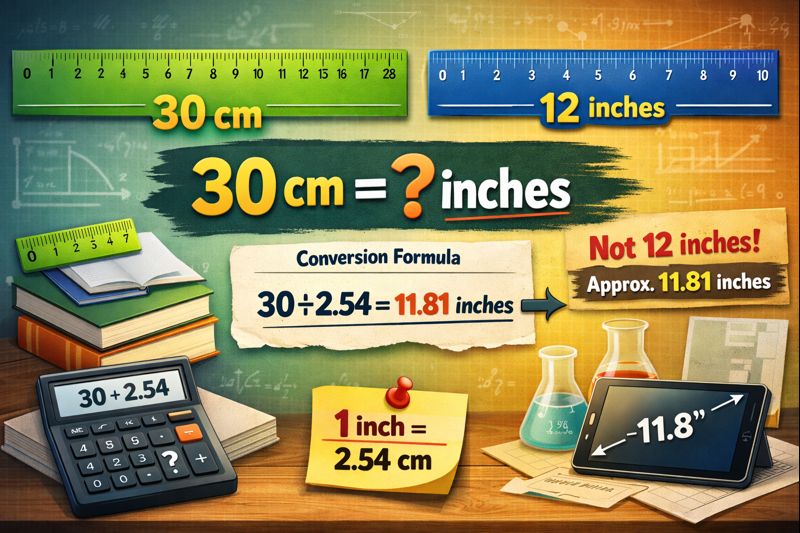
No, 30 cm is NOT equal to 12 inches.
Let’s do the math:
30 cm ÷ 2.54 = 11.81 inches
So 30 centimeters equals approximately 11.81 inches, which is close to 12 inches but not exactly the same.
The Actual Comparison:
- 30 cm = 11.81 inches
- 12 inches = 30.48 cm
The difference is small (about 0.48 cm or 0.19 inches), but in precise measurements for science experiments or technical drawings, this difference matters.
Is 30 cm Equal to 1 Foot?
No, 30 cm is slightly less than 1 foot.
One foot equals 12 inches. Since we already know 30 cm equals 11.81 inches, it falls just short of a full foot.
The Breakdown:
- 1 foot = 12 inches = 30.48 cm
- 30 cm = 11.81 inches = 0.984 feet
So 30 centimeters is about 98.4% of a foot—very close but not exact.
Real-World Context: If your teacher asks you to draw a line 1 foot long but you only have a metric ruler, you’d measure 30.48 cm, not 30 cm.
What Size is 30 cm in Inches?
As we’ve calculated:
30 cm = 11.81 inches (approximately 11.8 inches)
Visual Understanding:
Think of common objects to visualize this length:
- A standard school ruler (30 cm)
- The width of a large textbook
- The length of an A4 paper’s shorter side (21 cm) plus about 9 cm more
- Slightly shorter than the length of a regular notebook
Practical Calculation:
30 ÷ 2.54 = 11.811 inches
For most practical purposes, you can round this to 11.8 inches or even 12 inches when precision isn’t critical.
Other Common Conversions
Understanding related conversions helps you solve problems faster.
What is 40 cm Equal to in Inches?
40 cm = 15.75 inches
Calculation: 40 ÷ 2.54 = 15.748 inches
What is 12 Inches in cm?
12 inches = 30.48 cm
Calculation: 12 × 2.54 = 30.48 cm
Quick Reference Table:
| Centimeters |
Inches (Approximate) |
| 10 cm |
3.94 inches |
| 20 cm |
7.87 inches |
| 30 cm |
11.81 inches |
| 40 cm |
15.75 inches |
| 50 cm |
19.69 inches |
| 100 cm |
39.37 inches |
This table is perfect for quick homework checks or exam preparation.
Is 30 cm Big?
Whether 30 cm is “big” depends entirely on context.
When 30 cm is Considered Big:
- For a pencil (typical pencils are 15-19 cm)
- For an insect or small toy
- For a smartphone screen diagonal (most phones are 15-17 cm)
- For a cut or wound
When 30 cm is Considered Small:
- For a desk (typical desks are 120-150 cm wide)
- For human height (average adult is 160-180 cm)
- For a television screen (most TVs are 80+ cm diagonal)
- For a room measurement
Student Perspective:
In classroom terms, 30 cm is:
- The length of a standard ruler
- About the height of a large water bottle
- Shorter than most laptops (which are 33-38 cm wide)
- Perfect for measuring diagrams in geometry class
Bottom Line: 30 cm is a moderate, everyday measurement not particularly big or small on its own.
Real-Life Examples for Students
Example 1: Science Lab
Your biology teacher asks you to cut a string 12 inches long for an experiment, but your ruler only shows centimeters.
Solution: 12 inches = 30.48 cm ≈ 30.5 cm
Example 2: Art Project
You’re creating a poster and need a 30 cm border. Your American friend asks how many inches that is.
Solution: 30 cm = 11.81 inches ≈ 11.8 inches
Example 3: Online Shopping
You want to buy a tablet with a 30 cm screen. The website lists it in inches.
Solution: 30 cm ≈ 11.8 inches screen size
Example 4: Geometry Homework
Calculate the perimeter of a rectangle measuring 30 cm by 40 cm in inches.
Solution:
- 30 cm = 11.81 inches
- 40 cm = 15.75 inches
- Perimeter = 2(11.81 + 15.75) = 55.12 inches
Common Mistakes to Avoid
Mistake 1: Using Wrong Conversion Factor
Wrong: Dividing by 2.5 instead of 2.54 Right: Always use 2.54 as the conversion factor
Mistake 2: Confusing Multiplication and Division
Wrong: Multiplying cm by 2.54 to get inches Right: Divide cm by 2.54 or multiply by 0.3937
Mistake 3: Rounding Too Early
Wrong: Rounding 11.81 to 12 in the middle of a multi-step problem Right: Keep decimals until the final answer
Mistake 4: Assuming 30 cm = 12 inches
Wrong: Treating them as equal Right: Remember 30 cm = 11.81 inches, which is close but not exact
Mistake 5: Forgetting Units
Always write your units! Writing “30 = 11.81” is meaningless. Write “30 cm = 11.81 inches.”
Easy Tips to Remember
Tip 1: The 2.54 Rule
Remember: 1 inch is always 2.54 cm. This is the golden number for all conversions.
Tip 2: Quick Mental Math
For rough estimates, remember:
- 2.5 cm ≈ 1 inch
- 10 cm ≈ 4 inches
- 30 cm ≈ 12 inches (close enough for everyday use)
Tip 3: Use Your Ruler
Most rulers have both cm and inches. Match them up to see the relationship visually.
Tip 4: The “Divide by 2.5” Shortcut
For quick approximations, divide cm by 2.5 instead of 2.54. It’s not exact but close enough for estimates.
Example: 30 ÷ 2.5 = 12 (versus the exact 11.81)
Tip 5: Memorize Common Conversions
Keep a mental chart:
- 10 cm ≈ 4 inches
- 20 cm ≈ 8 inches
- 30 cm ≈ 12 inches
- 50 cm ≈ 20 inches
FAQs about 30 cm to inches
Q. How do I convert 30 cm to inches exactly?
Divide 30 by 2.54 to get 11.811 inches. For practical purposes, round to 11.8 or 11.81 inches. This is the most accurate conversion using the standard conversion factor.
Q. Is 30 cm the same as 1 foot?
No, 30 cm equals 0.984 feet, which is slightly less than 1 foot. One foot equals 30.48 cm, so 30 cm is about 0.48 cm shorter than a foot.
Q. What is the easiest way to remember cm to inch conversion?
Remember that 2.54 cm equals 1 inch. For quick mental math, you can approximate by dividing centimeters by 2.5, though this gives a slightly less accurate result.
Q. Why do we use both centimeters and inches?
Different countries use different measurement systems. The metric system (centimeters) is used worldwide, while the imperial system (inches) is common in the US, making conversions necessary for international communication.
Q. Can I use a calculator for cm to inch conversion?
Yes, absolutely! Simply divide the centimeter value by 2.54 or multiply by 0.3937. Most smartphones have built-in calculators perfect for this, and online converters are also available.
Q. What objects are approximately 30 cm long?
A standard ruler, a large water bottle, the shorter side of A4 paper plus 9 cm, and many textbooks are close to 30 cm. This helps visualize the measurement in everyday contexts.
Q. How many inches are in 35 cm?
35 cm equals 13.78 inches. Use the formula: 35 ÷ 2.54 = 13.78. This is useful when comparing measurements slightly larger than 30 cm.
Q. Do I need to convert cm to inches for exams?
It depends on your exam requirements. Always check if the question specifies units. For standardized tests and science exams, showing conversion work earns you marks even if calculations are slightly off.
Conclusion
Converting 30 cm to inches isn’t complicated once you understand the basic formula. Remember that 30 cm equals approximately 11.81 inches close to 12 inches but not exactly the same. This difference matters in precise academic work, science experiments, and technical projects.
Always use 2.54 as your conversion factor, show your work clearly, and don’t round too early in multi-step problems. Whether you’re working on geometry homework, measuring materials for a science project, or understanding product dimensions online, this conversion skill is invaluable.
Related Resources: