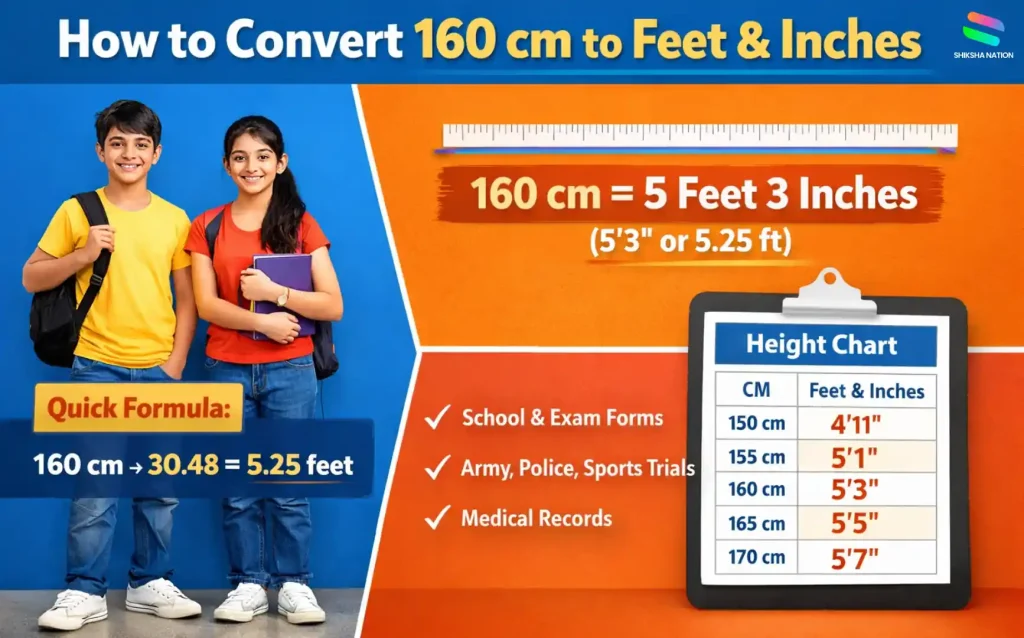
Many students and parents often search for 160 cm in feet when filling forms, checking eligibility, or simply understanding height better. While the number may look simple, confusion usually comes when converting it into feet and inches correctly.
In clear terms, 160 cm in feet and inches is approximately 5 feet 3 inches. But instead of just giving the answer, it is important to understand how this conversion works and where it is actually used in student life.
From school admission forms to competitive exams like Army, Police, or sports trials, height is often required in feet and inches. Many students make small mistakes while converting, which can lead to incorrect entries.
In this guide, you will learn the simple formula to convert cm to feet, see a height chart for quick reference, and understand what 160 cm height means in a real-life Indian context. The goal is to make this clear, accurate, and useful for both students and parents.

What is 160 cm in Feet and Inches?
If you are wondering what is 160 cm in feet, the simple answer is:
- 160 cm in feet and inches = 5 feet 3 inches
- In decimal form, 160 cm in feet = 5.25 feet
This means a height of 160 cm is slightly above 5 feet, commonly written as 5’3″ in school or exam forms.
Quick Understanding
| Measurement |
Value |
| Centimeters |
160 cm |
| Feet (decimal) |
5.25 ft |
| Feet & Inches |
5 feet 3 inches |
For students and parents, this conversion is useful while filling admission forms, sports entries, or checking height requirements where feet and inches format is required instead of cm.
How to Convert 160 cm to Feet (Simple Formula)
Understanding the 160 cm to feet formula helps students avoid mistakes in exams, forms, or physical eligibility checks. This is a basic cm to feet conversion that can be done in a few simple steps.
Step-by-Step Formula
- Use this formula: cm ÷ 30.48 = feet
- Example: 160 ÷ 30.48 = 5.25 feet
This method is standard for height conversion cm to feet and works for any height value, not just 160 cm.
Convert into Feet and Inches
- Take the decimal part: 0.25
- Multiply by 12: 0.25 × 12 = 3 inches
Final result: 5 feet 3 inches
For students, this step is important because most school or competitive forms ask height in feet and inches, not decimals.
160 cm Height in Feet – How Tall Is It?
If you are thinking how tall is 160 cm in feet, it comes to around 5 feet 3 inches (5’3″). In daily life, this is considered a moderate and common height for students in India.
Understanding 5’3″ in Real Life
- Slightly above 5 feet
- Comfortable height for most school and college activities
- Common among teenage students and adults
Comparison with Average Heights in India
| Category |
Average Height |
160 cm Comparison |
| Girls (India) |
5’1″-5’3″ |
Around average |
| Boys (India) |
5’5″-5’7″ |
Slightly below average |
The height 160 cm in feet is normal and acceptable in most situations. For parents and students, this means there is usually no concern unless specific exams or sports have fixed height criteria.
160 cm in Feet for Girl and Boy (India Context)
Many parents and students search 160 cm in feet in India to understand if this height is normal or acceptable. In most cases, this height fits well within the common range, but context matters.
For Girls
- 160 cm in feet for girl = 5’3″, which is close to the average height of Indian females
- Falls within a healthy and commonly seen range
- Suitable for school activities, college admissions, and most career paths
For parents, this means there is usually no concern, as it aligns with general growth patterns in India.
For Boys
- 160 cm in feet for boy = 5’3″, which is slightly below the average male height
- Still acceptable for most academic and general requirements
- Some fields (like defence or sports) may have specific height criteria
Overall, 160 cm is a normal height. What matters more is meeting the specific eligibility rules, not comparing unnecessarily.
Height Chart (150 cm to 170 cm in Feet & Inches)
This simple cm to feet conversion chart helps students and parents quickly understand height without doing calculations. It is useful while filling forms, comparing heights, or checking eligibility.
Quick Height Chart in Feet and cm
| CM |
Feet & Inches |
| 150 cm |
4’11” |
| 155 cm |
5’1″ |
| 160 cm |
5’3″ |
| 165 cm |
5’5″ |
| 170 cm |
5’7″ |
This height chart in feet and cm gives a clear idea of where a student’s height stands.
If needed, you can also check related conversions like 165 cm in feet or 170 cm in feet for better comparison.
Where Students Use Height Conversion in Real Life
Height conversion is not just a maths concept. Students often need to convert height cm to feet in real situations where the format is fixed.
Common Places Where It Is Used
- School and College Forms
Many admission forms ask height in feet and inches. Writing it correctly avoids rejection or confusion.
- Competitive Exams & Physical Tests
Exams like Army, Police, and sports trials have strict height criteria in feet. Even small errors in conversion can create issues during verification.
- Medical Records and Reports
Doctors may record height in different units. Parents should understand both cm and feet formats for clarity.
For students and parents, knowing this conversion helps in accurate form filling and eligibility checks, especially when instructions clearly mention feet and inches.
Common Mistakes in cm to Feet Conversion
Many students make small errors while converting height, especially during form filling. These mistakes look minor but can create confusion later.
Mistakes to Avoid
- Mixing feet with feet & inches
Writing 5.25 ft instead of 5’3″ is a common issue. Most forms expect feet and inches, not decimal values.
- Rounding incorrectly
Some students round off numbers too early, which changes the final answer slightly.
- Wrong format in forms
Writing only “5.3” or “5 feet” without inches can lead to incorrect entries.
For parents and students, it is better to double-check the format before submitting any form to avoid unnecessary problems.
Conclusion: Simple Way to Understand Height Conversion
Understanding height conversion becomes easy when you focus on the basic formula: cm ÷ 30.48 = feet. Instead of memorising answers, it is better to learn this simple method so you can apply it to any value.
For students and parents, this helps in filling forms correctly and avoiding small mistakes. Always remember to convert the final answer into feet and inches, as this format is commonly required.
With a clear approach and a little practice, height conversion can become quick, accurate, and stress-free in everyday use.
FAQs About 160 cm in Feet
Q. Is 160 cm equal to 5 feet 3 inches?
Yes, 160 cm in feet and inches is approximately 5 feet 3 inches. In decimal form, it is around 5.25 feet. This is the standard accepted conversion.
Q. How to write 160 cm height in feet in forms?
You should write it as 5’3″ (5 feet 3 inches). Avoid using decimal format like 5.25 ft unless specifically asked.
Q. Is 160 cm a good height for students?
Yes, 160 cm height in feet (5’3″) is considered normal. For girls, it is around average, and for boys, it is slightly below average but still acceptable in most cases.
Q. What is 160 cm in feet exactly (decimal vs inches)?
In decimal, 160 cm in feet = 5.25 ft. In practical use, it is written as 5 feet 3 inches, which is preferred in forms and records.
Q. How to quickly convert cm to feet without calculator?
You can divide by 30 for a quick estimate. For example, 160 ÷ 30 ≈ 5.3, which is close to 5 feet 3 inches.
Q. Why do forms ask height in feet instead of cm?
In India, many exams and official forms follow the feet and inches format, especially in defence and sports requirements.
Q. Is 160 cm acceptable for Army or Police exams?
It depends on the specific exam. Some roles have minimum height criteria, so students should always check official notifications.
Q. How tall is 160 cm in feet compared to others?
At 5’3″, this height is common among students. It falls within the normal range and does not indicate any issue.
Q. Can small conversion mistakes affect form submission?
Yes, incorrect format or wrong values can create problems during verification. Always double-check before submitting.