
The human brain is the most important organ of the nervous system. It controls how we think, learn, feel, and move. In simple words, the brain works like the main control center of the human body. It receives signals from the sense organs and sends messages to different body parts to perform actions. In basic biology study, students often learn about the human brain anatomy, its structure, and how different regions work together.
The human brain weight is about 1.3 to 1.4 kilograms in an adult person, which is roughly 2% of the total body weight. Even though it is small compared to the body, it uses a large amount of energy and oxygen. To understand the structure better, teachers often use a human brain diagram that shows the main sections like the cerebrum, cerebellum, and brainstem.
Learning about human brain parts and functions helps students understand how memory, thinking ability, emotions, and body coordination work. Each part of the brain has a specific role, but they all work together in a complex system. Many students also search for study materials such as human brain PDF notes, labeled diagrams, and revision guides to make the topic easier for exam preparation.
In this article, we will explore the structure, functions, and important features of the human brain in a simple and easy-to-understand way. It will help students build a clear basic understanding of this fascinating organ.
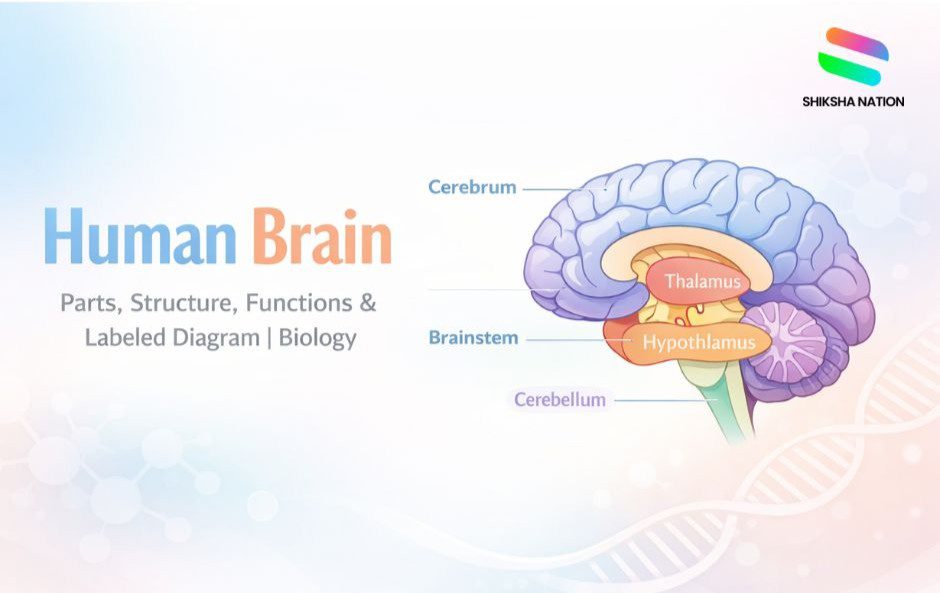
What is the Human Brain?
The human brain is the most complex and sophisticated organ in the known universe. It serves as the command centre of the human body, governing everything from the beat of your heart to the formation of your deepest memories. As the primary organ of the central nervous system (CNS), the brain processes sensory input, regulates bodily functions, drives emotions, and enables cognition and conscious thought.
On average, an adult human brain weighs between 1.0 kg and 1.5 kg - a relatively small mass that houses approximately 86 to 100 billion neurons. These neurons form trillions of synaptic connections, making the brain far more computationally complex than any artificial intelligence system created to date.
Unlike most other mammalian brains that share a similar basic architecture, the human brain is exceptionally developed in regions associated with language, reasoning, and abstract thought - particularly the prefrontal cortex. This distinguishes humans as the most cognitively advanced species on Earth.
Fact: The brain, together with the spinal cord, constitutes the Central Nervous System (CNS), which is the primary regulatory network of the human body.
Where Is the Brain Located?
The brain is housed within the skull (cranium), a bony protective structure made up of 22 bones - 8 cranial bones that encase the brain, and 14 facial bones. This bony enclosure provides critical protection against physical trauma from the front, sides, and top.
Protection by Cerebrospinal Fluid (CSF)
Surrounding the brain within the cranium is the Cerebrospinal Fluid (CSF), a clear, colourless fluid that plays a multi-functional protective role:
- Mechanical cushioning: CSF absorbs the impact of minor mechanical shocks and jolts, preventing injury to delicate neural tissue.
- Buoyancy: The brain is effectively suspended in CSF, which dramatically reduces its functional weight (from ~1.5 kg to nearly 25 grams of net weight). Without this buoyancy, the brain's own mass would compress blood vessels, cutting off supply to lower regions and causing widespread neuronal death.
- Immunological defence: CSF provides a basic layer of immunological protection by transporting immune cells and antibodies.
- Nutrient supply: It helps transport essential nutrients to brain tissue while clearing metabolic waste products.
Specialised ependymal cells lining the brain's ventricles produce approximately 500 mL of CSF every day, with the total volume in the system at any given time being around 150 mL (the rest is continually reabsorbed).
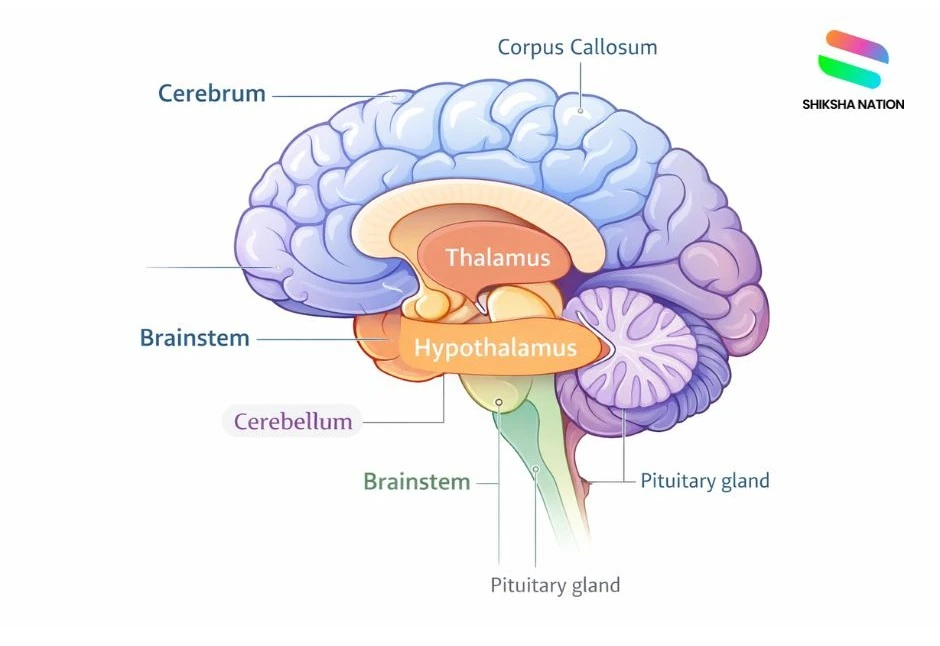
Human Brain: Structure and Major Parts
The human brain is anatomically divided into three major regions, each containing distinct sub-structures with specialised roles. These three regions are:
- Forebrain (Prosencephalon)
- Midbrain (Mesencephalon)
- Hindbrain (Rhombencephalon)
Forebrain - The Seat of Higher Cognition
The forebrain is the largest and most highly developed region of the brain. It occupies the anterior (front) portion of the skull and is responsible for the most advanced human functions, including thought, language, memory, and emotional regulation.
Sub-structures of the Forebrain:
Cerebrum - Largest Part of the Brain
The cerebrum is not only the largest part of the forebrain it is the largest structure in the entire vertebrate brain. It is divided into two cerebral hemispheres (left and right), connected by a thick band of nerve fibres called the corpus callosum, which facilitates communication between the two halves.
The outer layer of the cerebrum is called the cerebral cortex (also known as the cerebral mantle). This highly folded surface full of ridges (gyri) and grooves (sulci) dramatically increases the brain's total surface area, allowing for a far greater number of neurons to be packed within the skull.
The cerebrum is divided into four lobes:
| Lobe | Location | Primary Functions |
|---|---|---|
| Frontal Lobe | Front of the brain | Planning, reasoning, problem-solving, speech production, voluntary movement |
| Parietal Lobe | Top/upper region | Processing sensory input (touch, pain, temperature), spatial orientation, perception |
| Occipital Lobe | Back of the brain | Visual processing and interpretation |
| Temporal Lobe | Sides of the brain | Auditory processing, speech comprehension, memory encoding and recognition |
Brain Tissue Types:
The cerebral tissue consists of two distinct types:
- Grey Matter - Primarily composed of neuron cell bodies, dendrites, and synapses. It forms the outer cortex and is responsible for processing and computation.
- White Matter - Composed mainly of myelinated axons that connect different grey matter regions, enabling rapid communication across the brain.
Functional Zones of the Cerebrum:
- Sensory Areas: Receive and interpret signals from sensory organs (eyes, ears, skin, etc.)
- Motor Areas: Send commands to voluntary muscles to initiate physical movement
- Association Areas: Integrate sensory and motor information; responsible for complex cognitive functions like decision-making and creativity
Cerebrum Functions in Summary: Thinking, intelligence, consciousness, memory, interpretation of touch, hearing, and vision the cerebrum is the biological seat of the human mind.
Thalamus - The Brain's Relay Station
Located just above the brainstem and at the core of the brain, the thalamus acts as the brain's central relay hub. Almost all sensory information (except smell) passes through the thalamus before being directed to the appropriate regions of the cerebral cortex.
It also plays a critical role in motor signal transmission, relaying commands between the cortex, cerebellum, and brainstem for coordinated movement. Additionally, the thalamus is embedded within the limbic system the emotional and memory-processing network of the brain - making it central to memory consolidation and the storage of past experiences.
Hypothalamus - The Brain's Master Regulator
Situated directly below the thalamus, the hypothalamus is a small but enormously powerful structure responsible for maintaining the body's internal equilibrium (homeostasis). Despite its small size, it regulates a remarkable range of physiological and psychological functions:
- Temperature regulation - monitors and adjusts core body temperature
- Hunger and thirst - signals the need for food and water intake
- Emotional responses - influences mood, aggression, and fear
- Sleep-wake cycles - controls circadian rhythms through hormonal signalling
- Autonomic nervous system coordination - manages involuntary functions like heart rate and blood pressure
- Hormonal control - forms a critical hypothalamo-pituitary axis, serving as the primary link between the nervous system and the endocrine system (hormone-secreting glands)
- Sensory processing - receives and integrates impulses related to taste and smell
The hypothalamus is often described as the body's thermostat, appetite controller, and hormonal command centre all in one.
Midbrain - The Central Switchboard
The midbrain (or mesencephalon) is the smallest and most central part of the brain. It sits between the forebrain above and the hindbrain below, forming a crucial bridge for neural signal transmission. The midbrain consists of two major components:
Tectum
The tectum forms the dorsal (upper) surface of the midbrain. It contains two pairs of rounded bumps called the superior and inferior colliculi, which process visual and auditory signals respectively. The tectum plays a vital role in:
- Relaying sensory signals (especially from the ears) to the cerebrum
- Controlling reflex movements of the head, eyes, and neck in response to sudden stimuli (e.g., turning your head at a loud sound)
- Serving as a passage for neurons travelling to and from the cerebrum
Tegmentum
The tegmentum forms the ventral (lower) portion of the midbrain and is a densely connected region involved in:
- Motor control and voluntary body movements
- Sleep, arousal, and attention (through the reticular activating system)
- Pain modulation and necessary reflex actions
- Forming structural and functional connections with the thalamus, cerebral cortex, and spinal cord
Hindbrain - The Survival Centre
The hindbrain is the most evolutionarily ancient part of the brain. Located at the base of the skull, it controls the most fundamental life-sustaining processes. It comprises three key structures:
Cerebellum - The Coordination Centre
The cerebellum (Latin for "little brain") is the second largest part of the brain, positioned at the rear of the skull, behind and below the cerebrum. Its outer surface (cortex) features characteristic parallel ridges called folia, and its interior contains the cerebellar nuclei that relay processed signals.
Like the cerebrum, the cerebellum has two hemispheres with an outer grey cortex and an inner white medulla.
Functions of the Cerebellum:
- Coordinates voluntary muscle movements for smoothness and precision
- Maintains balance and posture during activities like walking, running, cycling, and swimming
- Coordinates eye movements
- Predicts future body positions during ongoing movements, allowing for seamless adjustments
- Regulates fine motor control (e.g., writing, threading a needle)
- Transfers processed information between brain regions via the cerebellar peduncles
Without the cerebellum, movements would be jerky and uncoordinated a condition known clinically as ataxia.
Medulla Oblongata - The Life-Support Centre
The medulla oblongata is situated in the lowest part of the brain, forming the direct continuation of the spinal cord. It is the primary controller of the body's autonomic (involuntary) functions - the processes that keep us alive without conscious effort:
- Heartbeat regulation - controls rate and rhythm
- Breathing - monitors blood oxygen/CO₂ levels and adjusts respiratory rate
- Digestion - coordinates peristaltic movements in the gut
- Reflex actions - including swallowing, coughing, sneezing, and vomiting
- Posture maintenance - works in conjunction with the cerebellum
Damage to the medulla oblongata is immediately life-threatening, as it controls functions essential to survival.
Pons - The Bridge
The pons (Latin for "bridge") is positioned between the midbrain above and the medulla oblongata below. True to its name, it acts as a vital communication bridge between multiple brain regions:
- Relays signals between the cerebellum and motor cortex
- Connects the spinal cord with the midbrain, cerebrum, and higher brain centres
- Controls sleep cycles and the transition between REM and non-REM sleep
- Regulates the depth and frequency of breathing
- Involved in sensory processing - taste, hearing, and balance
- Works with the cerebellum for coordinated movement
Human Brain Parts and Functions
| Brain Region | Sub-structure | Key Functions |
|---|---|---|
| Forebrain | Cerebrum | Thinking, memory, consciousness, sensory interpretation |
| - | Thalamus | Sensory relay, motor coordination, memory |
| - | Hypothalamus | Homeostasis, hormones, emotions, sleep, hunger |
| Midbrain | Tectum | Reflex responses, auditory/visual relay |
| - | Tegmentum | Movement, arousal, attention, reflexes |
| Hindbrain | Cerebellum | Balance, coordination, fine motor control |
| - | Medulla Oblongata | Heartbeat, breathing, digestion, reflexes |
| - | Pons | Sleep cycles, respiration, sensory processing, relay |